
Civil Coalition Criticises 'Recklessly' Drafted Police Bill, Calling It Power-Hungry
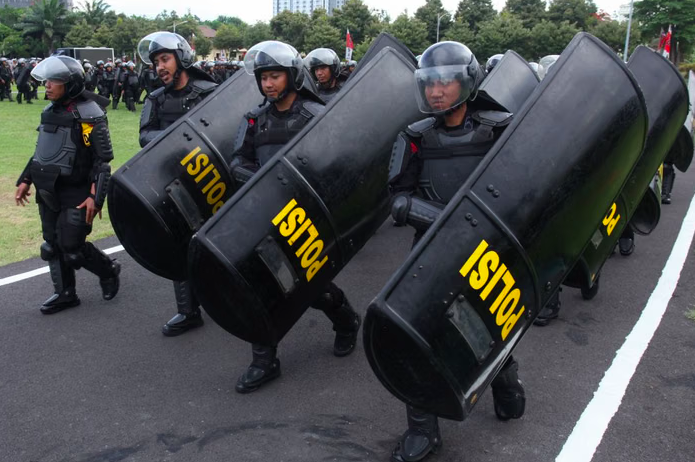
The Civil Society Coalition for Police Reform (RFP) has firmly rejected the plan to ratify the Revision of the Law on the National Police of the Republic of Indonesia (RUU Polri), scheduled for a House of Representatives (DPR) plenary session on Tuesday (9/6).
The Deputy Chairperson of the Indonesian Legal Aid Foundation (YLBHI) assessed that the deliberation of the revised law was conducted hastily, lacked transparency, and was laden with political power interests. “This recklessly drafted revision of the Police Law proves that the police reform touted by President Prabowo is nothing but a lie and empty talk,” said Arif Maulana in a statement on Tuesday (9/6).
The coalition considers the drafting process for the Police Bill to have lacked meaningful public participation and to contradict the spirit of police reform as stipulated in MPR Decrees No. VI/MPR/2000 and No. VII/MPR/2000 regarding the separation of the Indonesian Military (TNI) and the National Police. According to the coalition, the revision of the Police Law should be carried out transparently and accountably so that the public can oversee and provide input on the substance of the regulation.
“The DPR and the Government should learn from the reckless ratifications of the problematic revisions to the Corruption Eradication Commission (KPK) Law, the Job Creation Law, the TNI Law, the Criminal Procedure Code (KUHAP), or other unconstitutional laws that actually gave rise to various serious problems,” Arif said.
The coalition also highlighted several articles in the draft Police Bill that are considered problematic. One concerns the opportunity for active police personnel to hold positions in ministries or state institutions without having to resign from the police force. Article 28A of the draft Police Bill states that police personnel can be placed in ministries or institutions as long as it relates to police duties and functions. The coalition views this regulation as contradicting a Constitutional Court ruling and potentially disrupting the professionalism of the National Police.
“Placing personnel in ministries/institutions outside the police institution is clearly unconstitutional and will disrupt the police’s own professionalism, including the career paths of civil servants and the merit system in the relevant ministries/institutions,” Arif stated.
Furthermore, the coalition criticised the weak strengthening of the external oversight function for the police in the revised law. The National Police Commission (Kompolnas) is perceived to remain positioned merely as a consultative body without strong authority to supervise or sanction police personnel who violate regulations. “If the DPR and the government are serious about strengthening Kompolnas, then Kompolnas should be granted strong authority in supervising and sanctioning police personnel who break the rules,” he added.
Moreover, the coalition also questioned the plan to raise the retirement age for police personnel to 60 years for enlisted ranks, non-commissioned officers, and commissioned officers, and to 63 years for the National Police Chief. According to them, this policy has no clear urgency and has the potential to hinder regeneration within the police force.
The coalition also assesses that several other articles in the Police Bill could potentially broaden the police institution’s authority without adequate oversight mechanisms. One relates to police duties in the national strategic interest, which is considered open to multiple interpretations and opens the door for police involvement in various governmental affairs. Additionally, Article 19 of the Police Bill is seen as legitimising the use of a repressive approach in policing without strict limitations and oversight.
“This has the potential to legitimise violent practices and the use of excessive force, including firearms, in the execution of police duties,” Arif said.
On these grounds, the Civil Society Coalition for Police Reform urged the DPR and the government to halt the plan to ratify the Police Bill and reopen discussions transparently, involving inclusive public participation. “The revision of laws must be carried out democratically with the aim of bringing about fundamental changes that fully address the problems, not merely replacing an old law with a new one that simply creates new problems,” he concluded.