
Citizens Suffer as Currency Plummets: Wages Rise But Fail to Keep Pace with Inflation
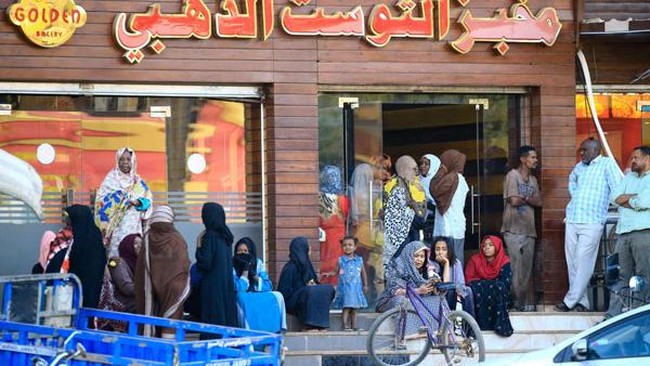
As the war enters its fourth year, Sudan’s economy is under increasing pressure. The exchange rate of the Sudanese pound has plummeted, while the prices of food and basic necessities continue to rise, making it difficult for the population to maintain purchasing power.
This situation is directly felt by Aisha, a 27-year-old woman who sells coffee and tea in Port Sudan. She runs her small business to help support her two parents and four brothers.
Aisha’s income has actually increased; she can now earn approximately 70,000 to 100,000 Sudanese pounds per day (roughly IDR 166,000–238,000). However, this rise in income has been unable to offset the surge in the cost of living.
“Before the war, a cup of coffee cost 1,000 Sudanese pounds. I could earn about 30,000 pounds a day, and that was enough to meet my family’s needs,” Aisha said. She now sells coffee for 3,000 pounds and tea for around 1,500 pounds per cup.
Food prices continue to rise, and the purchasing power of the Sudanese pound continues to erode. Before the war, 1,000 Sudanese pounds was enough to buy five pieces of bread; now, the same amount only secures three pieces. The price of sugar has also risen from approximately 4,000 pounds to 7,000 pounds per kilogram. Meanwhile, Aisha’s transport costs from her home to her place of business have surged fourfold.
The price of beef has reached 68,000 pounds per kilogram, placing it beyond Aisha’s reach. Lentils, which are relatively more affordable, are now priced at around 16,000 pounds per kilogram. Rising costs are also evident in healthcare and education services, adding further pressure to families affected by years of war.
Inflation remains above 40%. The war between the Sudanese Armed Forces (SAF) and the paramilitary Rapid Support Forces (RSF) has been ongoing since April 2023, disrupting domestic production, trade, and exports. This condition has tightened the supply of foreign exchange and pressured the Sudanese pound. According to data from the Sudan Central Bureau of Statistics, annual inflation reached over 41% in July 2026, although this was a decrease from approximately 51% in June.
However, the drop in inflation does not mean prices are falling. The consumer price index still increased by almost 1.5% from June to July, indicating that prices are still rising, albeit at a slower rate.
The United Nations Development Programme (UNDP) estimates that Sudan lost approximately US$6.4 billion in Gross Domestic Product (GDP) in 2023 alone. The UNDP also estimates that Sudan’s economy has shrunk by more than 40% during the war, while about one-third of businesses in the country have closed.
The Sudanese pound has collapsed. Before the war, US$1 was equivalent to about 600 Sudanese pounds, but by 22 September 2026, black market currency traders reported that US$1 reached approximately 7,500 Sudanese pounds, though values vary between cities and traders.
Economic analyst Mohyeldin Mohamed stated that the weakening of the Sudanese pound is influenced by several factors, including the disruption of the productive sector due to the war. He also highlighted allegations of looting and smuggling of various commodities, including gold and gum arabic, linked to the RSF.
According to Mohamed, Sudan requires short-term measures and long-term reforms to address economic pressures. In the short term, the government needs to increase domestic food production, strengthen productive economic sectors, and improve tax revenue. He also urged that revenue from the gold sector should be integrated into the official foreign exchange system to help strengthen the economy.
Citizens’ purchasing power is being further eroded. Maryam Ibrahim, a humanitarian worker and economic researcher who previously worked with the UN, stated that the fall in currency value has eroded the public’s purchasing power.
“The main impact of the currency devaluation is the loss of purchasing power. Salaries and savings are no longer sufficient to meet household needs,” said Ibrahim. She noted that families are beginning to reduce food portions, delay medical treatment, and withdraw children from school, or resort to borrowing money and essential goods to survive, as poverty and the food crisis in Sudan worsen.
The World Bank estimates that the extreme poverty rate in Sudan increased from 48% in 2023 to 59% in 2025. Meanwhile, according to the Integrated Food Security Phase Classification (IPC), approximately 19.5 million people, or 41% of Sudan’s population, faced an acute food crisis during the period from February to May. More than 5 million people faced extreme food insecurity that threatens lives, while around 135,000 people are at risk of famine.
Source: jawawa.id (https://jawawa.id/newsitem/citizens-suffer-as-currency-plummets-wages-rise-but-fail-to-keep-pace-with-inflation-1790337135)
Originally published by CNBC Indonesia (https://www.cnbcindonesia.com/news/20260925161447-4-770997/derita-warga-negara-mata-uang-anjlok-gaji-naik-tapi-ga-ngejar-inflasi), translated from Indonesian