
Citizens Discover Rice Social Assistance Levies, Here Is How to Report Them!
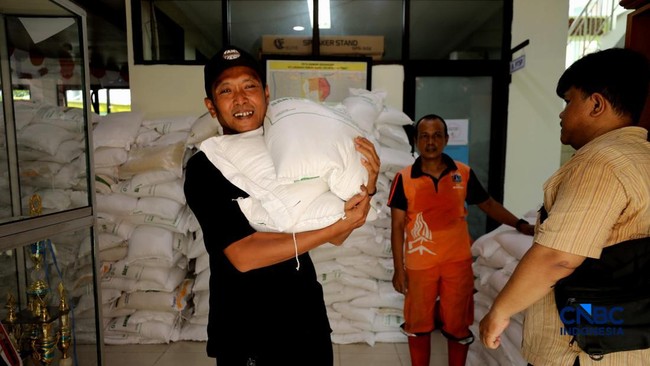
The National Food Agency (Bapanas) has emphasised that the rice food assistance provided by the government to the public must not be deducted or charged any form of fee. This clarification comes amidst the ongoing national distribution of rice food assistance for the July-September 2026 period. Bapanas stated that it has received reports regarding alleged levies imposed on Beneficiary Families (KPM) in several regions.
Bapanas Director of Distribution and Food Reserves, Rachmi Widiriani, stated that food assistance is a right of the recipients and must be received in full quantity and in good condition. “This food assistance is the full right of the KPS and must be received in its entirety in terms of volume and in good condition, without a single penny of deduction. We request all regional ranks, from assistants and village officials to distribution officers, not to carry out any levies for any reason. If such reports arise, we will certainly follow up alongside Perum Bulog and local governments,” Rachmi said in Jakarta, as quoted on Monday (14/09/2026).
Bapanas stated that it has coordinated with Perum Bulog, as the implementing distributor, and local governments to investigate the alleged levy reports. The agency has also opened a complaint channel for the public who find indications of irregularities in the distribution of food assistance through the official Bapanas Whistleblowing System (WBS).
Members of the public can submit complaints or enquiries through the Bapanas hotline at 0895391606768 or via the Bapanas PPID website. “We continue to strengthen monitoring and direct evaluation at distribution points to ensure the process is orderly, transparent, and truly reaches the recipients intact. We urge the public not to hesitate to report if they encounter indications of levies or other deviations in the field,” said Rachmi.
The second phase of the 2026 rice food assistance programme targets 33,244,408 Beneficiary Families across Indonesia. Recipients are members of the community categorised in deciles 1 to 4 based on the National Socio-Economic Single Data (DTSEN) from the Ministry of Social Affairs. Unlike previous schemes, the distribution for the July, August, and September 2026 period is being conducted as a lump sum.
This means that Beneficiary Families receive 30 kilograms of rice at once, representing the allocation for three months at a volume of 10 kilograms per month. The total assignment for the distribution of Government Food Reserves (CPP) for this programme reaches 997,200 tons of rice throughout Indonesia. The government aims to complete all distributions by the end of September 2026. As of early September, distribution has been underway in various regions and continues to be monitored through evaluation alongside Perum Bulog and local governments.
Bapanas reaffirmed that all costs for the rice food assistance programme are covered by the state. Consequently, there are no legitimate levies to be charged to Beneficiary Families when collecting aid, whether at village offices, sub-districts, or other distribution points. Bapanas has requested the public to report any requests for money or other forms of levies during the distribution process. The government will follow up on such reports with relevant parties to ensure that the food assistance, which is the right of the people, is received in full.
Source: jawawa.id (https://jawawa.id/newsitem/citizens-discover-rice-social-assistance-levies-here-is-how-to-report-them-1789361752)
Originally published by CNBC Indonesia (https://www.cnbcindonesia.com/news/20260914101027-4-767624/warga-temukan-pungutan-bansos-beras-begini-cara-lapornya), translated from Indonesian