
Cisumdawu Toll Road Crack Leads to Four-Month Contraflow Implementation
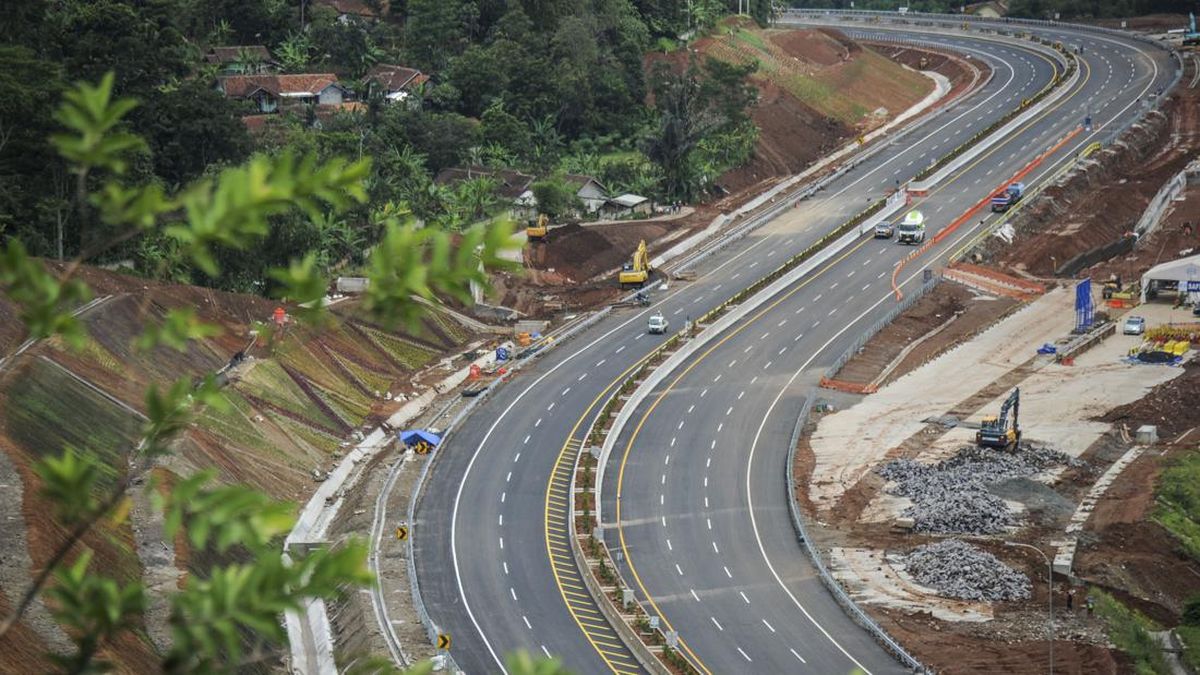
Police have implemented contraflow on the Cisumdawu Toll Road for the next four months due to a crack at KM 207A in the direction from Bandung to Cirebon. The crack measures 80 metres in length and 2 metres in depth. In addition to the crack, contraflow is in place to support repair work.
“Yes, it will be 3 to 4 months. It could be faster once the work is completed. That’s the contractor’s estimate, roughly 3 to 4 months,” said Kanit 3 PJR Tol Cisumdawu, Iptu Deni Ruchyat, when contacted on Friday (10/4).
Deni stated that the current contraflow spans 2.2 kilometres, from KM 206+125 to KM 208+200. During the contraflow period, 24-hour guarding is maintained from the start to the end point.
Deni advised Cisumdawu toll users to obey traffic signs when entering the contraflow lane. He also urged reducing speed, especially during rain on the toll road.
“Control your speed and obey the traffic signs we have prepared, so before the contraflow, on the lane, and after exiting, please monitor it, stay focused. During rain, do not exceed 40-50 kilometres per hour. Sometimes there is fog in some spots in the afternoon,” he advised.
For information, the Cileunyi-Dawuan-Sumedang (Cisumdawu) Toll Road has experienced a crack at KM 207A towards Cirebon. The crack is 80 metres long and 2 metres deep.
For now, vehicle traffic is diverted with contraflow engineering.
“Currently, on the Cisumdawu Toll Road under police discretion, the main road at KM 194A is closed and vehicles from Bandung to Cirebon are diverted to exit at Paseh Toll Gate. Additionally, contraflow will be implemented on Lane B (towards Bandung) from KM 206+125 to KM 208+200,” said Director of PT Citra Karya Jabar Tol (PT CKJT), Agustinus Sudrajat, in a press release received by reporters on Wednesday (8/4).
However, Agustinus stated that the Cisumdawu Toll Road section at KM 207A remains safe and passable following the sliding crack incident from KM 207+300 to KM 207+400.
In addition to engineering, short-term handling includes installing warning and speed reduction signs, filling the crack with asphalt material, and covering it with tarpaulin to prevent water ingress that could add load to the embankment.
For long-term handling, PT CKJT is conducting topographic measurements to confirm the width and length of the treatment area, additional soil investigations to identify soil layers, inclinometer instrumentation measurements to determine landslide plane depth, and geotechnical analysis to determine the type of reinforcement for landslide retention.
“Long-term handling is also planned using bore piles with a depth of around 30 metres over approximately 100 metres. The entire evaluation and repair process is carried out in accordance with applicable technical standards and safety procedures,” he said.
Regarding the cause, Agustinus said the crack occurred due to recent high-intensity rain. He also suspected a drainage system error.
“We identified this crack as resulting from high-intensity rain weather. Following the incident, we immediately conducted a comprehensive identification and evaluation of the drainage system,” he stated.
Agustinus emphasised that his team will conduct regular field monitoring, especially at high-risk points, particularly amid high-intensity rain conditions.
Coordination with relevant parties continues to ensure the toll road structure’s reliability functions well and lasts long-term.