
Circular Economy Opens Business Opportunities
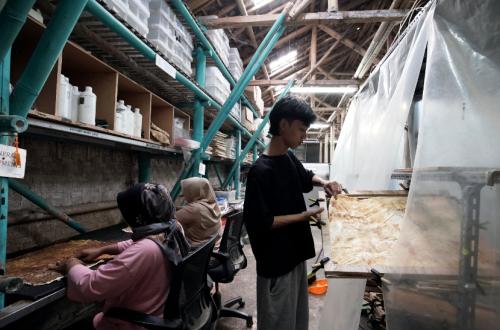
Unmanaged waste remains an environmental problem, while coastal communities and farmers face limited sources of income. These conditions are driving the development of circular businesses that process waste into raw materials while creating economic value for communities.
Data from the Ministry of Environment/Environmental Control Agency records that 21.85 percent of Indonesia’s 56.63 million tonnes of annual waste is not yet optimally managed. Indonesia also has 17.25 million smallholder farmers and more than 90 percent of small-scale fishers.
The approach is being developed by Parongpong RAW Lab and Mycotech Lab (MYCL), two social enterprises supported by the DBS Foundation. Both develop materials from waste by involving communities in the production chain.
Parongpong RAW Lab processes discarded fishing nets, or ghost nets, in Cilincing, Jakarta, and Muncar, Banyuwangi. The programme targets the collection of 20 tonnes of ghost nets, involving more than 600 fishers and 1,000 coastal community members, as well as building two microfactories.
As of August 2026, ghost net collection reached more than 4,500 kilogrammes, or around 46 percent of the 2026 target, with 179 fishers involved. The material is then developed into a number of products, including table lamps made from used nets.
Parongpong RAW Lab CEO and Founder Rendy Aditya Wachid said the business development also provides space for coastal communities to enter the circular economy chain.
“DBS Foundation’s support helps us build a more comprehensive system, from material collection, community education, and technological capacity building to developing products that can be accepted by the market. For us, the impact does not stop at waste reduction, but also how coastal communities can take an active role in the circular economy chain and obtain better economic benefits,” Rendy said on Thursday (20/8/2026).
Meanwhile, MYCL processes agricultural waste into mycelium-based biomaterials, including mycelium composite, mycelium leather, and seaweed biopolymer. As of 2026, MYCL has served 968 customers from 56 countries and involved more than 200 farmers in its supply chain.
In 2025, MYCL utilised 61.72 tonnes of biomass waste and avoided around 148.75 tonnes of CO2e from biomass that could potentially be burned or mulched. The company has also created more than 60 green jobs at the MYCL Eco Factory.
Mycotech Lab Co-founder Ronaldiaz Hartantyo said the use of agricultural waste opens opportunities to build new supply chains involving farmers and workers.
“For MYCL, DBS Foundation’s support not only helps us develop technology but also strengthens the foundation so that innovation can grow into an impactful business. By processing agricultural waste into biomaterials, we want to create alternative materials with lower impact while building a value chain that benefits farmers, workers, and industries that want to move towards a more circular future,” Ronaldiaz explained.
Through the DBS Foundation Grant, DBS Foundation has distributed more than SGD21.5 million in grants to more than 160 social enterprises in Asia since 2015. In Indonesia, grants distributed have reached more than SGD4 million to more than 20 social enterprises and impact businesses.
The model developed by the two companies shows that the circular economy can bring together environmental problems and economic needs. Waste is not only treated as a management problem but also as a raw material that can open business chains and new sources of income.