
CIPS: Trade Agreements Offer Opportunities to Expand Clean Energy Investment
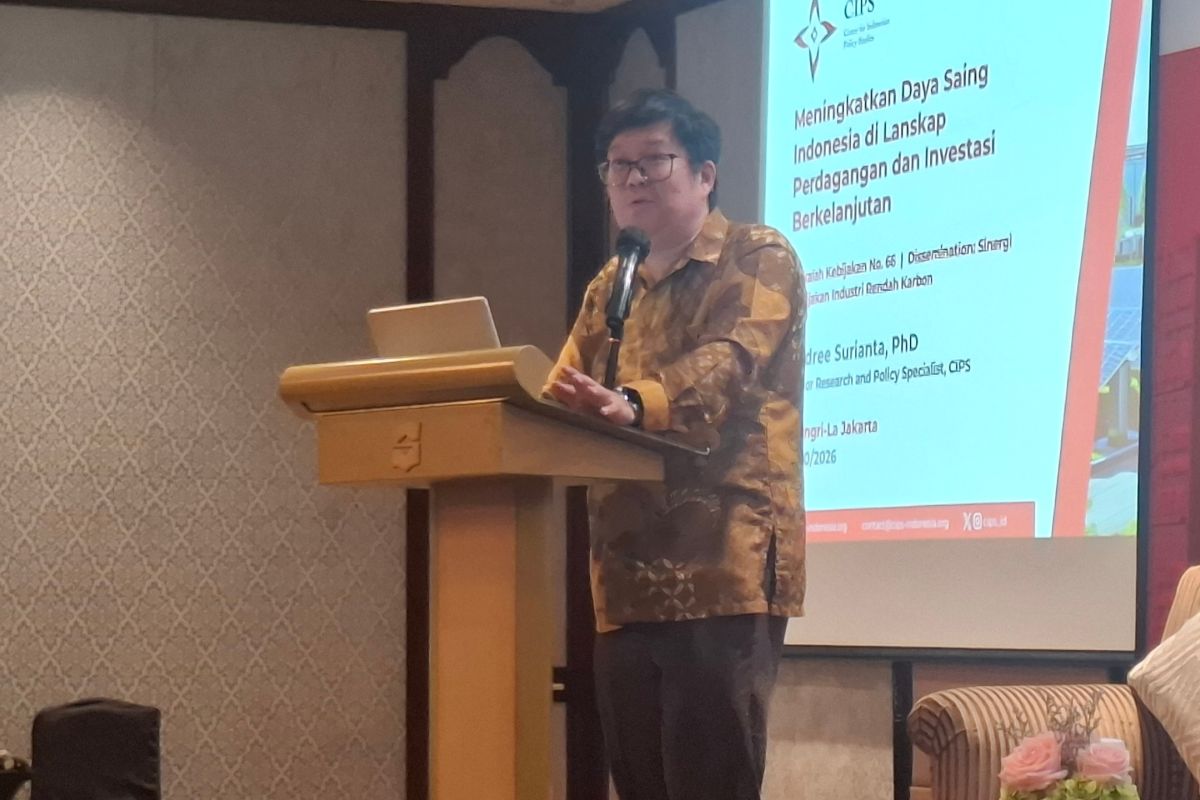
Jakarta (ANTARA) - The Center for Indonesian Policy Studies (CIPS) believes Indonesia’s trade agreements with several countries can be used to expand technology cooperation and clean-energy investment, strengthening the competitiveness of national industry.
“These trade agreements are already in place and can be used to conduct studies on how to align regulations or develop capacity,” CIPS Senior Research and Policy Specialist Andree Surianta said at the launch of a CIPS study in Jakarta on Thursday.
Andree explained that trade cooperation not only opens access to export markets, but can also support technology development and improve industries’ ability to meet low-carbon production standards.
He said Indonesia already had several economic cooperation frameworks that could be used to accelerate the industrial transition, including agreements with South Korea, Australia, the European Union and Canada.
He cited South Korean carmaker Hyundai’s investment in developing Indonesia’s electric vehicle industry, as well as cooperation with Australia to assess the feasibility of green hydrogen and low-carbon steel technologies.
The opportunities for cooperation with Australia could be developed through the ongoing review of the Indonesia-Australia Comprehensive Economic Partnership Agreement (IA-CEPA).
Indonesia and Australia began reviewing IA-CEPA by exchanging the first-stage reports on 27 August 2026. The review is intended to evaluate the agreement’s implementation during its first five years and identify new opportunities for cooperation.
CIPS also sees opportunities through the Indonesia-European Union Comprehensive Economic Partnership Agreement (IEU-CEPA), particularly to help domestic industry meet carbon-related requirements in the European market.
Andree cited Vietnam’s cooperation with the EU on developing emissions-monitoring systems and clean-energy investment as an approach Indonesia could learn from.
“This could provide a space to build a cooperation mechanism similar to Vietnam’s with the EU,” he said.
He said technical cooperation through trade agreements could also help adjust domestic policies that were not yet aligned with the needs of the industrial transition.
“Technical assistance can be used to review various regulations that overlap or are difficult to comply with,” he said.
Beyond the EU, the Indonesia-Canada Comprehensive Economic Partnership Agreement (ICA-CEPA) was seen as offering opportunities for investment partnerships and clean-energy development.
“With ICA-CEPA, we see that the opportunities may lie in investment and cooperation on clean energy,” Andree said.
ICA-CEPA is scheduled to take effect on 1 December 2026. Under the agreement, Canada will liberalise 90.55 per cent of its tariff lines for Indonesian products, in accordance with the agreed schedule.
Meanwhile, the Coordinating Ministry for Economic Affairs estimates that IEU-CEPA could increase Indonesia’s exports by US$10.9 billion, or around Rp198.19 trillion, based on an analysis of the trade agreement’s impact.
However, IEU-CEPA is still being prepared for signing. Coordinating Minister for Economic Affairs Airlangga Hartarto said on 28 October 2026 that he was aiming for the agreement to be signed that week before proceeding to ratification.
At the same event, the Ministry of Industry’s Director of International Industry Access, Shinta Virdhian, said free trade agreements could help broaden market access while developing sustainable trade and investment.
“In this context, an FTA (Free Trade Agreement) can be an instrument to broaden market access and support sustainable trade and investment,” Shinta said.
She cautioned, however, that taking advantage of these opportunities would require alignment between trade, investment, industrial and energy policies, as well as businesses’ readiness to meet global market demands.
Shinta added that investment needs to improve energy efficiency and adopt low-carbon technologies required attention, including in the case of small and medium-sized industries in national supply chains.
Source: jawawa.id (https://jawawa.id/newsitem/cips-trade-agreements-offer-opportunities-to-expand-clean-energy-investment-1793271280)
Originally published by Antara (Indonesian) (https://www.antaranews.com/berita/5819543/cips-perjanjian-dagang-peluang-perluas-investasi-energi-bersih), translated from Indonesian