
CIPS: Industry Prioritises Regulatory Certainty for Low-Carbon Production
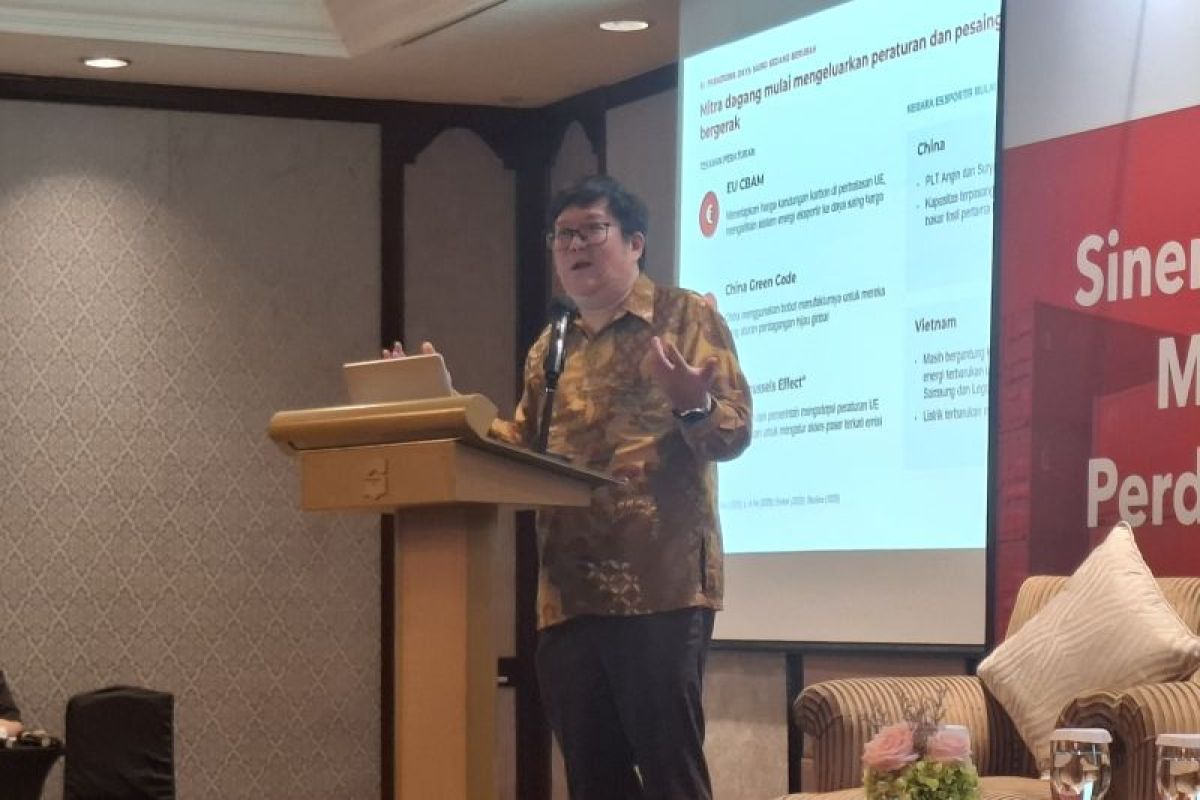
Jakarta (ANTARA) - A study by the Center for Indonesian Policy Studies (CIPS) has found that industry players prioritise regulatory certainty over financial incentives when investing in the transition to low-carbon production processes.
“Broadly speaking, industry wants certainty more than financial incentives,” CIPS Senior Research and Policy Specialist Andree Surianta said at the launch of the study in Jakarta on Thursday.
Andree said the findings came from research that also gathered industry perspectives on the needs and obstacles involved in aligning production processes with global sustainability standards.
Companies, he said, need assurance that investments to cut emissions and adopt cleaner technologies will be recognised and deliver economic benefits.
Industry players also want simpler licensing procedures, wider access to renewable energy and consistent policies so they can plan long-term investments.
“And lastly, if possible, regulations should not keep changing,” Andree said.
He cited changes to import rules that have required businesses to adjust their operations. Frequent regulatory changes, he said, can add to uncertainty for companies.
One regulation under scrutiny is Trade Minister Regulation No. 16/2025 on Import Policy and Arrangements, which was amended by Trade Minister Regulation No. 37/2025 and updated again through Trade Minister Regulation No. 18/2026.
CIPS also found that environmental reporting requirements imposed by different ministries and agencies are not integrated, potentially adding to companies’ administrative burdens and compliance costs.
These reports cover carbon emissions calculations, waste management and water use, and may be submitted through separate systems even when some of the information overlaps.
“Each ministry and agency has its own certification, standards and reporting system,” Andree said.
He said these systems should be aligned so environmental reporting serves not only as an administrative obligation, but also helps recognise emissions performance and improves Indonesian products’ access to international markets.
In Policy Paper No. 66, titled Improving Indonesia’s Competitiveness in the Sustainable Trade and Investment Landscape, CIPS calculated Indonesia’s carbon competitiveness score at 58.8, the lowest among the six ASEAN countries analysed.
CIPS calculated the score using six indicators, including the renewable energy mix, the carbon intensity of the electricity grid, economic complexity, export dependence on sectors affected by carbon policies, foreign investment and climate change mitigation performance.
The study also found that Indonesia’s electricity grid has a carbon intensity of 680 grams of carbon dioxide per kilowatt-hour, about 41 per cent above the global average.
According to CIPS, this poses a challenge for energy-intensive industries as export markets increasingly take carbon emissions into account in trade requirements.
To strengthen competitiveness, CIPS recommended using trade agreements to facilitate cooperation on low-carbon technologies, expanding industry access to clean energy, and aligning emissions measurement and reporting systems.
National Economic Council (DEN) member Mochamad Firman Hidayat agreed that simplifying regulations and licensing would support industry.
Firman said limited fiscal space meant that financial incentives were not always easy to provide. Reducing the regulatory burden could therefore offer an alternative form of support without increasing government spending.
“This should be a non-fiscal incentive,” Firman said.
He also cautioned that policy reforms should be implemented gradually, taking account of industry readiness and the range of interests involved in policymaking.
Also speaking at the event, Industry Ministry Director of International Industry Access Shinta Virdhian said industrial transformation required investment in energy efficiency and low-carbon technology, including among small and medium-sized industries in supply chains.
“Policy coordination and more targeted support can help Indonesian industry adapt to evolving global sustainability standards and seize expanding trade and investment opportunities,” Shinta said.
As part of the government’s efforts, the Industry Ministry launched the Green Small and Medium Industry (IKM) Empowerment Programme in July 2026, along with technical guidance on sustainable production. Ministry data for 2024 recorded around 4.45 million IKM units, equivalent to 99.79 per cent of all industrial business units.
The ministry is also targeting nine industrial subsectors to participate in carbon trading as early as 2027, and is preparing to streamline reporting through the National Industrial Information System (SIINas) to reduce duplicated administrative work.