
CIPS: Improving Independent Smallholders' Productivity Could Prevent Rp70 Trillion GDP Loss
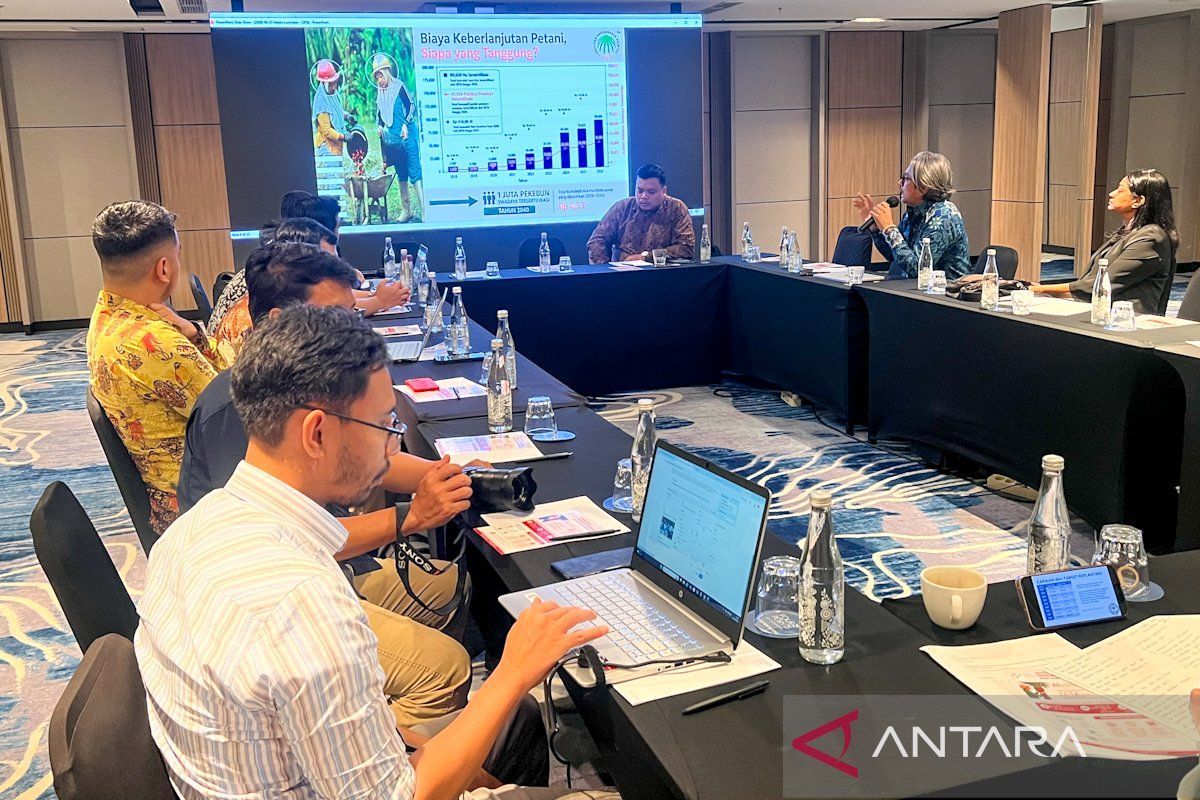
The Centre for Indonesian Policy Studies (CIPS) believes that improving the productivity of independent palm oil farmers is essential to prevent a potential loss of Rp70.3 trillion in Gross Domestic Product (GDP) and crude palm oil (CPO) output through the strengthening of replanting, legality, and financing.
CIPS Chief Executive Officer Anton Rizki stated that the productivity issue for independent palm oil farmers is an urgent matter that requires immediate attention. Currently, approximately 41 per cent of palm oil farmers in Indonesia are independent or smallholders who still have significant room to increase their productivity.
“If this is not addressed, our study estimates a potential loss of more than Rp70 trillion in terms of Indonesia’s GDP income. The potential impact is quite substantial,” Anton said in Jakarta on Tuesday.
He shared these findings during an Exclusive Media Luncheon Discussion titled ‘Increasing Smallholder Productivity: The Key to Boosting Indonesia’s Palm Oil Competitiveness’, which was attended by several palm oil farmer associations.
Furthermore, he emphasised that structural barriers still face farmers. Therefore, CIPS recommends increasing investment in farmers, not only in the form of funding but also through policy attention and collective efforts to encourage sustainable productivity improvements.
At the same event, CIPS Senior Policy Researcher and Analyst Rahmad Supriyante stated that their latest study shows that without addressing the constraints faced by smallholders, “Indonesia risks losing an additional 4.73 million tonnes of crude palm oil production, a loss in export increases of up to US$718.5 million, and an additional GDP loss of approximately Rp70.3 trillion.”
Rahmad emphasised that these findings are critical given that Ministry of Agriculture data (2026) records that smallholder farmers manage about 41 per cent of national palm oil land and contribute 35-40 per cent of Indonesia’s fresh fruit bunch (FFB) production.
“However, their productivity currently only reaches about 26.5 per cent of the maximum potential that can be achieved,” he noted.
He explained that the low productivity of smallholder farmers reflects various ongoing obstacles. This issue impacts not only farmer income but also limits the potential contribution of the palm oil sector to the national economy.
“As long as challenges such as replanting, financing, land legality, and institutional strengthening remain unresolved, Indonesia will continue to miss opportunities to create greater economic growth in the palm oil sector,” said Rahmat.
Behind the vast economic potential, smallholder productivity remains hindered by interconnected barriers, meaning their contribution to national palm oil production growth is not yet optimal.
A CIPS study (2026) noted that approximately 2.4 million farmers currently manage palm trees that are over 25 years old and no longer productive. Meanwhile, the government’s People’s Palm Oil Replanting (PSR) programme has yet to yield optimal results.
The study also found that farmers still face limitations in good agricultural practices (GAP) capacity, access to high-quality seeds, affordable financing, and adequate technical assistance.
Additionally, most smallholders are still hindered by land legality issues, which prevents them from accessing assistance or sustainable certification.
In reality, certification can serve as an instrument to encourage better cultivation practices, strengthen farmer institutions, increase capacity, and provide wider access to technical assistance and markets.
CIPS is urging for priority in palm oil replanting programmes with schemes that are more attractive to smallholders, the resolution of land legality, and the simplification of the Cultivation Registration Certificate (STDB) process.
This is vital so that smallholders can more easily access various government support programmes, including replanting, financing, and sustainable certification.
CIPS also believes that the jurisdictional approach at the regional level needs to be strengthened through collaboration between local governments, the private sector, civil society organisations, and farmers to ensure services such as training and technical assistance can reach more farmers inclusively.
“One of the main challenges in the palm oil sector is ensuring smallholders have access to the crucial factors that determine their productivity,” they said.
They added that as long as these barriers remain unresolved, Indonesia will continue to lose economic opportunities that could otherwise be optimally realised.
Responding to these findings, the Head of Smallholders at the Roundtable on Sustainable Palm Oil (RSPO), Guntur Cahyo Prabowo, emphasised that certification should not be viewed merely as a market requirement, but as part of a broader ecosystem to strengthen the capacity, productivity, and long-term competitiveness of smallholders.
He explained that many smallholders are lagging behind not due to a lack of commitment or willingness to develop.
Instead, Guntur said, they are often trapped in what is called “passive exclusion”—a condition where systems, policies, markets, and institutions unconsciously favour farmers who are already prepared, rather than helping more farmers to become ready.
He asserted that as global market expectations continue to evolve, Indonesia has the opportunity to reduce passive exclusion by helping more smallholders become prepared.
“It is not just about meeting standards, but also about competing, while proving that future growth can be achieved without relying on land expansion,” he concluded.