
Cipancuh Dam Dries Up, 10,000 Hectares of Rice Fields in Indramayu Threatened with Crop Failure
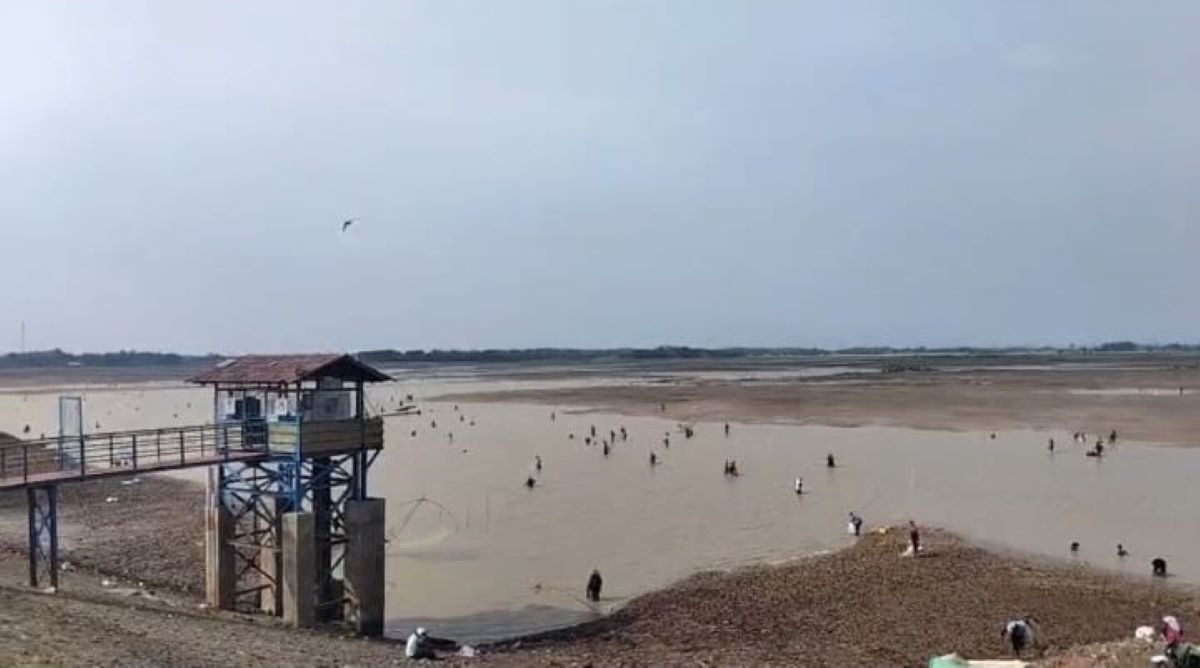
The Cipancuh Dam in Gantar District, Indramayu Regency, West Java, has reportedly dried up completely. This condition means the rain-fed dam can no longer supply water for irrigation needs across thousands of hectares of agricultural land in the West Indramayu region. Sutatang, Chairman of the Indramayu KTNA (Andalan Farmers and Fishers Contact Group), stated that this water crisis is directly impacting the growth of local farmers’ rice crops. “The reports we have received indicate that the Cipancuh Dam is no longer able to supply irrigation water. Currently, their only hope is the flow from the Cipunegara River, whose discharge is also limited,” Sutatang said on Friday.
The drying of the dam threatens rice productivity across five sub-districts, as the Cipancuh Dam has historically been the main water source for these areas. Sutatang noted that the water shortage is severely affecting the growth of rice plants, which are currently in various growth phases. Some farmers’ crops are just entering the vegetative to generative phase (tiller formation), while others are in the booting phase (primordia), and some fields have only recently begun their first planting period.
As an emergency response, the government has allocated additional water supply from the Salam Darma Dam at a rate of three cubic meters per second for the West Indramayu region. However, this assistance is deemed insufficient, as it only covers an estimated 25% of the irrigation needs for the 10,673 hectares of affected rice fields. “Although it helps, this supply is still far from enough considering the vast area of rice fields requiring irrigation,” Sutatang explained.
Given the situation, Sutatang has urged farmers who have not yet started planting to postpone their activities to avoid total losses. “Do not force planting if the water supply is insufficient. Prioritize the already planted fields so they do not experience total crop failure,” he said. For farmers who have already planted, he suggested utilizing alternative water sources such as deep-well pumps or artesian wells. He also called on the government to immediately increase the water supply to the West Indramayu region or to implement weather modification technology, such as artificial rain, if the dry season continues.
Separately, Cipancuh Dam Operator Derry explained that the dam relies purely on rainwater without any direct supply from rivers. Consequently, water depletion becomes an annual problem whenever the dry season arrives. “During the rainy season, the Cipancuh Dam can hold a large amount of water,” Derry said. However, based on the latest technical data, the dam’s water reserves have been completely exhausted since early last month. Currently, only small puddles remain at the bottom of the dam due to uneven ground contours. “We apologize to the farmers because the dam truly cannot supply irrigation water at this time,” Derry stated.
Source: jawawa.id (https://jawawa.id/newsitem/cipancuh-dam-dries-up-10-000-hectares-of-rice-fields-in-indramayu-threatened-with-crop-failure-1786099877)
Originally published by Media Indonesia (https://mediaindonesia.com/nusantara/919411/bendungan-cipancuh-kering-10-ribu-hektare-sawah-di-indramayu-terancam-puso), translated from Indonesian