
Cikuray Train Passengers Surpass 2.2 Million, Growing as Key Garut-Jakarta Route
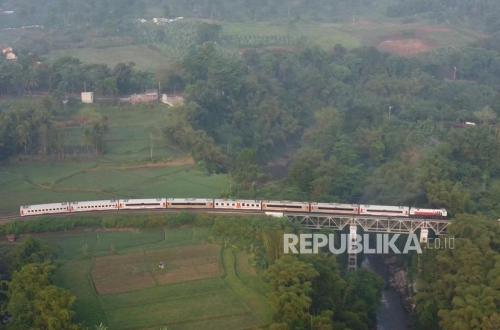
The Cikuray train service has increasingly become a preferred choice for travel on the Garut-Jakarta route. Since commencing operations in 2022 until April 2026, the subsidised economy class (PSO) train has served 2,226,342 passengers.
PT Kereta Api Indonesia (KAI) has recorded a steady increase in Cikuray train users over recent years. In the January-April 2026 period alone, the service was used by 211,498 passengers, comprising 107,459 travelling from Garut to Pasar Senen and 104,039 from Pasar Senen to Garut.
Anne Purba, KAI’s Vice President of Corporate Communications, stated that the growth in passenger numbers demonstrates the Cikuray train’s growing importance in regional mobility.
She explained that the Cikuray service is utilised by diverse groups, including students, workers, micro, small, and medium enterprises (MSMEs), traders, and tourists travelling between cities.
‘The Cikuray train connects numerous stories in a single journey. Students heading to major cities like Jakarta for education, workers commuting to their jobs, tourists enjoying Garut’s beauty at affordable fares, and people visiting family and relatives—all these journeys are part of the service,’ Anne stated.
KAI data shows that on the Garut-Pasar Senen route, passenger numbers rose from 157,735 in 2022 to 272,648 in 2023, then increased to 305,959 in 2024 and reached 313,926 in 2025.
On the Pasar Senen-Garut route, passenger numbers grew from 135,530 in 2022 to 242,119 in 2023, rising to 285,130 in 2024 and 301,797 in 2025.
With the furthest route fare from Garut to Pasar Senen at Rp45,000, the Cikuray train is a popular transport choice due to its affordability.
The Cikuray service operates 12 stations: Garut, Cibatu, Leles, Kiaracondong, Bandung, Cimahi, Purwakarta, Cikampek, Karawang, Cikarang, Bekasi, and Pasar Senen. The route connects diverse economic zones, including Garut’s agricultural areas, Bandung’s education and trade hubs, Karawang and Cikarang’s industrial zones, and Jakarta’s central activity areas.
Anne noted that the rising passenger numbers highlight the railway’s growing role in supporting regional mobility and economic activities. ‘Railways grow alongside community needs. As societal and economic activities expand across regions, opportunities to deliver greater benefits will continue to emerge,’ she said.