
Cianjur Develops Organic Rice as Diversification Effort to Boost Agricultural Productivity
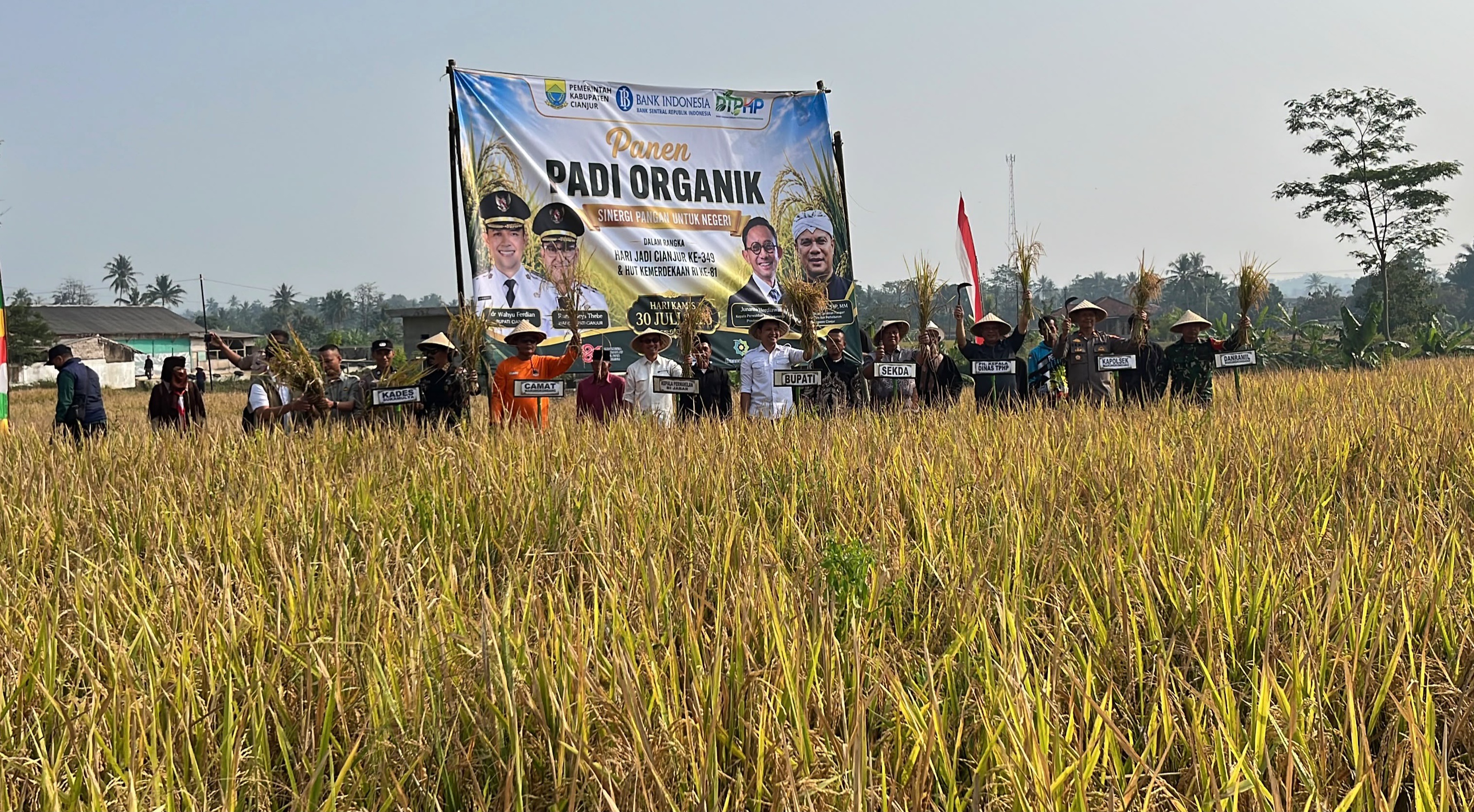
As an agrarian region, Cianjur Regency in West Java continues to develop its agricultural sector through both intensification and diversification efforts. One such initiative involves promoting organic rice cultivation, which is considered to have relatively high productivity compared to inorganic methods.
Inna Ratna Sofia, Head of Infrastructure, Facilities and Extension Services at the Cianjur Food Crops, Horticulture and Plantation Agency (DTPHP), said that organic rice development is currently limited to demonstration plots (demplot). Five locations have been selected as organic rice demonstration plots: Warungkondang, Cilaku, Cibeber, Karangtengah and Cianjur sub-districts.
“It is still at the demonstration or pilot stage. These organic rice demonstration plots are managed by farmer groups, each covering 5,000 square metres or half a hectare,” she said on Sunday (23/8).
She noted that grain or rice production from organic methods has shown an increasing trend. One hectare of paddy field can produce an average of 8 tonnes of grain.
“This can be considered a success because with chemical fertilisers productivity is usually only 5-6 tonnes per hectare,” she said.
The harvest index for organic rice is relatively similar to inorganic rice. The only difference lies in the treatment during the fertilisation process.
“Organic rice also depends on water availability. So the harvest index can be two or three times,” she explained.
Inna said that in the early planting stages, organic rice tends to be vulnerable to pests or plant-disturbing organisms. However, the potential for pest attacks can be prevented using natural pesticides that farmers can mix themselves.
“As for the threat of drought, it is the same. Organic rice still requires a water supply,” she explained.
Therefore, she said, farmers must pay attention to organic rice planting patterns. If the harvest period is calculated correctly, the likelihood of crop failure during the dry season is very small.
“The essence of organic rice is more about the treatment, especially the use of fertiliser. Economically, organic rice is certainly more profitable because its productivity is quite high. This will definitely have an impact on farmers’ incomes. However, organic rice does require extra care. It requires diligence,” she concluded.