
Ciangir Prison inmates trained in competitive skills
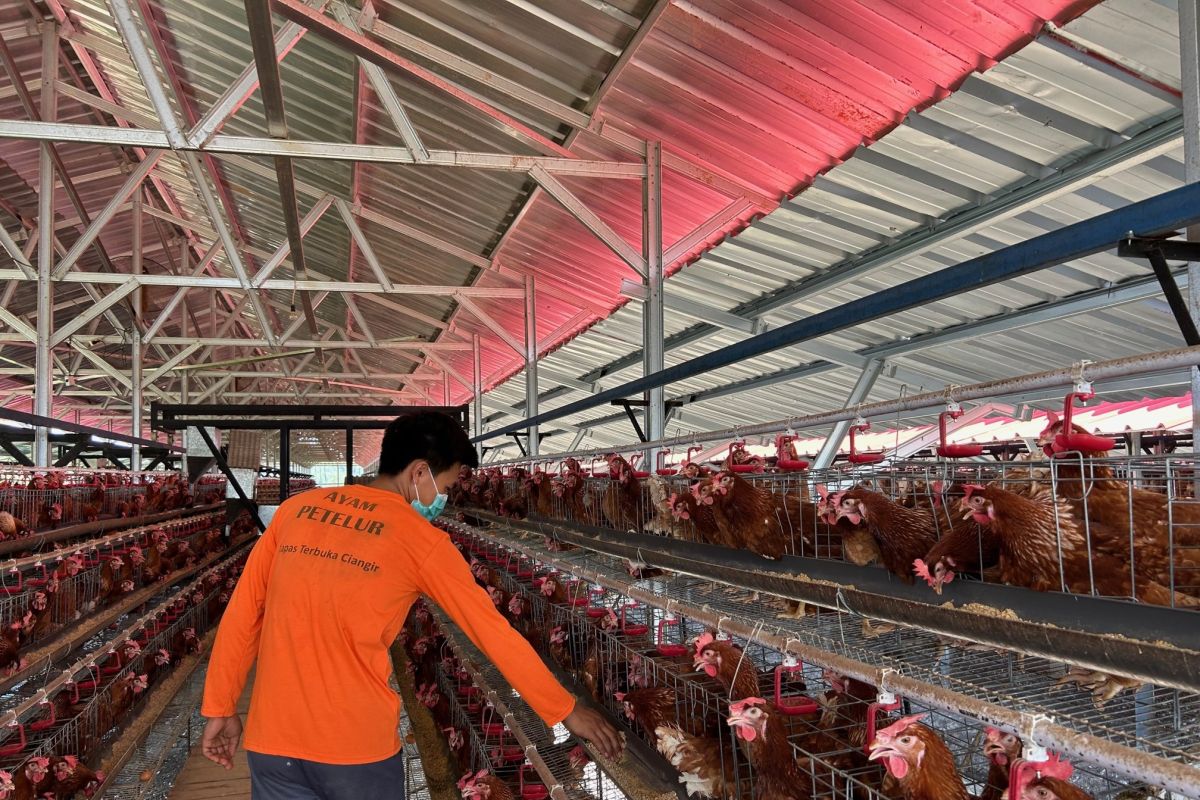
Inmates at the Class IIB Ciangir Open Prison in Tangerang Regency, Banten, are being provided with competitive skills training in the agricultural and livestock sectors, enabling them to compete with other farmers and breeders.
Head of the Banten Regional Office of the Directorate General of Corrections, Lili, stated at Ciangir Prison on Thursday that the facility currently houses 50 inmates, with plans to increase the number by 20 to a total of 70. Lili explained that the inmates’ activities are not limited to eating, drinking, and sleeping; they are empowered to implement the accelerated programme of Minister of Immigration and Corrections Agus Andrianto, which focuses on food security to support President Prabowo Subianto’s Astacita vision.
“The skills possessed by Ciangir Prison inmates are not the same as those outside. Their skills exceed those on the outside so they can be ‘fighters’ out there. Having been trained here, they can work outside, benefit themselves, and not make mistakes again,” Lili said. He described Ciangir Prison as a miniature version of Nusakambangan Prison, which also runs a food security programme with extensive agricultural, fishery, and livestock land.
“At Ciangir Prison, inmates are empowered; they work in livestock and agriculture, they gain skills, and they also receive a share of the proceeds. So when they are released, they have skills to make their families proud, they are independent, so they won’t make mistakes again and can finance their own lives,” Lili added.
Ciangir Prison spans 23 hectares, with 4 hectares used for buildings and inmate housing, and the remainder dedicated to raising layer chickens, free-range chickens, sheep, and cattle, as well as farming, rice paddies, and vegetable plantations. In the livestock sector, inmates are not only trained to care for and feed sheep but also taught breeding techniques.
Head of Ciangir Prison, Soeistanto Poedji Djatmiko, known as Tanto, said the initial breeding stock was 20 sheep. Within 1.5 years, the flock grew to 85, and 25 sheep were successfully sold during the 2026 Eid al-Adha celebration. “Inmates are trained in weaning innovation. Female sheep that have given birth are separated from their lambs, and the lambs are hand-reared by the inmates and given milk. Meanwhile, the ewes can be bred again within a few months,” Tanto said.
In the layer chicken farm, which has been operating for three months, inmates are not only feeding the chickens and collecting eggs but are also trained to care for the birds with adequate feed and supplements to keep them healthy and highly productive. Ciangir Prison employs a mentor and a veterinarian to train the inmates in layer chicken farming. Currently, 35,000 layer chickens are being cultivated, producing 860 kilograms or approximately 12,000 eggs per day, with a target to expand the flock to 60,000 birds. The prison also raises free-range chickens for meat, and their eggs are hatched to increase the flock size. There are currently 60 free-range hens.
“We also have an automatic egg incubator, an incubator machine for hatching embryos during the first 18 days. This machine has an automatic rotating tray to turn the eggs, along with higher temperature and humidity settings,” Tanto said.
Yusuf (27), one of the inmates, expressed his happiness and gratitude for being able to participate in the self-sufficiency training. Besides gaining knowledge in poultry farming, he also receives a monthly premium of Rp500,000. He added that his days serving his sentence are no longer boring, as he can interact outside and breathe fresh air. The man from West Java admitted he had no livestock skills before his incarceration. After being taught in prison, he now possesses the knowledge to work on a poultry farm back in his home village. “I chose the chicken coop because there is a poultry farmer in my village. After I am released, I plan to work on that poultry farm,” Yusuf said.