
CIA Report: Israel on the Brink of Civil War and Institutional Collapse
TEL AVIV — Israel faces the threat of an internal crisis that could develop into civil war and even the collapse of state institutions. The warning is said to be contained in a classified US Central Intelligence Agency (CIA) report, which highlights increasingly sharp political divisions, economic pressures and military exhaustion after years of conflict.
The report, prepared in August 2026, is titled Fracture From Within. A Drop Site News report published jointly with Capital & Empire on 5 October said the assessment was produced by the CIA’s Red Cell, a unit tasked with challenging conventional assumptions and developing alternative analyses of strategic risks.
According to two US sources familiar with its contents, CIA analysts judged that several longstanding problems in Israel could compound one another. They include rising war costs, pressure on the economy, reserve-force exhaustion, disputes over compulsory military service, settler violence in the West Bank and political instability under Prime Minister Benjamin Netanyahu’s government.
A source in the US intelligence community cited by Drop Site News warned that Israel could be just one trigger away from a genuine internal conflict.
“This is not a fanciful scenario,” the source said, referring to the assessment of the risk of internal conflict ahead of Israel’s election on 27 October 2026.
The full report has not been made public. The CIA did not respond to Drop Site News’ request for confirmation.
The report highlights the lasting impact of Israeli military operations in Gaza, Lebanon and Iran on conditions at home.
Repeated reserve-force call-ups have disrupted Israelis’ family and working lives. At the same time, military spending has risen while the public faces pressure from the cost of living.
These issues could intensify tensions between groups who believe the burden of war is being shared unequally.
One concern is the return of large numbers of soldiers and reservists from the battlefield after lengthy deployments. Some have reportedly experienced psychological distress as a result of their wartime experiences.
The report says the combination of political polarisation, war trauma and access to firearms among veterans could increase the risk of clashes if social tensions continue to rise.
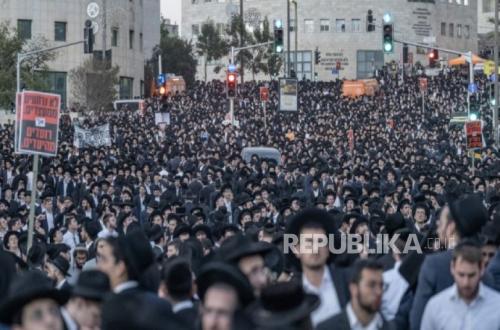
Another issue highlighted is the dispute over exemptions from compulsory military service for ultra-Orthodox Jewish men, or Haredim.
For years, many men from this community have received exemptions in order to continue their religious studies. The policy has come under increasing scrutiny as Israeli reservists continue to be mobilised for military operations on several fronts.
For some reservists and their families, the issue is an unequal distribution of the burden. Some citizens have repeatedly had to leave their jobs and families to serve, while others are not required to perform military service.
Ultra-Orthodox leaders, on the other hand, argue that military service could disrupt religious life and the obligation to study the Torah.
The dispute has become a source of political tension in Israel, particularly as the need for military personnel has grown after a prolonged war.
Netanyahu and political uncertainty
The situation is unfolding ahead of Israel’s election, scheduled for 27 October 2026. The political contest is becoming more complicated as both Netanyahu’s supporters and his opponents struggle to secure a parliamentary majority.
A report by Palestine Chronicle also highlighted Netanyahu’s efforts to remain in power amid disputes over government policy and the direction of the war.
The political instability could worsen existing divisions. However, opposition to Netanyahu does not necessarily mean opposition to Israeli military operations in Gaza or the country’s policies towards Palestinians.
Some opposition figures are instead focused on security failures, the handling of the war and the government’s domestic policies.
Israel’s challenges therefore involve not only competition between the government and opposition, but also disagreements over the distribution of the war’s burden, the direction of state policy and the future of its political leadership.
Alongside political and military issues, the report is said to identify economic pressures as a factor that could deepen instability.
Rising defence spending and the effects of war on daily life could place a burden on Israeli households. Palestine Chronicle, citing Drop Site News, said food prices, including those of fresh fruit and vegetables, had risen by 9.5 per cent over the past two years.
Internationally, the report is also said to express concern about Israel’s deteriorating image and declining support for the country among some sections of the US public.
Washington’s support has long been one of the main pillars of Israel’s military and diplomatic capabilities. Changes in US political attitudes could affect relations between the two countries in the longer term.
Drop Site News also cited a US intelligence source who said that frustration was growing in some parts of the US intelligence and military communities over the scale of political and military resources used to support Israel.
The report does not, however, establish that the United States will end its support for Israel. Its concern is the possibility of weakening political backing and the impact this could have on Israel’s strategic position.