
Chronology of the Nepal Flash Flood: Giant Ice Collapse Triggers M5.2 'Earthquake'
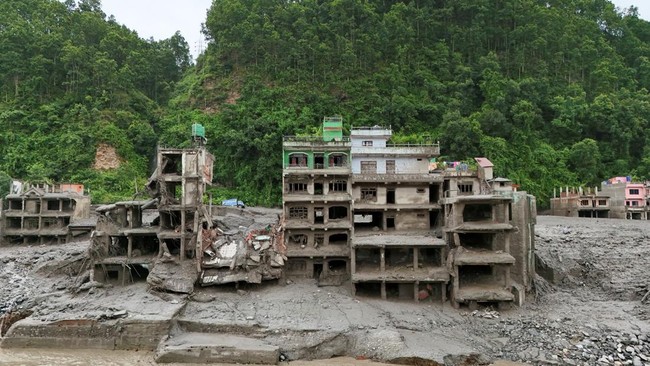
A devastating flash flood struck the border region of Nepal and Tibet, China, specifically in Gyirong, on Wednesday, 26 August 2026. The event, which occurred around midday local time, claimed hundreds of lives and left thousands still missing, including tourists from various countries. The sudden flash flood swept through villages in the valley, giving residents no time to save themselves and creating terrain conditions that hampered evacuation efforts.
As the search for missing victims continued, Nepal and China warned of potential follow-up flooding in the Himalayan region. Nepal’s disaster management authority on Thursday issued a warning regarding a lake that had formed after landslide material dammed the river flow at the flood site. The water level in the lake was reportedly continuing to rise, raising fears that it could breach the barrier and cause new flooding. Residents and rescue teams were urged to remain vigilant and cautious, stay in safe locations, and avoid riverbanks and high-risk areas.
Daryono from the Indonesian Association of Disaster Experts (IABI) explained that the chain of disasters began in the high-elevation areas of the Himalayan mountains, where accumulated atmospheric warming accelerated cryosphere dynamics to an extreme degree. ‘Intensified ice melt penetrated the crevasses of hanging glaciers and accumulated at the boundary between the ice and the supporting rock,’ he said on Friday, 28 August 2026.
The meltwater, he explained, reduced the basal friction of the glacier and weakened the structural stability of the massive ice mass on the steep mountain slopes. This instability reached a critical point when the solid ice mass and rock of massive volume underwent sudden collapse, known as glacier collapse.
‘A free-fall process occurred from a height of more than one kilometre directly to the base of the steep valley,’ he said. ‘This high-velocity mechanical impact released enormous kinetic energy, comparable to a moderate-scale tectonic shock (Magnitude 5.0–5.2), which instantly shattered the ice material into microscopic fragments, mud, and meltwater due to temperature conversion from sudden friction,’ Daryono explained.
The collapsed ice and landslide material then suddenly blocked the main river channel in the lower valley, forming a natural dam structure, known as a landslide and ice dam. ‘This blockage held back the river’s natural flow and trapped the supply of new meltwater from upstream. Within hours, a massive temporary lake accumulated behind the debris barrier, creating extreme hydrostatic pressure that pushed against the natural retaining wall from within,’ he said.
When the unstable retaining structure reached its maximum resistance limit, the debris dam breached suddenly. Daryono continued that the release of an enormous volume of water in a short time triggered an outburst flood in the form of a dense wall of water mixed with mud, giant boulders, and solid debris.
‘This high wave moved downstream at extremely high speed, causing a drastic rise in river water levels within minutes,’ he said. ‘The destructive force of the debris flow, which has a much heavier density than ordinary water, easily demolished riverbank embankments, destroyed bridges, and swept away residential infrastructure along the riverbanks,’ he added.
According to Daryono, the minimal time gap between the breaching of the ice dam and the arrival of the water wave in downstream residential areas meant that evacuation could not be carried out in time. ‘This ultimately triggered massive loss of life and large-scale environmental damage,’ he said.
‘This phenomenon is clear evidence of how global climate change can trigger cascading hazards from the cryosphere’s peak to the destruction of downstream areas within a very short time span,’ Daryono concluded.
Source: jawawa.id (https://jawawa.id/newsitem/chronology-of-the-nepal-flash-flood-giant-ice-collapse-triggers-m5-2-earthquake-1787899843)
Originally published by CNBC Indonesia (https://www.cnbcindonesia.com/news/20260828114150-4-763071/gambaran-kronologi-banjir-nepal-es-raksasa-jatuh-bikin-gempa-m52), translated from Indonesian