
Chronology of the Argo Bromo Anggrek and KRL collision at Bekasi Timur Station
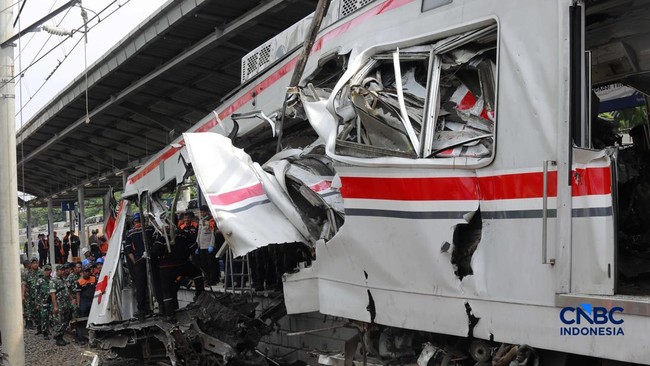
The National Transport Safety Committee (KNKT) has disclosed preliminary results of an investigation into the collision between the Argo Bromo Anggrek train and a KRL Commuter Line service on the Kampung Bandan–Cikarang route at Bekasi Timur Station on 27 April. KNKT Chair Soerjanto Tjahjono reported the early phase of the investigation into the collision between Argo Bromo Anggrek, running Gambir–Surabaya Pasar Turi as KA 4B, and the KRL Commuter Line on the Kampung Bandan–Cikarang route as KA 5568A at Bekasi Timur Station.
“On this occasion, we from KNKT report the preliminary investigation into the Argo Bromo Anggrek and KRL Commuter Line collision at Bekasi Timur Station. In this presentation, we are only presenting factual data, not analyses and there are no conclusions about the causes of the accident. However from what we present, some understanding can be drawn about why the accident could have occurred,” Soerjanto told the hearing of the DPR Ri Commission V on Thursday (21/5/2026).
Here is the chronology and the causes of the collision:
KNKT reported the initial chronology: at 20:33:59 WIB, KRL Commuter Line 5568A arrived on track 6 at Bekasi Station. Then 5568A stopped to wait for the passage of KA Sawunggalih on Pasar Senen–Kutoarjo (KA 116) at Bekasi.
At 20:34:45 WIB, KA 116 Sawunggalih arrived on track 3 at Bekasi Station to board/alight passengers. At 20:38:32 WIB, Sawunggalih was dispatched from Bekasi.
After being deemed safe, 5568A departed from track 6 of Bekasi Station at 20:45:32 WIB. Then 5568A arrived on track 1 at Bekasi Timur Station at 20:48:13 WIB.
A few seconds after 5568A arrived, precisely at 20:48:29 WIB, KRL Commuter Line bound for Cikarang–Angke with KA 5181 collided with a Green taxi at the crossing near Bekasi Timur Station.
After boarding/unboarding, KA 5568A departed Bekasi Timur again at 20:48:53 WIB. But after moving about 1.69 m, it stopped again around 20:48:59 WIB due to crowds following the taxi’s collision with KA 5181.
At Bekasi Station, at 20:50:43 WIB, Argo Bromo Anggrek KA 4B passed on track 3 with the signal showing safe or green. However, a few minutes later, at 20:52:12 WIB, the collision occurred between Argo Bromo Anggrek KA 4B on track 3 and KA 5568A on track 1 at Bekasi Timur.
KA 5568A left Bekasi Station eight minutes later than scheduled, while Argo Bromo Anggrek crossed Bekasi eight minutes earlier than scheduled, creating a very narrow time window for the driver of Argo Bromo Anggrek to brake.
The Argo Bromo Anggrek driver had already attempted braking 1.3 km from Bekasi Timur, but the braking was not sufficient; the driver also sounded the horn (signal 35) because a KRL was ahead and braking did not succeed.
signalling and communications
KNKT also investigated the signalling and communications systems related to this incident. On the Bekasi–Bekasi Timur line, there are three interlocked signals that are integrated: the Bekasi Station exit signal, the repeater signal, and the interceding block signal between Bekasi and Bekasi Timur.
Based on simulations conducted by KNKT and others, the Bekasi exit signal showed a safe or green aspect. The repeater signal showed an unsafe or flat-line signal, and the block signal showed an unsafe or red signal.
Soerjanto said the Argo Bromo Anggrek driver had difficulty seeing the repeater signal in the Bekasi–Bekasi Timur section because the lighting from nearby houses obscured it.
“So this is what we see in the locomotive cabin, and also in the KRL cabin, at night the visibility is poor, so the driver had difficulty seeing the repeater signal due to the lighting from houses and markets around the track; there is light from residents’ houses and street lamps with intensity and colour resembling the repeater signal,” he said.
Not only that, the simulation also showed that the communication used by each train driver utilised different radios.
“KA 5181 uses a Tait Radio and is in the S.27 (PK Selatan) communications zone, while KA 5568A uses a Sepura Radio in the same S.27 (PK Selatan) zone, and KA 4B uses a Locomotive Radio in the S.1 (PK Timur) zone,” he explained.
With this simulation, KNKT preliminary findings indicate anomalies in Bekasi signalling, where the Bekasi exit signal did not detect the signals that followed and the position of KA 5568A at Bekasi Timur, where the exit signal should have shown caution or yellow.
In addition, there were obstructions near the repeater signal in the Bekasi–Bekasi Timur sections, and radio communication interference between the trains and the station authorities, contributing to the accident at Bekasi Timur.
“One of the causes is the Bekasi signal not being able to detect KA 5568A at Bekasi Timur. There were also lighting obstructions near the repeater signal and issues with communications contributing to the accident,” Soerjanto concluded.
(chd/wur)
Source: jawawa.id (https://jawawa.id/newsitem/chronology-of-the-argo-bromo-anggrek-and-krl-collision-at-bekasi-timur-station-1779542596)
Originally published by CNBC Indonesia (https://www.cnbcindonesia.com/news/20260521165338-4-736790/begini-kronologi-tabrakan-ka-argo-bromo-vs-krl-di-stasiun-bekasi-timur), translated from Indonesian