
Chronology of Illegal Rice, Salt, and Second-hand Clothing Import Seizures Worth Rp27 Billion
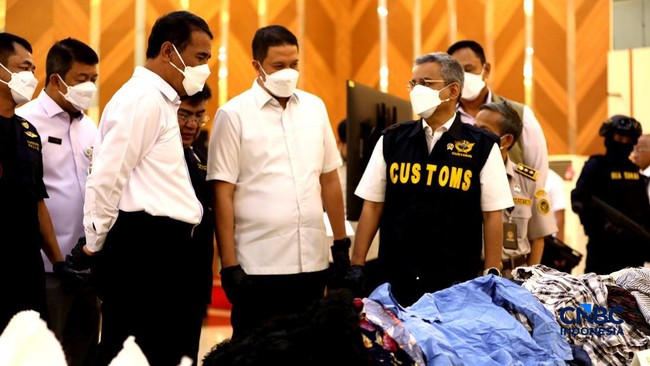
The Directorate General of Customs and Excise of the Ministry of Finance (DJBC Kemenkeu) has revealed the chronology of the interception of illegal rice and salt imports, as well as unauthorised second-hand clothing imports.
Director General of Customs and Excise, Djaka Budi Utama, stated that there were four locations where the illegal goods were discovered. “Customs carried out four enforcement actions: in the waters of the Malacca Strait, Tanjung Perak Port, the Bogor Bonded Zone, and Tanjung Priok Port,” said Djaka during a press conference at the Customs Headquarters on Tuesday (22/9/2026).
From these four operations, Customs successfully secured 30 containers containing rice and salt at two different locations, as well as 1,435 bales of suspected second-hand clothing at two other locations. “From these four actions, Customs secured 30 containers containing rice and salt that did not match the customs declarations, as well as approximately 1,435 bales of suspected second-hand clothing,” Djaka continued.
The first enforcement action was carried out at Tanjung Perak Port, Surabaya, East Java, on 19 August 2026, involving 15 containers of goods declared as ammonium chloride from India, with a total weight of 412.5 tonnes. The process began with an import declaration by PT TI, but strong suspicions of discrepancies led to the issuance of an intelligence note as the basis for a physical inspection by officials from the East Java Customs Regional Office I and Tanjung Perak Customs. Physical inspections and testing at the Surabaya Customs Laboratory revealed 202,450 kg of rice and 211,000 kg of salt. The value of the goods in this seizure is estimated to reach Rp7.85 billion.
The next enforcement, conducted in Bogor on 7 September 2026, was a result of follow-up information from the Tanjung Perak operation, regarding a similar shipment suspected of using the same modus operandi through other ports. Based on information received, there were suspected discrepancies in goods imported by PT ILW. The goods, originating from India and packed in 15 containers, were declared as low-grade salt-chemical used for leather tanning purposes, weighing 420,000 kg. However, after monitoring, officers found 194,900 kg of rice and 225,400 kg of white granules suspected to be salt, with the total value of the goods estimated at Rp8 billion.
In addition to the two illegal rice and salt seizures, Customs also conducted two operations against compressed bales of suspected second-hand clothing. The first action took place on 14 August 2026, following community information regarding the smuggling of second-hand clothing from Malaysia using an unnamed vessel (Rampago) in the Gosong Bunga-Bunga waters, Serdang Bedagai, North Sumatra. In response, the North Sumatra Customs Regional Office deployed the BC 7005 Patrol Boat for interception and further inspection. Officers discovered 430 bales of second-hand clothing, which are currently being processed, along with 4 packages of motor vehicle spare parts.
The subsequent enforcement was conducted on 17 September 2026, against 8 containers of suspected second-hand clothing bales at Tanjung Priok Port. Following up on information, Tanjung Priok Customs found indications of cargo consisting of suspected second-hand clothing bales. Through further investigation, officers discovered one additional container on the same ship that was also suspected of carrying second-hand clothing bales, leading to the inspection of 9 containers in total.
Inspections at Tanjung Priok revealed cargo consisting of textiles and textile products (TPT) of various brands and types of clothing packed in bales. The current total has reached approximately 1,005 bales and is still being processed. The total value of the goods is estimated to reach Rp8.040 billion. Regarding these findings, officials are conducting further examinations and in-depth investigations for handling in accordance with applicable regulations.
Regarding the modus operandi of these illegal imports, Djaka revealed that the methods used include misdeclaration, concealment and physical similarity through deceptive packaging, and cover-up loading or camouflage through the arrangement of goods. “These methods show an attempt to disguise the true type of goods so that they differ from what was declared in the customs documents,” said Djaka.
Consequently, the authorities will continue to optimise supervision through a combination of various information sources and monitoring methods. “We are combining intelligence information, community information, risk analysis of supplier and importer profiles, technology, and field supervision. Every enforcement action will be further developed to identify the origin of the goods, the destination of the smuggled items, and the parties involved,” concluded Djaka.
Source: jawawa.id (https://jawawa.id/newsitem/chronology-of-illegal-rice-salt-and-second-hand-clothing-import-seizures-worth-rp27-billion-1790059945)
Originally published by CNBC Indonesia (https://www.cnbcindonesia.com/news/20260922120048-4-769835/kronologi-penindakan-impor-beras-garam-pakaian-bekas-ilegal-rp27-m), translated from Indonesian