
Chronicle of the Critical Time of the Tragedy in East Bekasi
Ruka was returning home from work that night in the front carriage of KRL 5568A, right after the women’s-only carriage, on Monday, 27 April 2026. At several stations beforehand, the train he was on experienced slight delays in arrival. Upon reaching East Bekasi Station, the train stopped for more than five minutes. Information from staff to passengers indicated that the train could not proceed because KRL 5181B had collided with a green taxi bearing licence plate B-2864-SBX on the opposite track, heading towards Jakarta.
While the train was stationary, Ruka peered out through the open door. He photographed the stationary KRL that had hit the green taxi. According to him, although there was this accident, his train on the opposite rail should still have been able to pass, as there was a considerable distance available. However, the problem was a crowd of residents blocking the track heading out of Jakarta.
“Look (at the KRL that hit the green taxi), but it doesn’t seem to be blocking the track. It looks like my train stopped because of the crowd, that mass gathering. So the track wasn’t clear. Actually, if there hadn’t been the crowd, we probably could have continued,” Ruka told detikX.
While peering and photographing towards the front of that train, the EXIF data of his photo showed the time as 20:51. A few seconds later, the KRL doors closed again, signalling an imminent departure. But what happened seconds after was a loud ‘bruakkk!’, a sound like metal clashing from the direction of the rearmost carriage. KA Argo Bromo Anggrek had collided with the rearmost carriage of the KRL he was on.
Ruka fell inside the carriage, as did the other passengers. The train he was on was pushed forward. The impact was strong.
“That was the first thing I thought: why is the train moving on its own? Oh, then suddenly someone shouted, it’s been hit! It’s been hit!” he recounted.
The collision time of 20:51, as stated by Ruka, was also confirmed by the YouTube channel Trainspotter ID, which was live-streaming from KA Argo Bromo Anggrek. In the video recording automatically uploaded after the live stream, at minute 17:40, KA Argo Bromo Anggrek departed from Gambir Station at real time 20:31. The collision occurred at minute 38:54 in the video recording. Thus, KA Argo Bromo Anggrek collided with KRL 5568A at 20:51, given the 21-minute 16-second difference between the video recording and real time.
About six minutes later, Head of the National Search and Rescue Agency (Basarnas) Marshal TNI Mohammad Syafii received information about the train accident involving KA Argo Bromo Anggrek and the KRL. Precisely at 20:57.
In that situation, Syafii said, Basarnas Special Group (BSG) was deployed, as this elite team has special capabilities and equipment.
“The team entering must use full protective gear, such as gloves, protective clothing, helmets, helmet visors, and other equipment,” Syafii told detikX.
The struck KRL, according to Syafii, was known to be in a parked position waiting for clearance after the previous incident involving the collision with the taxi at the crossing.
“Info on the train accident with the train: what train, what number, where each train came from, schedule to arrive at that station, how long the KRL stopped waiting for the clearance process,” he stated.
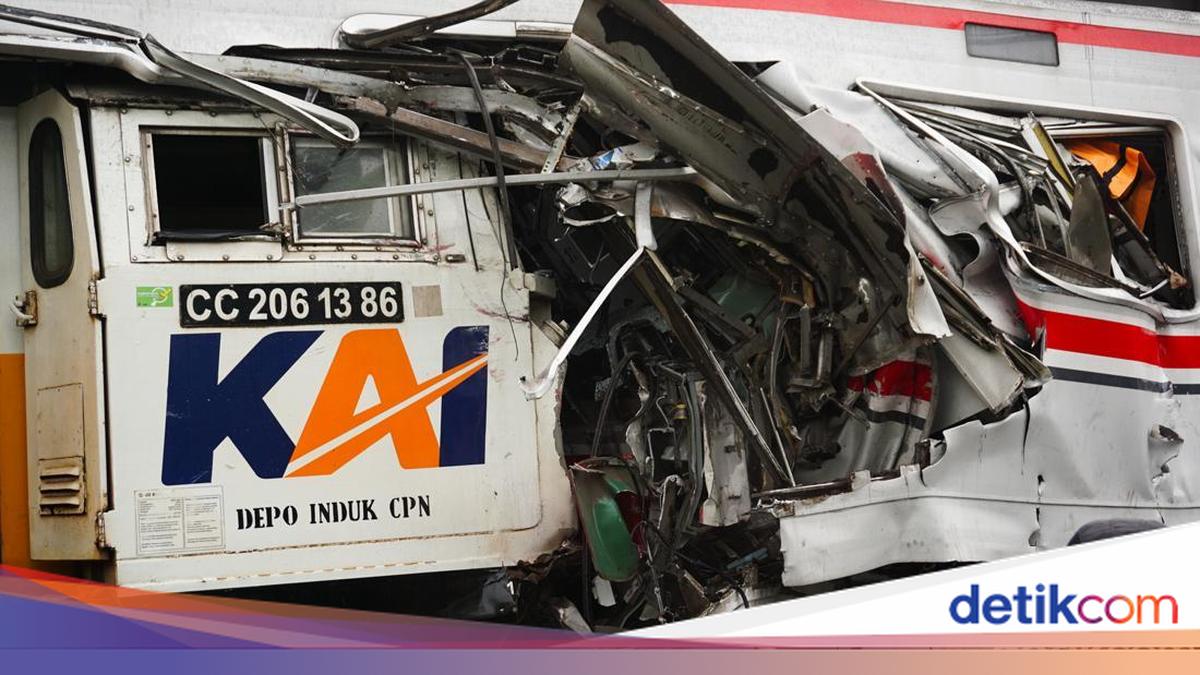
At the site, the evacuation process did not go smoothly. Five victims were found alive but trapped by train frame materials. The carriage structure was reported to have severe damage, with the floor rolled up to a thickness of about 2.5 metres.
Victims of the KRL and Argo Bromo collision were assisted by medical personnel arriving at the location.
He added that limited space and the presence of personnel from various agencies, such as TNI and Polri, required strict coordination on the ground.
From that process, five victims were evacuated and immediately referred to hospital with special handling, including medical procedures to reduce pain during the cutting of train materials.
Meanwhile, the total death toll on the night of the incident was recorded as 14 people. However, the data evolved after evacuation and further checks at the hospital. PT KAI then reported two additional victims, bringing the total death toll to 16.
Regarding the extent of damage, Syafii explained that the two train sets were seriously affected. The locomotive was said to have fully entered the KRL carriage body, leaving very limited space.
“Effectively, perhaps about 2 metres of space remaining,” he said.
The second carriage remained relatively intact, though the coupling between carriages suffered damage and denting from the hard impact.
Police subsequently elevated the handling of the train accident case in Bekasi to the investigation stage. Head of Public Relations of Metro Jaya Police Kombes Budi Hermanto said the upgrade from preliminary investigation to full investigation was done after investigators obtained several pieces of initial evidence in the collision case between KA Argo Bromo Anggrek and the Jakarta-Cikarang KRL.
To date, investigators have examined 24 witnesses to delve into the case. Additionally, seven others are still being questioned as they are suspected of having important roles in train operations, from central train control officers, train dispatchers, signal officers, KRL engineers, to KA Argo Bromo Anggrek engineers and assistant engineers.
Furthermore, police are collaborating with the Forensic Laboratory Centre of National Police Headquarters to investigate the cause of the accident. One aspect being explored is the possibility of technical disruptions, including issues with the electrical system or signals at the incident location.
detikX has contacted the Vice President of Corporate Communication