
Chromebook Corruption Trial: Peratin Supports Prosecutor's Objection on Witnesses
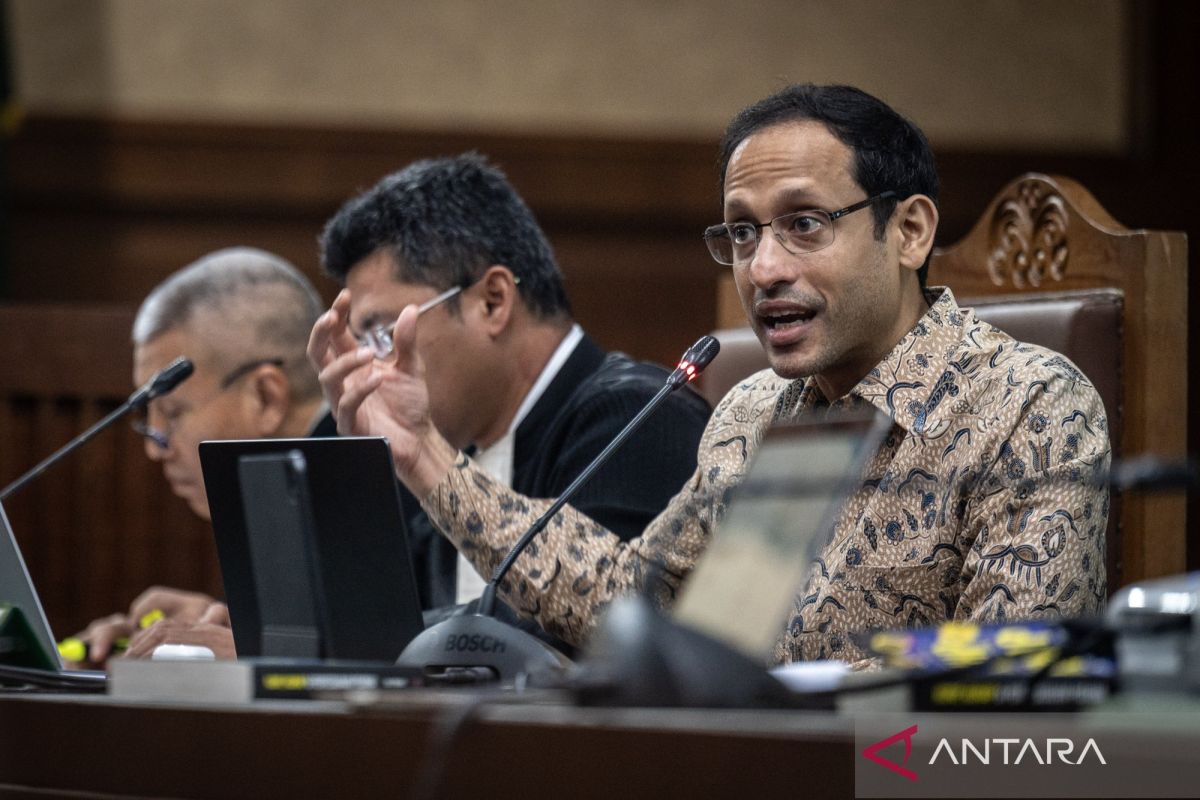
Jakarta (ANTARA) - The Indonesian Information Technology Lawyers Association (Peratin) supports the public prosecutor’s objection regarding the virtual examination of witnesses from Google in the trial of the Chromebook procurement corruption case.
“The panel of judges can read and consider that this mitigating witness’s testimony is not or lacks value,” said the General Chairman of the Indonesian Information Technology Lawyers Association (Peratin), Kamilov Sagala, in his statement in Jakarta on Thursday.
The trial of the alleged corruption in the procurement of Chromebooks at the Ministry of Education, Culture, Research, and Technology (Kemendikbudristek) was resumed at the Corruption Court at the Central Jakarta District Court on Monday (20/4).
In that hearing, the defendant, former Minister of Education Nadiem Makarim, presented three witnesses from Google Asia Pacific virtually from Singapore, one of whom was the former President of Google Asia Pacific, Scott Beaumont.
The virtual appearance of the witnesses was justified by the lack of accompaniment from the Prosecutor’s Attaché in Singapore. However, the Prosecutor’s Office is said to have been cooperative in coordinating for accompaniment.
“Instead, if the mitigating witness appears in person, that can be assessed as having positive testimony value,” he said.
According to him, what Nadiem’s side did by presenting witnesses virtually is futile.
Moreover, such an attitude can be categorised as contempt of court because it does not respect the panel of judges and the value of the trial in the Unitary State of the Republic of Indonesia (NKRI), for whatever reason.
He said that if the witnesses are indeed cooperative, they could appear in person in the courtroom in Jakarta. Moreover, the travel time from Singapore to Indonesia only takes one hour.
Non-compliance
Meanwhile, Public Prosecutor (JPU) Roy Riady expressed an objection to the trial procedure because the legal counsel did not comply with the applicable procedural law in Indonesia.
“Based on Article 65 of the Criminal Procedure Code, the determination of the panel of judges should be submitted to the prosecutor for execution. However, the lawyers did not provide that determination letter, so the JPU did not receive official administrative notification,” he said.
He said the JPU once requested a postponement so that the examination of witnesses in Singapore could be supervised by local law enforcement authorities (APH) to safeguard sovereignty and maintain good inter-state relations, considering the objection conveyed through the Indonesian Embassy (KBRI) in Singapore.
However, the defendant’s legal counsel requested that the trial proceed with the reason of the witnesses’ busyness. Meanwhile, the JPU stated that they do not reject the substance of the testimony, but demand that all procedural aspects be carried out in accordance with the legislation.
Roy also reminded of the importance of considering reciprocal inter-state relations in that legal process to avoid future polemics.
Furthermore, regarding the case material, Roy mentioned that the statements from the Google witnesses, namely Scott Beaumont and Caesar Sengupta, actually further strengthen the JPU’s indictment.
In the trial, it was revealed that there were meetings in February 2020 and April 2020 via Zoom discussing Google’s business with PT Aplikasi Karya Anak Bangsa (AKAB) as well as Nadiem’s position as Minister of Education at that time related to Chromebook technology.
“Based on those facts, the JPU is increasingly convinced that the procurement in that ministry was not based on real state needs identification, but rather inclined towards the defendant’s personal business interests,” he said.