
Chinese-Style Rural Development: Ancient Village Transformed into Mega Resort, Farming Under Solar Panels
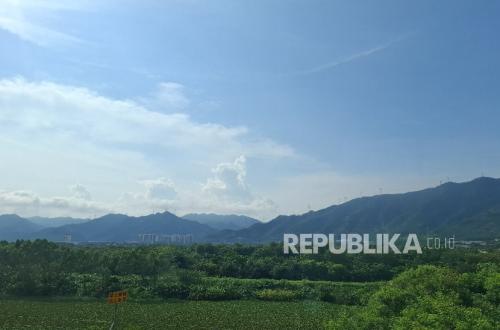
Setting foot in Qingyuan, Guangdong Province, China, felt like returning to my hometown in West Java. As far as the eye could see, green hills and rivers flowing beneath them, not much different from the scenery common in a tropical country. Only the temperature and humidity reminded me that this was not Indonesia.
Southern China had just been hit by Typhoon Noul when I arrived in Guangdong on Sunday (26/7/2026). The category 10 storm had disrupted hundreds of journeys to and from southern China and Hong Kong. Around 200,000 people were evacuated, more than 350 flights were cancelled, and residents were urged not to carry out outdoor activities.
Thank God, we arrived safely in China. Together with 20 journalists and influencers from ASEAN countries, I was taking part in the ASEAN Media China Tour: Dynamic Guangdong programme, ahead of APEC China 2026, to be held in November 2026.
July is usually the height of summer in southern China. But the weather in Guangdong at the time was overcast with light rain throughout the day after the storm had passed. The temperature dropped from around 38 degrees Celsius to 25 degrees Celsius when we arrived. Lin Weiqiang, General Manager of the Sanhe Daoli Hot Spring Resort, Guangzhou White Swan Hotel Management Co., Ltd., said we were fortunate because the weather had become more hospitable.
“Our area was hit by a typhoon since yesterday, with very strong winds that damaged the rice crops, but we are happy to receive visitors like this. Welcome to our home,” he said, greeting us warmly at the entrance of the Daoli Hot Spring Resort in Sanhe Village, Sankeng Town, Qingxin District.
Weiqiang said the area used to be just an ancient village, where only a few farmers lived off modest harvests. The Sanhe Daoli Hot Spring Resort now stands neatly and orderly across 130 hectares.
The agricultural area was combined with a tourism project involving investment from Qingyuan Daoli Hotel Management Co., Ltd. A total of 30 old farmhouses, 30 hectares of vacant land, 70 hectares of farmland, and fish ponds were transformed into a resort whose most expensive rooms can fetch Rp25 million per night.
“We follow the principle of restoring the old to its original state. This project develops the entire village into a hot spring resort, promoting deep integration between ancient villages, ancient architecture, and the hot spring resort industry,” he said.
The main challenge, of course, was the scepticism and lack of confidence among the villagers. However, after organising village representatives to visit and learn from other regions, their perspectives changed, their concerns disappeared, and they actively cooperated in revitalising the houses and promoting the implementation of the project.