
Chinese Media Highlights Indonesia-Beijing Relations: Why?
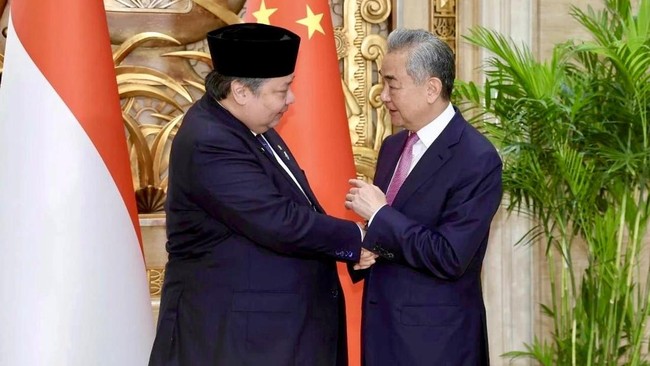
Jakarta, CNBC Indonesia – Economic relations between Indonesia and China are currently in the spotlight of the Chinese media, including the Hong Kong-based South China Morning Post (SCMP).
In an article titled “Can China and Indonesia’s strong financial ties withstand ‘resource nationalism’?”, the paper described how the two countries enjoy increasingly close economic cooperation, from the nickel sector and electric vehicles (EVs) to manufacturing and finance. On the other hand, changes in Indonesia’s policies on natural resource management are beginning to pose challenges for Chinese investors.
The report noted that Jakarta–Beijing economic ties have entered a new phase, as Indonesia seeks to capture greater added value from its mineral wealth.
For more than a decade, China has been Indonesia’s main partner in developing resource-based industries, particularly nickel, a key material for stainless steel and EV batteries.
One of the Chinese companies that has benefited most from Indonesia’s nickel potential is Tsingshan Group. The company entered Indonesia in 2009 to secure nickel supplies.
By leveraging Indonesia’s nickel reserves, the largest in the world, Tsingshan has grown into one of the world’s biggest stainless steel producers. In 2025, the company recorded revenue of around 432 billion yuan, equivalent to US$63.8 billion.
Economic ties between the two countries have since broadened beyond mining to mineral processing, manufacturing, electric vehicles and financial services.
“Indonesia provides the resources, while China contributes capital, technology and manufacturing expertise, creating an increasingly integrated economic ecosystem,” said Zhao Xijun, a professor of finance at Renmin University of China, quoted on Wednesday (20/7/2026).
China Chases Indonesia’s EV Boom
The government of President Prabowo Subianto is said to be pushing downstreaming policies so that Indonesia does not merely export raw materials but also produces high-value-added goods. One key focus is the electric vehicle and battery industry.
Indonesia is targeting 2 million electric cars and 12 million electric motorcycles on the roads by 2030. This target has prompted Chinese automakers to become increasingly aggressive in building production facilities in Indonesia.
One of them is BYD, which is preparing an EV plant in West Java with a production capacity of up to 150,000 units per year. The project represents an investment of around Rp11.2 trillion, or US$616 million.
Beyond EVs, Chinese companies are also expanding investment in the battery sector. Shenzhen-listed Azure Corporation, for example, announced plans to build a US$290 million lithium battery facility with an annual production capacity of 5 gigawatt-hours.
SCMP noted that Indonesia’s strategy is not merely to create an EV market, but also to position the country as a global EV battery production hub, given its status as holder of the world’s largest nickel reserves.
Indonesia–China Financial Cooperation Deepens
Alongside industry, financial ties between Indonesia and China are also strengthening. In June 2026, the People’s Bank of China designated the Bank of China’s Jakarta branch as Indonesia’s official yuan clearing bank.
In the same period, Bank Mandiri became a direct participant in the Cross-border Interbank Payment System (CIPS), China’s cross-border payment system often viewed as an alternative to the global SWIFT network. Bank Indonesia and the Chinese authorities have also expanded cooperation on the use of local currencies for bilateral transactions.
The value of transactions under the local currency settlement (LCS) scheme between Indonesia and China more than doubled in 2025, rising to US$13.19 billion from US$4.9 billion in 2024.
Resource Nationalism a New Challenge
However, according to SCMP, this economic closeness faces challenges stemming from Indonesia’s increasingly strict natural resource management policies. SCMP described this as a rising form of “resource nationalism” — the government’s effort to ensure the greatest benefits from natural wealth flow to the domestic economy.
The Indonesian government has capped national nickel production for 2026 at around 260–270 million tonnes, down roughly 30% from the previous year. The policy has affected a number of foreign investors.
Operations at the Weda Bay Nickel mine, one of the largest nickel mines in the world, involving Tsingshan, Eramet and Antam, were temporarily halted after the production quota was exhausted.
Analysts believe Indonesia’s move aims to prop up nickel prices and boost state revenue. However, the policy has made some Chinese investors more cautious.
“China remains important capital for Indonesia’s economic development, and the Indonesian government understands this reality,” said Hu Jie of the Shanghai Advanced Institute of Finance.
A Relationship That Remains Strategic
Despite the challenges, China has remained Indonesia’s largest trading partner for 13 consecutive years and has been among the top three sources of foreign direct investment over the past decade. The Chinese government has also affirmed that Indonesia remains an important investment destination, with Foreign Ministry spokesperson Lin Jian saying Jakarta has repeatedly expressed readiness to deepen industrial and supply chain cooperation with Beijing.
However, analysts say the future of Indonesia–China economic relations will depend on the ability of Chinese companies to adapt to Indonesian policy. The relationship is expected to remain close, but with a new dynamic in which Beijing brings capital and technology while Jakarta grows increasingly assertive about capturing the added value of its own natural wealth.
“Chinese companies must transform from mere exporters into joint development partners if they wish to succeed in the long term,” wrote the Shanghai Academy of Social Sciences.