
Chinese Investors Eye Africa, Indonesia's Nickel Dominance Threatened by New Policies
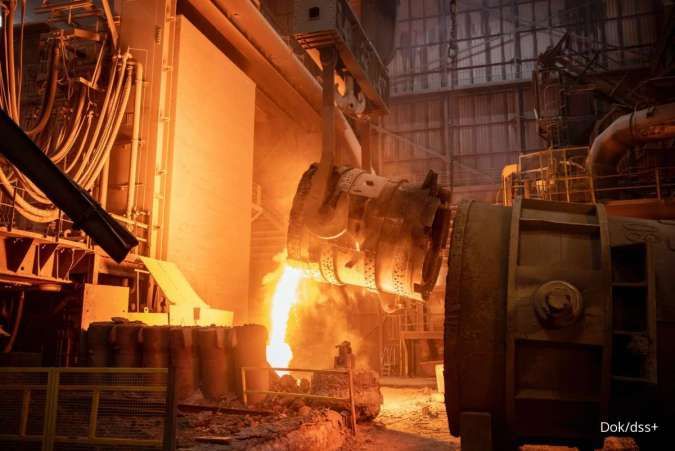
A number of Chinese companies, which have played a significant role in transforming Indonesia into the world’s largest nickel producer, are beginning to explore overseas investment opportunities. This move comes amidst increasing policy pressure in Indonesia, which is seen as testing the investment model that has historically driven the rapid growth of the national nickel industry.
These Chinese companies were previously the driving force behind the development of smelters and industrial estates that positioned Indonesia as a global growth hub for the nickel industry, particularly after the government banned nickel ore exports in 2020. According to U.S. Geological Survey data, Indonesia’s mined nickel production share is projected to surge to over 60% of global production by 2025, up from approximately 30% in 2020.
Low-cost production supported by Chinese investors has led to a global nickel market surplus, depressing prices and forcing several high-cost producers, such as Glencore, BHP, and Sumitomo, to close or partially suspend their operations. At the end of May, President Prabowo announced plans to control the export of coal, palm oil, and ferroalloys through a centralised state mechanism. Although nickel pig iron (NPI), the primary product of Chinese producers, was subsequently stated to be excluded from this scheme, the proposal has nonetheless triggered investor concerns regarding policy stability.
Previously, investors have also faced tightened nickel ore mining quotas, planned tax increases, and significant revisions to Indonesia’s mineral benchmark prices. These conditions prompted the Chinese Chamber of Commerce in Indonesia to send a letter to President Prabowo, warning that such policies could potentially hinder future investment. “This clearly has a negative impact on the industry. If the government increases bureaucracy and controls commodity selling prices, it will affect the scale of investment,” said Tim Hoff, a senior mining analyst at Canaccord.
Data shows that Foreign Direct Investment (FDI) into Indonesia fell by 6% in 2025, after growing by 19% the previous year. While mining sector investment peaked in 2024, new investment in the basic metal processing sector has tended to stagnate since then.
Tsingshan, the world’s largest stainless steel producer, has submitted a multi-billion dollar investment proposal to the government of Madagascar to build an industrial estate encompassing the development of various minerals, including nickel. Madagascar’s Minister of Mines, Karl Andriamparany, stated that the project concept was inspired by the Morowali and Weda Bay industrial estates in Indonesia. However, the proposal is still under evaluation and has not yet obtained mining permits. Tsingshan is known to have signed a memorandum of understanding with the Madagascar government in February.
According to two sources familiar with the discussions, Lygend is in talks to acquire a stake in the Kabanga nickel project in Tanzania from Lifezone Metals. In the Pacific region, Lygend has also submitted a bid to the state-owned mining company of New Caledonia, SMSP, to take a stake in the Koniambo nickel project, which is currently non-operational. If realised, investments in both Tanzania and New Caledonia would represent Lygend’s first nickel projects outside of Indonesia.
Nevertheless, analysts believe these new projects face much greater challenges compared to Indonesia. Changes in Indonesian policy have indeed tightened global nickel supply projections and pushed nickel prices to their highest levels in two years. This situation provides new hope for projects like Koniambo, which produced over 28,000 tonnes of nickel at its production peak in 2018.
However, new projects in Madagascar and Tanzania are considered to carry higher risks and lack the combination of advantages held by Indonesia, such as abundant ore reserves, relatively complete infrastructure, and large-scale industrial capacity. Madagascar has only recently lifted a 16-year moratorium on mining permits for most minerals. Meanwhile, the Kabanga project in Tanzania is one of the world’s largest undeveloped nickel sulphide deposits. However, according to estimates by Lifezone Metals, the project requires an initial investment of nearly US$1 billion and will take approximately six years to reach a target annual production of around 50,000 tonnes of nickel.
Despite these various challenges, Indonesia remains the hub of the global nickel industry. However, increasing policy uncertainty appears to be prompting Chinese investors to prepare long-term alternatives abroad.
Source: jawawa.id (https://jawawa.id/newsitem/chinese-investors-eye-africa-indonesias-nickel-dominance-threatened-by-new-policies-1780649426)
Originally published by internasional.kontan.co.id (https://internasional.kontan.co.id/news/investor-china-mulai-lirik-afrika-dominasi-nikel-indonesia-terancam-kebijakan-baru), translated from Indonesian