
Chinese Defence Minister Proposes New Security Concept
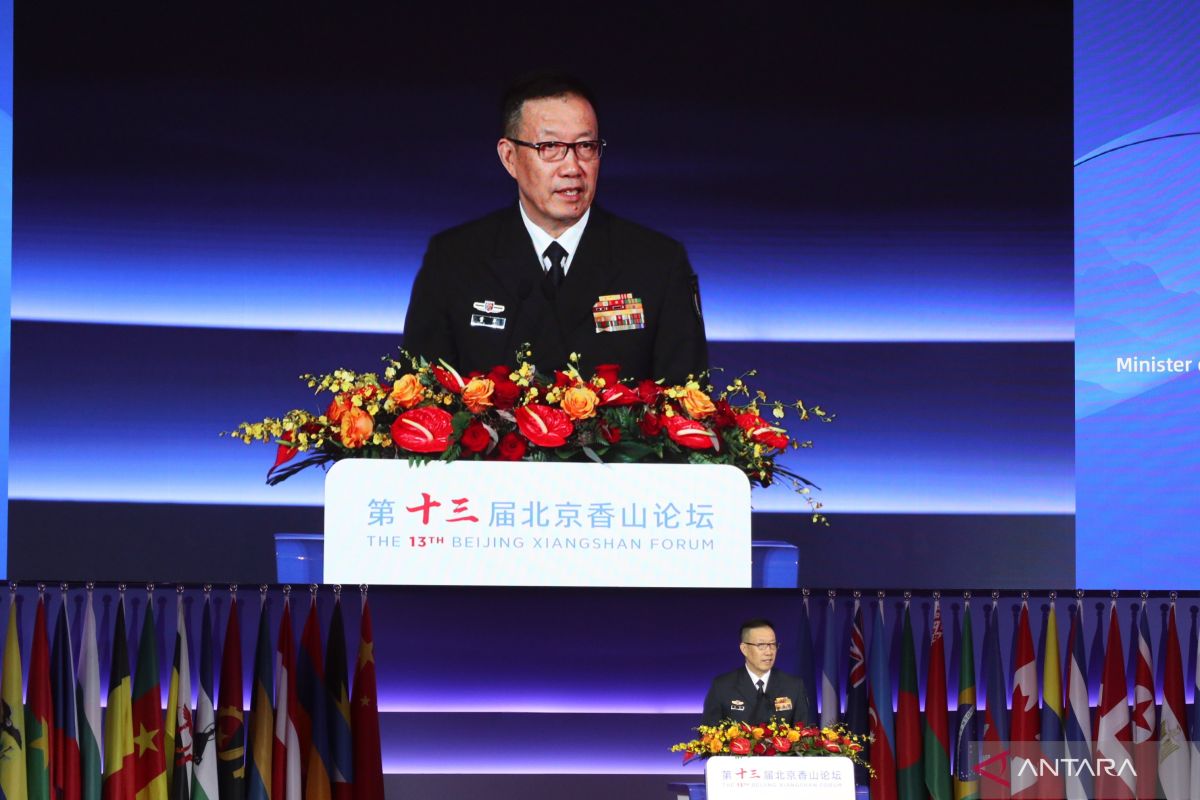
Beijing (ANTARA) - Chinese Defence Minister Dong Jun has proposed a new security concept to face increasing challenges as global governance reaches a critical juncture.
“Global governance has reached a critical point: to advance or to regress. International security is in a fragile state, which is why I wish to present a proposal to build a new security consensus,” stated Chinese Defence Minister Dong Jun during the opening of the “Beijing Xianglar Forum” in Beijing on Wednesday.
The Beijing Xiangshan Forum is taking place from 15-17 September 2026, under the theme “Building Consensus on Stability, Advancing Common Security Governance”. The event is attended by hundreds of military officers, diplomats, and academics from Asia, Europe, and the United States to discuss international security and order.
“Traditional security theories are increasingly difficult to use to explain the various conflicts and issues we face today. The outdated zero-sum mindset is unable to resolve the complex security issues of the present. A global security concept that is common, comprehensive, cooperative, and sustainable provides a new approach that is gaining increasing recognition and positive responses,” said Dong Jun.
According to Dong Jun, this concept advocates for respecting and guaranteeing the security of every nation, integrating both traditional and non-traditional security sectors, and enhancing security governance through coordinated efforts.
“Security must be achieved through political dialogue and peaceful negotiations, while conflicts should be resolved through development so that the root causes of insecurity can be eliminated. We need to build the broadest possible consensus and seek solutions through mutual respect,” Dong Jun added.
His second proposal involves maintaining stability through multilateralism, where major powers must act responsibly, small and medium-sized nations should contribute actively, and the United Nations must fulfil its proper role.
“We must adhere to true multilateralism, firmly upholding a UN-centred international system, an international order based on international law, and the fundamental norms of international relations based on the purposes and principles of the UN Charter,” stated Dong Jun.
The third proposal focuses on preventing risks through clarity in historical perspective.
“We must learn from history and remain vigilant against all forms of hidden or evolving hegemony and militarism. We must not allow them to flourish,” he added.
He also urged nations to prevent new risks from spreading into the security sector, to be wary of the loss of governance control, and to reject the practice of exporting domestic problems abroad to exacerbate tensions.
His fourth proposal is to resolve issues through dialogue and consultation, as violence cannot solve problems or eliminate the roots of conflict, and instead creates more difficulties.
“China has a saying: ‘Nothing is difficult in the world for those who are willing to climb.’ What is most needed to maintain dialogue and consultation is sincerity in resolving issues, a willingness to communicate on an equal and respectful footing, and a gradual effort to build mutual trust and expand common ground,” explained Dong Jun.
Dong Jun stated that the international community must respect the sovereignty and will of relevant parties, uphold justice, actively provide platforms for communication and dialogue, and encourage efficient coordination between various global and regional multilateral mechanisms.
Fifth, he proposed strengthening the foundation of security through shared development. “Behind these issues often lie deep-seated problems, such as developmental imbalances, inequality of rights, and a narrowing space for development,” said Dong Jun.
He noted that the fundamental solution for security governance is to bridge the development gap and reduce the disparity between the North and the South.
“China always advocates for shared development to promote common security. China’s modernisation provides greater development space, stability, and certainty for the entire world, and we welcome all parties to join the ‘high-speed train’ of development and continue to strengthen the foundation of universal security,” Dong Jun asserted.
His sixth proposal is to deepen cooperation through action-oriented approaches.
According to Dong Jun, the Chinese military is willing to work with all parties to achieve tangible results through pragmatic cooperation and to realise a mutually beneficial future.
“The Chinese military is approaching its centenary and is currently accelerating modernisation. We are willing to share experiences and ideas regarding military development and management with all parties, provide assistance according to our capabilities to the armed forces of nations in need, and expand pragmatic cooperation in areas such as friendship exchanges, personnel training, equipment, and technology,” he stated.
Indonesian Defence Minister Sjafrie Sjamsoeddin was also present at the opening of the Beijing Xiangshan Forum, though he did not deliver a speech.
Other high-ranking security officials and defence ministers in attendance included Vietnam’s Defence Minister Phan Van Giang, Singapore’s Defence Minister Chan Chun Sing, Thailand’s Defence Minister Adul Boonthumjaroen, Cambodia’s Defence Minister Tea Seiha, Belarus’s Defence Minister Victor Khrenin, Lieutenant General Sebastien Vallette of the French Ministry of the Armed Forces, Russia’s Deputy Defence Minister Anna Tsivileva, and other relevant officials.