
Chinese Businesspeople Write to Prabowo, Requesting Improvements in Business Climate and Law Enforcement in Indonesia
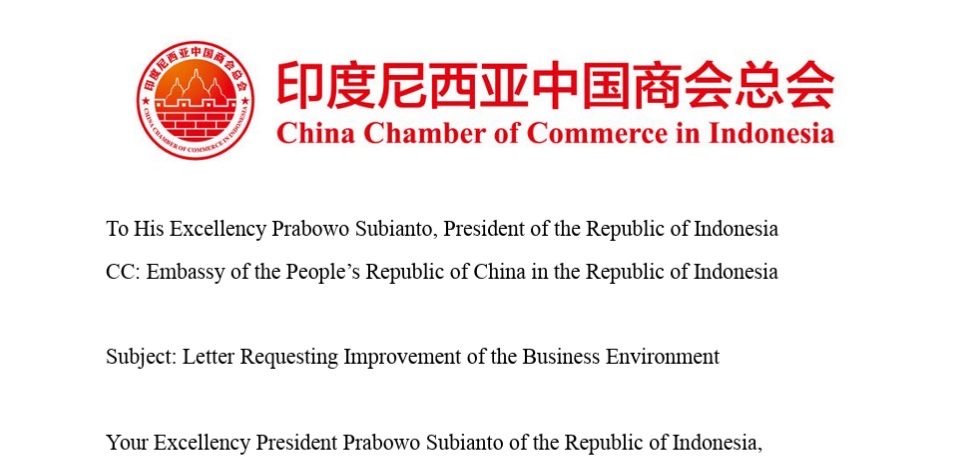
IKPI, Jakarta: Several Chinese companies investing in Indonesia have written to the President of the Republic of Indonesia, Prabowo Subianto, requesting improvements to the domestic business climate.
The letter was sent via the China Chamber of Commerce in Indonesia and copied to the Embassy of the People’s Republic of China in Indonesia.
In the letter, the investors claim to remain optimistic about Indonesia’s economic potential and assert that they have contributed to economic growth, job creation, and the development of downstream industries in the country.
However, they assess that business conditions have recently become increasingly difficult due to regulations deemed too stringent, excessive law enforcement, and practices of corruption and extortion by rogue officials.
“These issues severely disrupt normal business activities, directly undermine long-term investment confidence, and raise widespread concerns among Chinese investment companies regarding the current business climate and their future development prospects in Indonesia,” the letter states, as quoted on Thursday (14/5).
The businesspeople highlighted several government policies perceived as burdensome. One is the repeated increases in taxes and levies, including mineral resource royalties, accompanied by increasingly intensive tax audits.
They also complained about tax fines worth tens of millions of US dollars, which have triggered panic among business actors.
Additionally, Chinese investors spotlighted the planned foreign exchange retention policy for natural resource exporters, which requires placing a portion of export proceeds in Indonesian state-owned banks for a certain period. This policy is seen as potentially disrupting company liquidity and long-term operations.
Another complaint concerns the slashing of nickel mining quotas by more than 70% for several major mines. According to them, the reduction to a total of 30 million tonnes disrupts the downstream industrial chain, including the electric vehicle and stainless steel sectors.
The businesspeople also touched on the tightening of law enforcement in the forestry sector, including the imposition of fines up to US$180 million on companies deemed to lack valid forest area borrowing permits.
In the letter, they further complained about the halting of several major projects, including a hydroelectric power plant project accused of damaging forest areas and exacerbating flooding. The government is said to have directly intervened in project operations and imposed sanctions.
Issues with work visas for foreign workers also came under scrutiny. Investors view the foreign worker permitting process as increasingly complicated, expensive, and restrictive, thereby hindering the mobility of technical and managerial personnel.
Not only that, they also highlighted the government’s plans to impose new export duties, eliminate electric vehicle incentives, and reduce tax facilities in special economic zones.
Specifically in the nickel sector, Chinese investors criticised the increase in the Benchmark Mineral Price (HPM) for nickel ore and changes to its calculation formula by the Ministry of Energy and Mineral Resources. This policy is claimed to have caused production costs for nickel ore to surge by up to 200% and to enlarge operational losses for companies.
They warned that such conditions could disrupt investments, exports, and jobs for more than 400,000 workers in Indonesia’s nickel industrial chain.
Through the letter, the investors requested that the Indonesian government maintain policy stability, clarify law enforcement standards, and open more effective communication channels between the government and the business world.
They hope the government can promptly improve policies deemed burdensome to foreign investors. (ds)