
Chinese AI Takes Root in ASEAN, from Agriculture to Healthcare
Nanning (ANTARA) – For many farmers, planting a new crop is an exciting opportunity, but taking a risk on untested land can be daunting.
Landy AI, an agricultural large language model (LLM) developed by a Chinese company, is now helping more than one million farmers across China and the Association of Southeast Asian Nations (ASEAN) explore new possibilities on their land.
By marking the location of their farmland on a GPS map and entering the crop they want to grow, users can immediately receive a report assessing whether it is suitable for the site and the potential profit it could generate.
This is one of several functions offered by the model developed by JJR Science & Technology Group Co., Ltd., a smart-agriculture company based in the Guangxi Zhuang Autonomous Region in southern China.
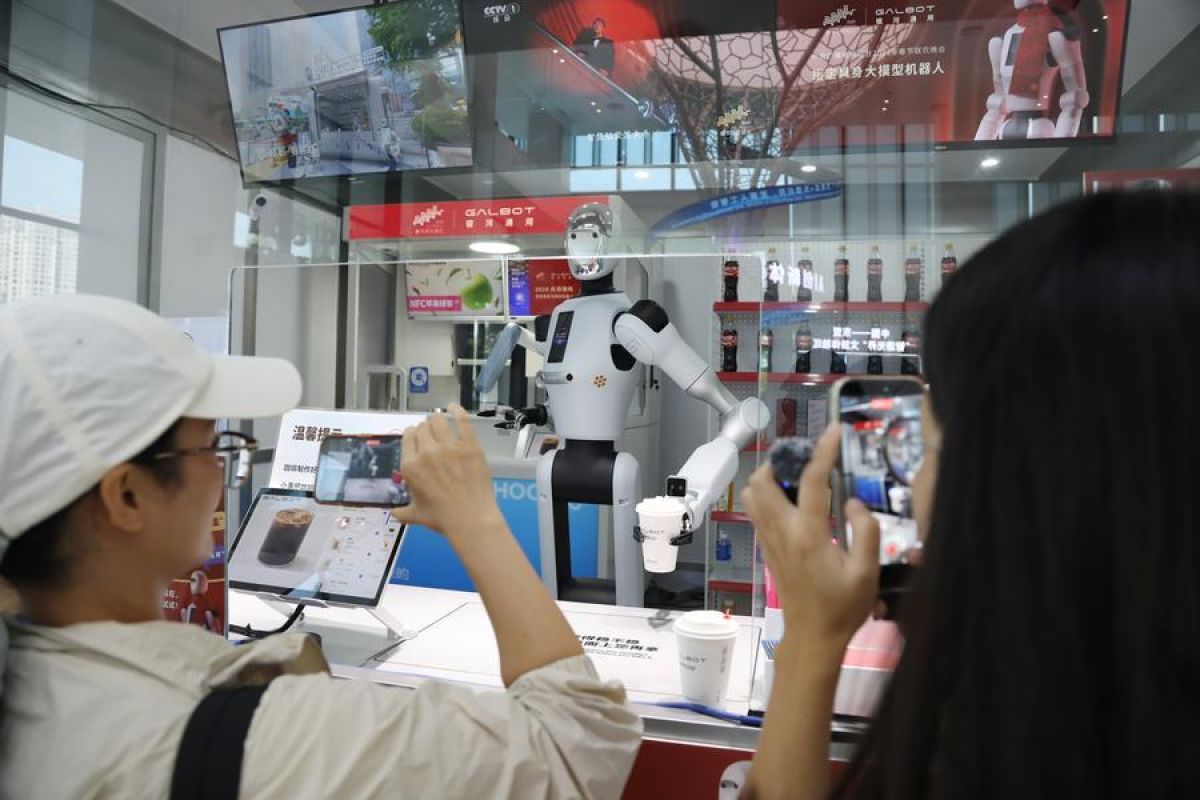
The model is among the products on display at the China-ASEAN Artificial Intelligence Application Cooperation Centre in Nanning, the regional capital. The centre was established last year, when bilateral trade between China and ASEAN exceeded US$1 trillion for the first time. Since then, it has catalogued more than 1,000 potential AI applications, opened 279 of them to developers, set up offices in Vietnam, Laos and Malaysia, supported more than 30 cross-border projects, and formed an alliance of 55 companies.
Guangxi, one of China’s main gateways to ASEAN, is drawing on its geographical advantages, technological capabilities and similarities with ASEAN markets to develop AI solutions tailored to local needs and meet the region’s growing demand for AI applications.
JJR is one company following the AI trend. Founded in 2008, it began developing Landy AI in 2024. Since then, it has gathered extensive data on temperatures, rainfall and sunlight in different areas, as well as information on crop characteristics, production processes and marketing strategies.
Together, these datasets enable Landy AI to support farmers’ decisions on pre-production investment, cultivation techniques and post-production sales.
Two years after its launch, Landy AI now supports six languages: Chinese, English, Lao, Thai, Khmer and Malay. JJR has also developed an AI-based orchard inspection system that collects real-time data on weather, pests and soil using various sensors, as well as a computer-vision system that monitors crop growth and identifies risks from pests and diseases.
In Kampong Chhnang province, Cambodia, JJR’s AI helps manage equipment such as sprinkler and drip-irrigation systems in vegetable greenhouses. In Pakse, Laos, meanwhile, more than 4,000 mu (about 267 hectares) of banana plantations are being managed more precisely with JJR’s new technology.
The popularity of AI-based agricultural applications in ASEAN markets is no coincidence. “Many Southeast Asian countries grow tropical crops such as bananas, dragon fruit and durians, which are closely aligned with Guangxi’s strengths in crop cultivation,” said Lin Zhongda, head of international business at JJR. Guangxi itself produced nearly one-seventh of China’s total fruit output in 2025.
Deployed across more than 2 million mu (about 133,333 hectares) of farmland in China and ASEAN countries, the company’s smart-agriculture solutions are expected to reduce labour costs by more than 20 per cent, said Chen Xiujuan, director of JJR’s management centre. She added that Landy AI users range in age from 20 to 60, in keeping with the product’s original purpose.
“Experienced farmers have shown strong interest in and demand for professional agricultural knowledge and AI assistants to help them develop new opportunities,” Chen said. “Young people committed to rural revitalisation can use our AI to make up for their lack of experience.”
From Guangxi, AI is also playing a growing role in healthcare, bringing benefits to ASEAN countries. At the School of Stomatology of Guangxi Medical University, a multilingual AI interpretation system developed by its affiliated hospital enables real-time translation between Chinese and more than 10 Southeast Asian languages, with a focus on dental terminology, said Kuang Hai, one of the hospital’s leaders.
Meanwhile, a system combining AI and virtual reality allows dentists from ASEAN countries to practise clinical procedures in an immersive virtual environment without travelling across borders.
Kuang, a specialist in cleft-lip and cleft-palate care who has led several surgical missions to Laos, said the hospital was also using AI to develop a speech-assessment and rehabilitation platform for patients with cleft lip and palate. The platform is now being used by several organisations in Laos.
Many patients continue to experience speech difficulties after surgery because of poor coordination of their lip muscles, but speech rehabilitation is often neglected, Kuang said. “The platform uses AI to analyse patients’ speech, identify problems, and provide tailored online guidance and exercises. It saves patients the time and cost of travelling to hospital for therapy, while also improving rehabilitation outcomes,” Kuang added.
So far, the platform has handled more than 2,000 patient visits, including patients from remote mountainous areas of Guangxi. In addition to Chinese, it also supports Lao.
Alongside these applications, Guangxi is working to provide the computing power needed to support real-world AI deployment.
In Nanning, RunDo, a platform operated by Runjian Co., Ltd., remotely monitors nearly 300 megawatts of solar capacity at almost 3,000 sites in Malaysia, using drones and AI in place of manual inspections. The company says the platform has raised maintenance efficiency by more than 30 per cent and cut labour costs by more than 20 per cent.
Runjian’s token factory in Nanning can generate up to 200 billion tokens per hour. “We package computing power into standardised token services that users can access as needed, much like electricity or water,” said Huang Haijiang, executive vice-president of Runjian’s token business division.
This allows users to avoid the cost and complexity of building their own computing infrastructure and fine-tuning AI models, while paying only for what they use, Huang added.
Guangxi’s efforts are part of a broader national drive to expand AI applications and explore overseas markets.
Guidelines issued by China’s State Council last week to accelerate the development of new quality productive forces highlighted the need to advance the “AI Plus” initiative and promote high-standard opening-up. This points to new opportunities for AI cooperation between China and ASEAN, which have remained each other’s largest trading partners for six consecutive years.
At last month’s 23rd China-ASEAN Expo, 296 AI companies took part, a 48 per cent increase on the previous edition.
Xie Zhujun, deputy director of the information centre at the Guangxi Academy of Social Sciences, said China-ASEAN digital cooperation focuses on long-term coordination and has significant potential to support the real economy, bringing sustained benefits to people across the region.
Source: jawawa.id (https://jawawa.id/newsitem/chinese-ai-takes-root-in-asean-from-agriculture-to-healthcare-1791993121)
Originally published by Antara (Indonesian) (https://www.antaranews.com/berita/5786985/ai-tiongkok-mulai-mengakar-di-asean-dari-budidaya-hingga-kesehatan), translated from Indonesian