
China's Yuan Becomes Iran's 'Backdoor' to Evade US Dollar Pressure
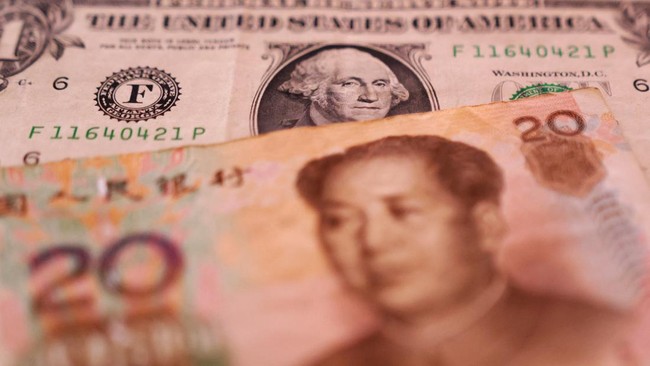
The dominance of the US dollar has long provided Washington with significant power to monitor global business transactions. As most international transactions using the dollar must pass through US-owned banks, the US can track money flows and exert pressure on specific nations, even cutting off their access to dollar-based transactions through the imposition of sanctions.
This power has been a primary weapon for the US for many years. When a country, company, or individual is placed on a sanctions list, their access to the dollar-based financial system can be disrupted, causing significant impact as the dollar remains the primary currency for global trade and financing.
However, this dominance is now facing challenges. Several countries opposed to the US are seeking shortcuts so that their transactions do not always pass through the Washington-led financial system. One such method gaining widespread use is the Chinese financial system and the yuan currency.
For countries like Iran, using the yuan provides a way to continue conducting business despite being under heavy US sanctions. By utilising the Chinese currency and payment networks outside the US banking system, Iran can reduce the risk of its transactions being monitored or blocked by US authorities.
China has been building alternative routes for cross-border transactions in recent years, notably through the Cross-Border Interbank Payment System (CIPS). Launched in 2015, CIPS is used to process yuan-based cross-border payments and is frequently cited as an alternative to the global payment systems used by international banks.
While its scale is not yet as large as Western financial systems, the presence of CIPS makes yuan-based international transactions easier. Additionally, China is promoting new payment platforms based on blockchain technology and central bank digital currencies, allowing inter-central bank transactions to occur without passing through US financial institutions.
These steps make it easier for other nations to trade and invest using the yuan without constant dependence on the US dollar. “For many years, many countries have wanted an alternative to the dollar system,” said Alisha Chhangani from the Atlantic Council, as cited by the Wall Street Journal. She noted that China’s long-term preparations mean alternative payment technologies can now be used on a larger scale, making paths outside the US dollar a tangible choice rather than mere discourse.
For China, this presents an opportunity. For years, many nations have desired alternatives to the dollar, but such alternatives struggled to develop due to the dollar’s dominance, the depth of the US financial market, and the global reliance on Western payment networks. Beijing is now filling this gap by building payment infrastructure, expanding yuan usage, and offering transaction routes that are not entirely under US influence.
Iran serves as one of the clearest examples of this shift. In recent years, the use of the yuan has helped Tehran maintain significant revenue, particularly from oil sales to China. Despite strict US sanctions, Iranian oil exports to China continue, with much of the payment conducted in yuan.
However, the process is not as simple as China paying Iran directly in yuan. In many cases, payments from Chinese oil buyers are not sent directly to Tehran. Funds may be held by certain parties and then used to pay Chinese contractors working on projects in Iran, such as the construction of airports, oil refineries, or other infrastructure. Under this scheme, Iran can still reap economic benefits from oil sales, even if the money does not always arrive as a direct transfer to the Iranian government’s accounts.
In other schemes, payments from Chinese oil refineries may flow to intermediaries and then be used to pay Chinese exporters, allowing goods such as vehicle spare parts or industrial products to be sent to Iran. In this way, Iranian oil revenue is converted into the goods, services, and development projects the country requires.
China’s financial system plays a vital role here, with much of the fund flow from Iranian oil trade reportedly passing through yuan-based payment routes, including CIPS. The volume of transactions through CIPS has continued to rise; in 2024, the value of yuan-based cross-border payments processed via CIPS reached RMB175 trillion, a 43% increase from the previous year. This growth continued into 2025, with CIPS annual business volume reaching RMB180 trillion. The network is also expanding, with 194 direct participants and 1,597 indirect participants as of 25 June 2026.
This increase in CIPS transactions is also visible in Indonesia. Bank Indonesia (BI) revealed that direct rupiah-renminbi transactions through CIPS since 1 June 2026 have reached 3 billion yuan, equivalent to US$443 million. This growth is quite rapid. BI Deputy Governor Thomas Djiwandono stated that the value of transactions through CIPS surged by more than 200% in just one week, noting during an online press conference on Thursday (18/6/2026) that the total transactions since 1 June reached 3 billion yuan, representing a very positive increase.
Source: jawawa.id (https://jawawa.id/newsitem/chinas-yuan-becomes-irans-backdoor-to-evade-us-dollar-pressure-1782726768)
Originally published by CNBC Indonesia (https://www.cnbcindonesia.com/research/20260629130911-128-746511/yuan-china-jadi-jalan-tikus-iran-hindari-tekanan-dolar-as), translated from Indonesian