
China’s Trade Surplus Tops Rp18,000 Trillion as Orders Flood In
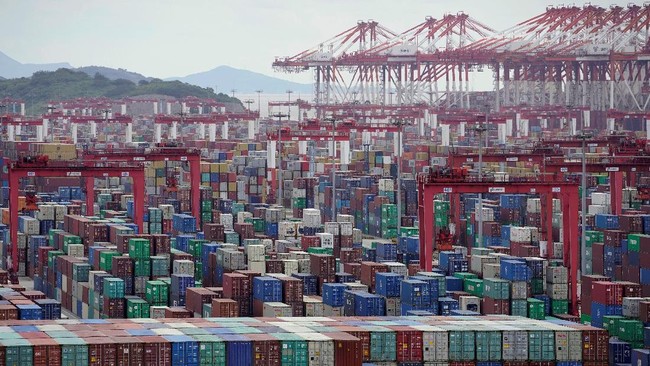
Jakarta, CNBC Indonesia – China’s trade surplus topped US$1 trillion, or around Rp18,000 trillion, in the first 10 months of this year, fuelled by surging demand for technology products used to build artificial intelligence (AI) infrastructure in countries around the world. With domestic consumption sluggish and the property sector in a prolonged crisis, Beijing is increasingly relying on export markets to sustain economic growth.
The milestone also highlights the world’s second-largest economy’s growing dependence on overseas demand, which could trigger fresh tensions with its trading partners.
According to Reuters on Tuesday (10 November 2026), Chinese customs data showed that exports rose 35.2% year on year in October in US dollar terms.
Growth eased only slightly from September’s 36.3% increase, and remained above the 33.5% growth forecast by economists in a Reuters poll.
Strong exports lifted China’s trade surplus to US$1.04 trillion over January–October 2026. This is the second consecutive year in which the country’s trade surplus has exceeded US$1 trillion, and this time the threshold was reached a month earlier than in 2025.
The surge in the surplus reflects rising global demand for China’s high-tech products. Massive investment in data centres and AI infrastructure has created an expanding market for the country’s technology industry.
Demand for Chinese technology products is expected to remain strong through 2027 as global investment in AI continues to expand. However, this could also worsen domestic economic imbalances and intensify trade friction with export destinations.
The European Union is one trading partner that may tighten its trade policies towards China.
European leaders have previously called for additional trade restrictions on Chinese products, after the two sides reached an agreement to limit Chinese hybrid vehicle exports to the bloc in the coming years.
As those restrictions have yet to take effect, Chinese manufacturers are expected to accelerate shipments to the European market before the rules come into force. This could provide an additional short-term boost to exports.
Meanwhile, China’s trade relationship with the United States remains uncertain.
On Monday (9 November 2026), Beijing formally announced a two-month extension of its trade truce with Washington. The previous agreement was due to expire on 10 November.
Last week, however, China said that any increase in purchases of US agricultural products would depend on the implementation of the reciprocal tariff-reduction agreement approved by the two countries.
Joe Peissel, chief macroeconomist at Trivium China, warned that Chinese manufacturers’ expansion into international markets could lead to more trade barriers.
“The risk of additional tariffs and other trade barriers will remain high in 2027, particularly as Chinese manufacturers continue to expand their presence in overseas markets,” Peissel said.
Imports surge, while surplus with US remains large
China’s imports also grew faster than the market had expected.
Imports jumped 41.6% year on year in October, far exceeding the median forecast of 32% in a Reuters poll of economists.
The figure also marked an acceleration from September, when imports grew by 31%.
China’s trade surplus with the US narrowed slightly to US$32.71 billion in October, from US$34.01 billion the previous month.
Despite the decline, the trade gap between the two countries remains substantial and continues to be a source of dispute between Washington and Beijing.
China’s oil imports fell 13.3% compared with October last year.
However, oil shipments reached their highest volume since March, as buyers sought to secure supplies after the US-Israeli war against Iran disrupted oil flows from the Middle East.
These trade developments come ahead of the Asia-Pacific Economic Cooperation (APEC) summit, scheduled to take place next week in Shenzhen, China.
Chinese President Xi Jinping and US President Donald Trump are expected to meet again at the forum. If it goes ahead, it will be their third meeting this year.
Tariff policy and other trade issues are expected to feature prominently on the agenda.
At an earlier meeting between Xi and Trump in Washington in September, the two countries proposed a US$60 billion package of reciprocal tariff reductions, including around US$17 billion related to US agricultural products.
Domestic economy remains under pressure
Despite its strong export performance, China still faces significant challenges in stimulating consumer spending.
The property downturn, which has lasted for several years, has eroded household wealth and weakened consumer confidence in the economic outlook. As a result, people are holding back on spending, and domestic demand has yet to provide a sufficiently strong engine for growth.
The effects are also being felt by China’s car industry. As domestic vehicle sales continue to weaken, manufacturers are becoming increasingly aggressive in seeking buyers in international markets.
Separate data from an industry association showed that Chinese car exports maintained solid growth in October. By contrast, domestic vehicle sales fell for the 12th consecutive month.
The divergence highlights the growing importance of overseas markets to China’s manufacturing sector.
However, a strategy that relies too heavily on exports also carries risks. If global demand slows or destination countries tighten trade barriers, Chinese industry could come under greater pressure.
For now, growth in global AI investment remains one factor supporting exports.
Macquarie analysts said the durability of this trend would determine the direction of China’s trade in the coming quarters.
“Export prospects depend on how long the AI boom lasts,” the analysts wrote.
They forecast that China’s export growth would pick up again in the fourth quarter of 2026 before slowing in the first quarter of 2027.
Source: jawawa.id (https://jawawa.id/newsitem/chinas-trade-surplus-tops-rp18-000-trillion-as-orders-flood-in-1794286238)
Originally published by CNBC Indonesia (https://www.cnbcindonesia.com/news/20261110110514-4-783820/china-kebanjiran-pesanan-surplus-dagang-tembus-rp18000-triliun), translated from Indonesian