
China's Smart Agricultural Machinery Finds Growing Opportunities in ASEAN
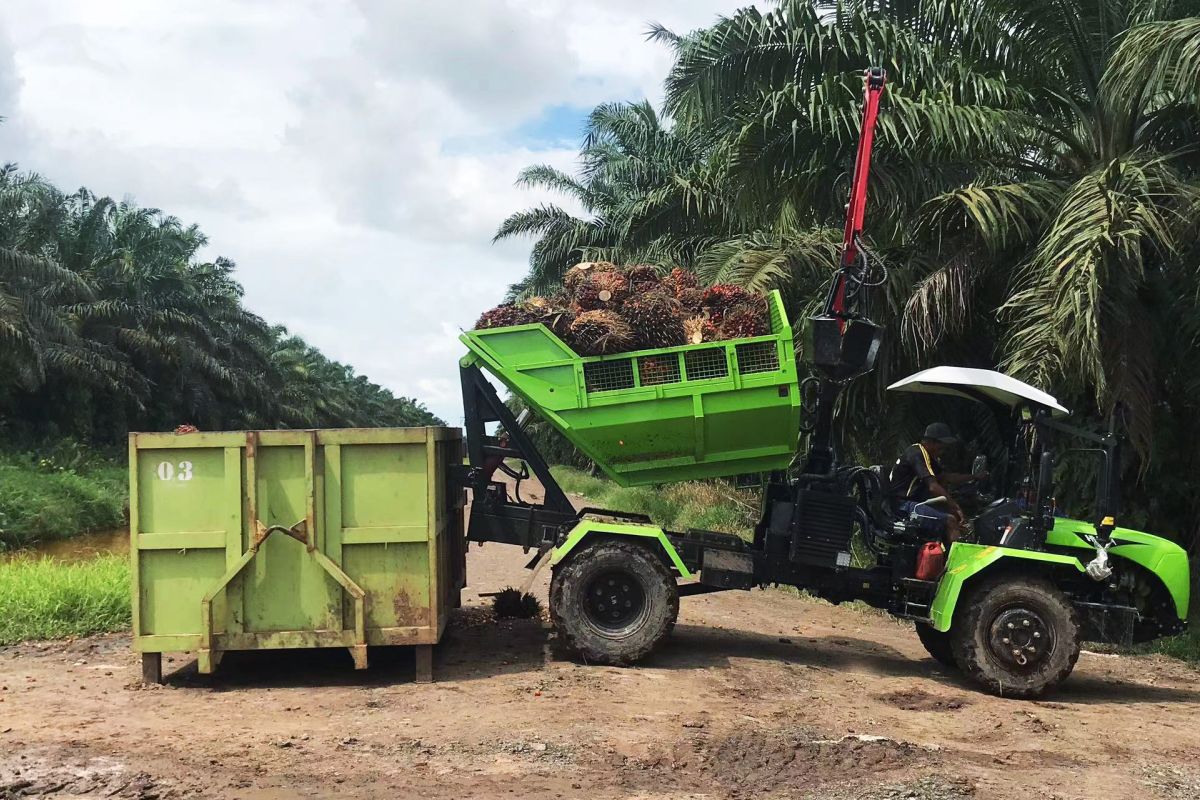
Nanning - As the palm oil fruit harvest season arrives, Chinese palm oil fruit transport vehicles are now operating in various plantations across Indonesia. These vehicles can easily navigate complex terrain, helping to reduce costs and increase efficiency in the local palm oil industry.
“Palm oil plantations in Indonesia are vast, often spanning tens of thousands of hectares, with roads mostly consisting of simple gravel paths. Traditional equipment tends to experience high wear and tear,” said Huang Qinghua, assistant chairman of the company.
He stated that previously, transportation equipment in many ASEAN plantations relied on brands from the United States and Japan, which were not suited to local conditions and typically broke down after about one and a half years of use.
In contrast, the transport vehicles developed by China demonstrate strong adaptability and high cost-effectiveness, making them increasingly popular in the ASEAN market. “Our equipment can easily handle complex terrain in countries like Indonesia and Malaysia. According to several plantation clients, operational costs can be reduced by an average of 37 percent, while our products are also more competitive in terms of price,” he said.
Currently, the product has generated output value exceeding 50 million yuan (1 yuan = Rp2,471) in the Indonesian and Malaysian markets alone, with sales continuing to rise. In Laibin City, Li Jinwei, head of an agricultural cooperative, uses a mobile application called “Didi Farm Machinery” developed by the local agricultural department to quickly recruit four machine operators.
“In the past, managing mechanised farming for 3,000 mu of sugarcane land required manual searching for operators and coordinating equipment, which was time-consuming and labour-intensive,” said Li. Now, through the platform, machines and farmers can be precisely matched. One planting machine can complete work on 15 to 20 mu per day, equivalent to the workload of 15 to 20 workers.
China’s agricultural mechanisation has experienced rapid development in recent years. By 2025, the comprehensive mechanisation rate for land preparation, planting, and harvesting reached 76.7 percent. The number of agricultural drones exceeded 300,000 units, with annual operational coverage surpassing 460 million mu (1 mu = 0.0667 hectares).
In Guangxi, one of China’s major sugar-producing regions, the high proportion of hilly terrain previously made mechanisation difficult. However, smart agricultural machinery and digital technology have now significantly improved farming efficiency.
The vehicles produced by Guangxi Hepu County Huilaibao Machinery Manufacturing Co., Ltd. were independently designed and developed. The vehicles are tailored to the operational conditions of palm oil plantations in ASEAN countries such as Indonesia and Malaysia, and can adapt well to hilly terrain and harsh working environments.
In Laibin City, Li Jinwei, head of an agricultural cooperative, uses the mobile application “Didi Farm Machinery” developed by the local agricultural department to quickly recruit four machine operators. “In the past, managing mechanised farming for 3,000 mu of sugarcane land required manual searching for operators and coordinating equipment, which was time-consuming and labour-intensive,” said Li. Now, through the platform, machines and farmers can be precisely matched. One planting machine can complete work on 15 to 20 mu per day, equivalent to the workload of 15 to 20 workers. Data shows that in 2025, China’s exports of agricultural machinery and components reached $18.96 billion (1 USD = Rp17,002), up 25 percent year-on-year. Additionally, Southeast Asian countries have become a key market for Chinese agricultural machinery exports, with smart equipment such as Beidou-navigated tractors and crop protection drones entering farmlands in ASEAN nations.
At a sugarcane base in Laibin, sensors installed underground monitor soil pH, moisture, and nutrients in real time. The digital land management system provides real-time recommendations, effectively addressing challenges such as pest control and production decision-making.
“Through digital soil surveys, fertiliser can be applied according to actual needs,” said Wang Zeping, a researcher from the Guangxi Academy of Agricultural Sciences. Thanks to precision management technology, fertiliser use in some fields has decreased by 15 percent, while yields have increased by 200 kilograms per mu, achieving cost savings and sustainable, environmentally friendly development.
Data shows that in 2025, China’s exports of agricultural machinery and components reached $18.96 billion (1 USD = Rp17,002), up 25 percent year-on-year. Additionally, Southeast Asian countries have become a key market for Chinese agricultural machinery exports, with smart equipment such as Beidou-navigated tractors and crop protection drones entering farmlands in ASEAN nations.
“Thailand produces large quantities of tropical fruits such as durian, mangosteen, and longan, but the harvesting, sorting, and quality analysis processes are still largely manual. We greatly need advanced machinery to improve efficiency and quality,” said Dares Kittiyopas, president of the Thai Society of Agricultural Engineering, at a China-ASEAN agricultural mechanisation cooperation conference held at the end of 2025.
Dares added that Thailand’s agricultural workforce is continuously declining, thus accelerating the transformation towards mechanisation and smart agriculture. The country has high demand for crop protection equipment, tractors and their parts, as well as harvesting machines.