
China's New Generation of Workers Shipped Worldwide, America on Edge
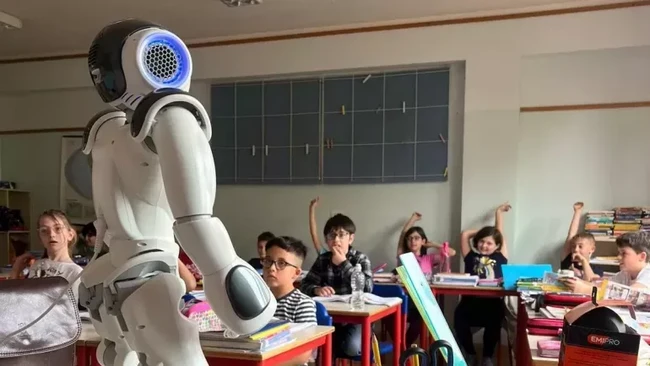
The market projection for humanoid robots in China is predicted to rise by Morgan Stanley. The global investment bank assesses that the industry transition from the demonstration stage to commercialisation is occurring much faster than anticipated.
In its latest report, Morgan Stanley estimates that humanoid robot shipments in China will reach 50,000 units throughout this year. This figure is almost double the previous projection of 28,000 units. Previously, in January, the bank had also doubled its initial estimate of 14,000 units.
Morgan Stanley expects the Chinese humanoid robot market value to reach US$2 billion this year and soar to US$15 billion by 2030. Meanwhile, annual shipments are projected to exceed 446,000 units by the end of the decade. These estimates only account for market sales and do not include robots for prototypes, testing, pre-orders, or internal use.
“Commercial verification, policy support, and supply chain feedback indicate that the adoption of humanoid robots in China is progressing more rapidly,” said Morgan Stanley equity analyst Sheng Zhong, as quoted by CNBC International.
Furthermore, a number of local manufacturers are now racing to increase production capacity and have begun operating robots across various sectors, ranging from factories and supermarkets to restaurants. The Chinese government has also made the development of ‘embodied AI’—artificial intelligence embedded in physical systems such as robots—one of its priorities for the next five years.
Beijing is directing local governments to provide subsidies in the form of land and office space for startups, while also requesting that banks provide financing with more lenient terms.
Regarding investment opportunities, data from research firm Omdia shows that approximately 13,000 humanoid robots were shipped worldwide last year. Chinese companies dominate the top five in global shipments, while the US-based company Figure AI ranks seventh and Tesla ranks ninth. Tesla CEO Elon Musk previously stated that the company’s Optimus humanoid robot would only begin public sales by the end of 2027.
Joe Ngai, Senior Partner and Chairman of McKinsey Greater China, believes humanoid robots have the potential to become the next major investment opportunity due to China’s rapid technological advancements. “When you walk outside [in China], you see many startups and more advanced companies, with robots dancing. However, the use of robots in the industrial sector often goes unnoticed,” Ngai told CNBC International during the World Economic Forum (WEF) Annual Meeting in Dalian. “If you visit any factory in China today, the level of automation and robotics implemented there is higher than anywhere else in the world.”
Morgan Stanley’s supply chain research also indicates that the commercialisation of humanoid robots is accelerating, particularly in the manufacturing and logistics sectors. The use of robots is also expanding into cashierless retail stores and various interactive commercial services.
Morgan Stanley identified the Suzhou-based robotic component company, Leaderdrive, as one of the primary beneficiaries of this rapid development. The bank raised its 12-month target price for Leaderdrive shares to 464 yuan from a previous 269 yuan. Leaderdrive supplies precision robotic components to Chinese humanoid robot manufacturers such as Ubtech and Galbot.
Simultaneously, Chinese robot companies are aggressively expanding into international markets. Shanghai-based Seer Intelligent, which recently began trading on the Hong Kong Stock Exchange, has been expanding its business overseas since 2021. According to Seer Intelligent’s Chief Operating Officer, Jonathan Fan, revenue from over 65 countries accounted for approximately 18% of the company’s total sales last year.
However, Fan acknowledged that geopolitical uncertainty and trade tensions remain the greatest challenges to the company’s global expansion. “We are focusing on geographical diversification to reduce dependence on a single market and ensure compliance with local regulations in every country where we operate,” he stated.
Meanwhile, policymakers in Washington are increasingly concerned about China’s rapid progress in the field of Artificial Intelligence (AI) and the world’s growing dependence on technology from the mainland. In an opinion piece published in Foreign Policy this week, Suzanne Nossel, Lester Crown Senior Fellow for US Foreign Policy and International Order at the Chicago Council on Global Affairs, warned that the United States risks falling behind if it focuses solely on the race to create new AI capabilities.
“If Washington treats this competition merely as a race to achieve new capability benchmarks, the US could lead in discovery but lag behind in influencing where and how AI is used globally,” Nossel wrote. “The sales campaign for the US AI ecosystem will not be able to drive adoption quickly enough to keep pace with China’s momentum,” she added.