
China's Exports Post Spectacular Record, These Products Are Selling Fast
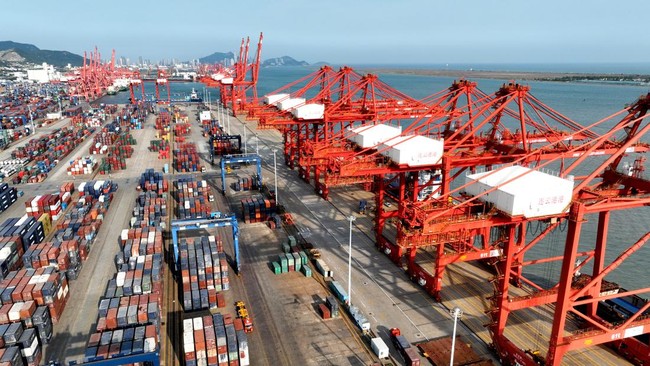
Jakarta, CNBC Indonesia - China’s export growth soared last month thanks to strong foreign appetite for high-tech and artificial intelligence (AI) products. The surge provides vital support for the Bamboo Curtain’s economy, which is currently weighed down by sluggish domestic demand.
Citing Reuters on Tuesday (8/9/2026), customs data showed exports jumped 25% year-on-year in August, marking a peak. The figure was in line with market expectations and accelerated sharply from the 23.9% growth recorded in the previous month.
On the other hand, imports also took flight, rising 28.2% compared with a 27.5% increase in July, although slightly below the initial projection of a 30% rise.
The striking gap between resilient exports and weak domestic activity highlights Beijing’s acute dependence on foreign demand, particularly as policymakers struggle to revive consumption and investment to achieve this year’s growth target of 4.5% to 5%.
ANZ’s Senior China Strategist, Zhaopeng Xing, noted that massive demand for AI products, electric vehicles (EVs), solar cells and lithium-ion batteries had offset the adverse impact of extreme weather. He also observed that Chinese companies were still rushing to accelerate shipments to the United States amid the shadow of tariff uncertainty.
Restriction Threats and a Truce
Relying on overseas shipments to absorb industrial capacity effectively exposes China to the risk of restrictions from its trading partners. The US and the European Union have jointly pressed Beijing to cut its colossal trade surplus.
China’s trade surplus swelled to US$119.09 billion (approximately Rp2,107.8 trillion) in August, expanding from US$112.5 billion (Rp1,991.2 trillion) in the previous month. Over the first eight months, the surplus has reached US$805.51 billion (Rp14,257.5 trillion), putting this year’s figure on track to surpass US$1 trillion (Rp17,700 trillion) for the second consecutive year. Specifically, the trade surplus with the US also crept up to US$29.18 billion (Rp516.4 trillion) from US$28 billion (Rp495.6 trillion) in July.
Despite frequent friction, the trade truce between Beijing and Washington agreed late last year remains intact. The two governments are even currently exploring reciprocal tariff cuts on US$30 billion (Rp531 trillion) worth of goods from each side ahead of a follow-up summit at the end of this month.
Zhiwei Zhang, President and Chief Economist at Pinpoint Asset Management, agreed that reliance on external markets remains the main engine driving the economy.
“China continues to rely on exporters to support the economy,” he explained.
Domestic Problems and a Multi-Trillion Injection
In contrast to the export sector, which is celebrating an AI boom, industries dependent on the domestic market are grappling with producer price inflation and weak demand. After growth cooled to 4.3% in the second quarter, economic data released last month showed that industrial output and retail sales both slowed. Meanwhile, the property market, once the backbone of the economy, remains trapped in a prolonged slump.
Premier Li Qiang in August called for efforts to stabilise external demand and expand international trade cooperation, while openly acknowledging the hardship faced by various industries and companies due to minimal domestic demand.
In response, the government has bolstered fiscal support for the economy, including deploying a giant financing instrument worth 800 billion yuan (approximately Rp2,110 trillion) to underpin infrastructure investment. Hao Zhou, an analyst at Guotai Haitong Securities in Hong Kong, assessed that the strong export performance temporarily frees Beijing from pressure to urgently announce large-scale measures to rescue the property market and employment.
“The latest trade data does not materially strengthen the case for an interest rate cut in the near term. Although further policy support cannot be ruled out, the combination of resilient external demand, steady industrial momentum and increasingly targeted fiscal measures suggests that the timing and necessity of additional monetary easing will require further observation,” he concluded.