
China’s Energy Ambitions in the Himalayas Raise Disaster Risks Across Asia
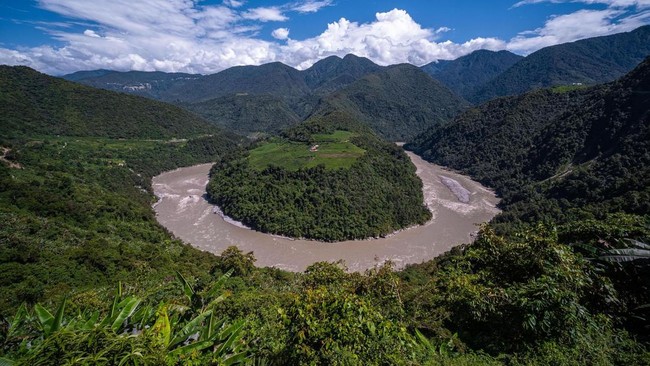
Jakarta, CNBC Indonesia – China’s construction of a giant dam in the Himalayan region has raised concerns about environmental and infrastructure security in neighbouring countries, particularly India and Bangladesh. The project could also affect Japan’s investment interests in South Asia.
The Medog Dam, being built on the Yarlung Tsangpo River in Tibet, is designed to generate around 60 gigawatts (GW), making it one of the world’s largest hydropower projects.
The river flows from Tibet into India, where it is known as the Siang, and then joins the Brahmaputra river system before entering Bangladesh. Disruptions to the river’s flow upstream could therefore affect downstream areas.
An analysis by Stephen R. Nagy and Jagannath Panda in The Japan Times says the Medog project poses not only environmental risks but also geopolitical and economic concerns for countries in the region.
A giant dam in a disaster-prone region
One of the main concerns about the Medog project is its location in the Himalayas, an area prone to earthquakes and landslides, and where glaciers are undergoing change.
For example, an earthquake in Nyingchi, Tibet, in 2017 reportedly triggered more than 1,800 landslides and formed several temporary lakes after landslide debris blocked rivers.
This illustrates how an earthquake or landslide near the project could obstruct river flows and create natural dams. If the trapped water were suddenly released, flooding could occur downstream. Climate change adds to the complexity of these risks by accelerating glacial melt and altering rainfall patterns.
There is, however, no evidence that the Medog Dam will suffer a structural failure. The concern is instead the scale of the potential consequences if an extreme disaster occurs, making environmental monitoring and independent safety assessments important.
India and Bangladesh face potential impacts
In India, the main risks are to the states of Arunachal Pradesh and Assam, which are traversed by the Brahmaputra. The river is vital to agriculture, transport, ecosystems and the livelihoods of millions of people.
Sudden changes in water flow could threaten settlements, bridges, irrigation networks and power-generation infrastructure. Changes in sediment distribution could also affect the fertility of farmland and aquatic ecosystems.
Bangladesh, farther downstream, also faces potential risks from flooding, riverbank erosion and changes in freshwater availability.
The scale of any impact would depend on dam operations, seasonal conditions and the dynamics of the river’s flow. These risks are therefore not inevitable once the Medog project begins operating.
Japanese infrastructure investment also at stake
Japan also has an interest in stability in the Himalayan region, particularly through its infrastructure investment in north-eastern India.
Through the Japan International Cooperation Agency (JICA), Japan has supported the construction of roads, bridges and transport networks to improve connectivity between areas. The investment is intended to strengthen trade and expand economic access in north-eastern India, where geography has long posed challenges.
Arunachal Pradesh, an Indian state bordering China, is one area of particular interest.
Although political sensitivities limit Japan’s direct involvement in the state, infrastructure development in neighbouring states, including Assam, is also strengthening the region’s economic connectivity.
Some transport routes and economic activity in the area depend on the stability of the Brahmaputra river system, which originates in Tibet. Extreme flooding or significant changes in the river’s flow could damage infrastructure, raise maintenance costs and disrupt goods distribution and trade.
The Medog project is therefore also a concern for Japan. Although the dam is being built in China, its potential downstream effects could increase investment risks and disrupt the economic connectivity Japan is developing with India.
Japan and India need disaster mitigation measures
In response to these potential risks, Japan and India are seen as needing to strengthen cooperation on disaster mitigation, particularly to protect infrastructure and communities along the Brahmaputra.
Japan’s experience in earthquake-resistant infrastructure, river management and early-warning technology could help improve the region’s resilience to natural disasters.
In their analysis, Nagy and Panda propose cooperation involving satellite monitoring, surveillance of glacial lakes, assessments of seismic activity and river-flow modelling. Such efforts could help detect potential hazards and improve preparedness for extreme disasters.
Cooperation could also be extended to Bangladesh, which lies downstream along the Brahmaputra. Japan has development interests there too, including transport infrastructure projects and development of the Matarbari industrial zone.
By strengthening disaster-monitoring technology and building more resilient infrastructure, cooperation among the three countries could reduce potential economic losses while protecting downstream communities.
China’s transparency is key to regional security
The Medog project demonstrates that renewable energy projects are not automatically free of environmental and social risks. Although the dam will generate electricity without burning fossil fuels, a project on this scale could still affect river ecosystems, water flows and the livelihoods of downstream communities.
In terms of governance, transparency is a major concern. As an upstream country, China is seen as needing to provide information about river conditions and dam operations so that India and Bangladesh can prepare for potential disaster risks.
The importance of information-sharing is also reflected in a 2024 UN-Water report. Globally, 79 countries reported a lack of data and information as a challenge to cooperation on transboundary water management; 78 reported limited resources, while 65 cited difficulties in exchanging information.
Although these figures describe the global situation, they are relevant to the Medog issue, which involves a river flowing across national borders. For India and Bangladesh, access to hydrological data is important for anticipating changes in water levels, managing flood risks and protecting economic activity along the Brahmaputra.
Ultimately, the sustainability of an energy project cannot be judged solely by the amount of electricity it produces or its contribution to reducing emissions. Managing environmental risks, protecting affected communities and ensuring transparent governance are also essential to preserving its long-term economic benefits.
Source: jawawa.id (https://jawawa.id/newsitem/chinas-energy-ambitions-in-the-himalayas-raise-disaster-risks-across-asia-1792759889)
Originally published by CNBC Indonesia (https://www.cnbcindonesia.com/research/20261023135414-128-778916/ambisi-energi-china-di-himalaya-risiko-bencana-mengintai-asia), translated from Indonesian