
China's DF-26D 'Guam Killer' Revealed: What Makes It So Hard to Intercept?
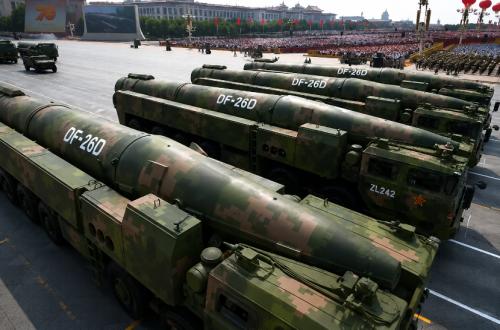
The warhead structure of the DF-26D intermediate-range ballistic missile has been shown to the public for the first time since the variant appeared during a Chinese military parade in October 2025. The latest reveal has prompted speculation that Beijing is continuing to enhance its missile penetration capabilities against modern air defence systems.
Defence media outlet Janes reported on Tuesday, 23 June 2026, that footage broadcast by China Central Television (CCTV) showed the latest version of the DF-26 featuring control fins near the warhead. The fins are suspected to improve the missile’s manoeuvrability during the terminal phase, just before it strikes its target.
This manoeuvring capability allows the missile’s trajectory to change both horizontally and vertically, potentially increasing its ability to penetrate missile defence systems and to attack moving targets.
Chinese authorities have yet to reveal the official specifications of the DF-26D. However, several observers believe the new design indicates the use of a next-generation manoeuvrable reentry vehicle (MaRV), and does not rule out the possibility of adopting a hypersonic glide vehicle concept that can continuously manoeuvre as it speeds towards its target.
If this is the case, the DF-26D is expected to be far more difficult to intercept than conventional ballistic missiles, which follow more predictable trajectories.
The basic DF-26 variant has been operated by the People’s Liberation Army Rocket Force (PLARF) since 2016. According to data from the Center for Strategic and International Studies (CSIS) Missile Threat Project, the two-stage solid-fuel missile has a range of approximately 4,000 kilometres, can carry conventional or nuclear warheads weighing between 1,200 and 1,800 kilograms, and is launched from a road-mobile transporter erector launcher.
With this range, the DF-26 is believed to be China’s first conventional ballistic missile capable of reaching Guam, the location of various strategic US military bases in the Western Pacific. This capability has led defence analysts to frequently dub the missile the ‘Guam Killer’.
In addition to being able to attack land targets, China is also developing an anti-ship variant of the DF-26. CSIS notes that this variant is expected to use an active terminal seeker, enabling it to strike moving warships at sea. Testing of the anti-ship variant was reported to have taken place in 2020 in the South China Sea.
The development of the DF-26 over the years has also continued to draw the attention of the Pentagon. In its annual report on Military and Security Developments Involving the People’s Republic of China, the US Department of Defense has repeatedly assessed the DF-26 family of missiles as a key component of Beijing’s anti-access/area denial (A2/AD) strategy to restrict the movement of US military forces in the Indo-Pacific region.