
China's Chint Group Eyes Indonesia's Renewable Energy Projects, Ready to Invest US$7 Billion
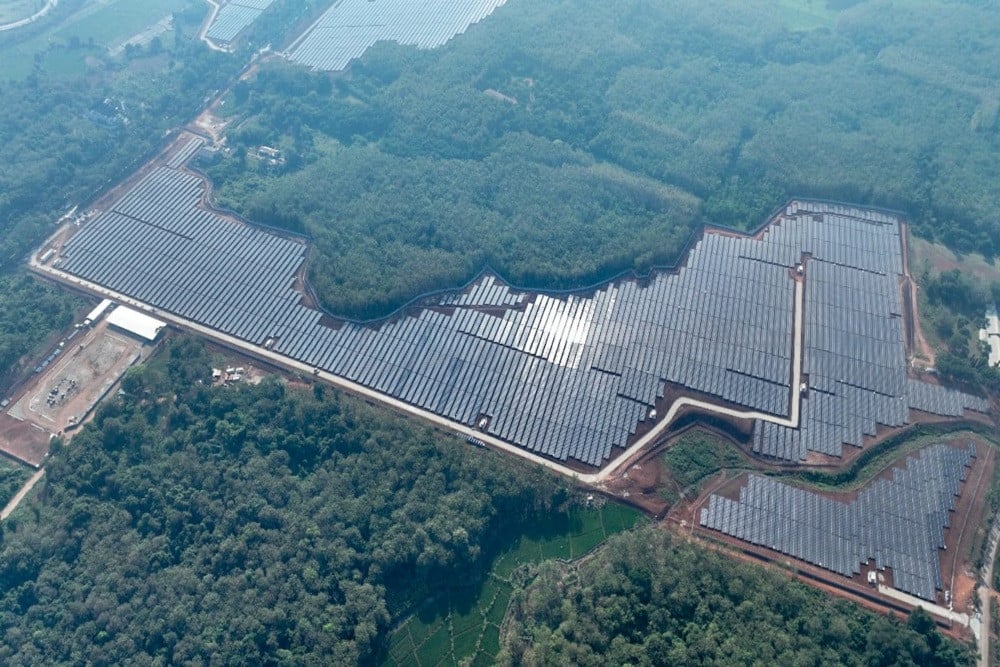
The Chinese manufacturing firm, Chint Group, has stated its intention to undertake long-term investments in Indonesia’s renewable energy sector, with a value of up to the equivalent of US$7 billion.
This was conveyed by the CEO of Chint Solar, Lu Chuan, representing the owner of the Chint Group, Nan Cunhui, during a meeting with the Special Staff to the Minister of Finance for Industry and Environmental Economy, Michael Goutama, on Tuesday (9/6/2026).
The meeting was attended by representatives from the Ministry of Finance and the Chint Group to discuss potential investment opportunities, particularly in the renewable energy sector. Michael noted that Chint is one of the largest manufacturers of solar power plants (PLTS) and solar panels.
“We are honoured; they came here to explore cooperation with the Ministry of Villages to build self-sufficient or industrial villages, and are also exploring investments in renewable energy,” he told reporters during the meeting at the Djuperanda I Building of the Ministry of Finance, Jakarta.
Michael further explained that the company has been in discussions with the government for two years regarding these investment plans. However, this was the first meeting held with the direct presence of Nan Cunhui, the owner of the conglomerate.
The visit was scheduled for one day, with the Chint Group expected to sign an agreement that evening to proceed immediately with investments in Indonesia. Michael noted that the group brought a team of nine people specifically to present an action plan, rather than just a Memorandum of Understanding (MoU).
During the meeting, Michael also outlined various government policies, including the current fiscal situation. The fiscal authorities expressed openness to offering fiscal incentives to enhance investment competitiveness.
“Under the current regulatory regime, we already have tax holidays and a list of incentives that are conducive to investors. I believe this is sufficient, as is the decision regarding tax holidays within the Ministry of Finance,” he explained.
Regarding long-term renewable energy investment, Lu Chuan, CEO of Chint Solar, explained that the company possesses an end-to-end supply chain for renewable energy projects. He assessed that Indonesia holds immense potential for driving the transition to renewable energy.
The manufacturing conglomerate already maintains a branch office in Indonesia and participates in several power plant projects. The company is now targeting more renewable energy projects within the country.
At least two projects are intended to be realised simultaneously. The first involves the development of an Independent Power Producer (IPP) for solar energy with a large investment value, where the produced electricity could be exported to the Singaporean market via a subsea cable.
The second project focuses on village industrialisation, enabling local communities to operate such plants. Lu mentioned plans to create a pilot model for village solar power plants, similar to those implemented in China, where the company has experience supplying solar energy to 2 million homes.
Lu emphasised that the investment target is not short-term, but rather a long-term commitment spanning the next 5 to 10 years.
“In the long term, we can plan for 10 years, with investments of approximately US$6 billion to US$7 billion for all these projects. We are confident that our technology and experience in renewable energy align with local policy guidelines and will support Indonesia’s energy transition,” he stated.
In terms of implementation, Lu mentioned plans to commence both projects promptly, with the company preparing feasibility studies, technical proposals, and financing plans by the second half of 2026.
The company also aims to ensure that village industrialisation is accompanied by the transfer of technology and knowledge to local communities. In parallel, Chint Solar aims to build module factories in villages, with plans to expand these locations in the future.
“We must establish factories here simultaneously so that the supply can be managed locally. This also serves as a solution for local villages to achieve sustainable growth alongside our energy supply solutions,” said Lu.