
China's cheaper AI tokens a double-edged sword for Asian businesses
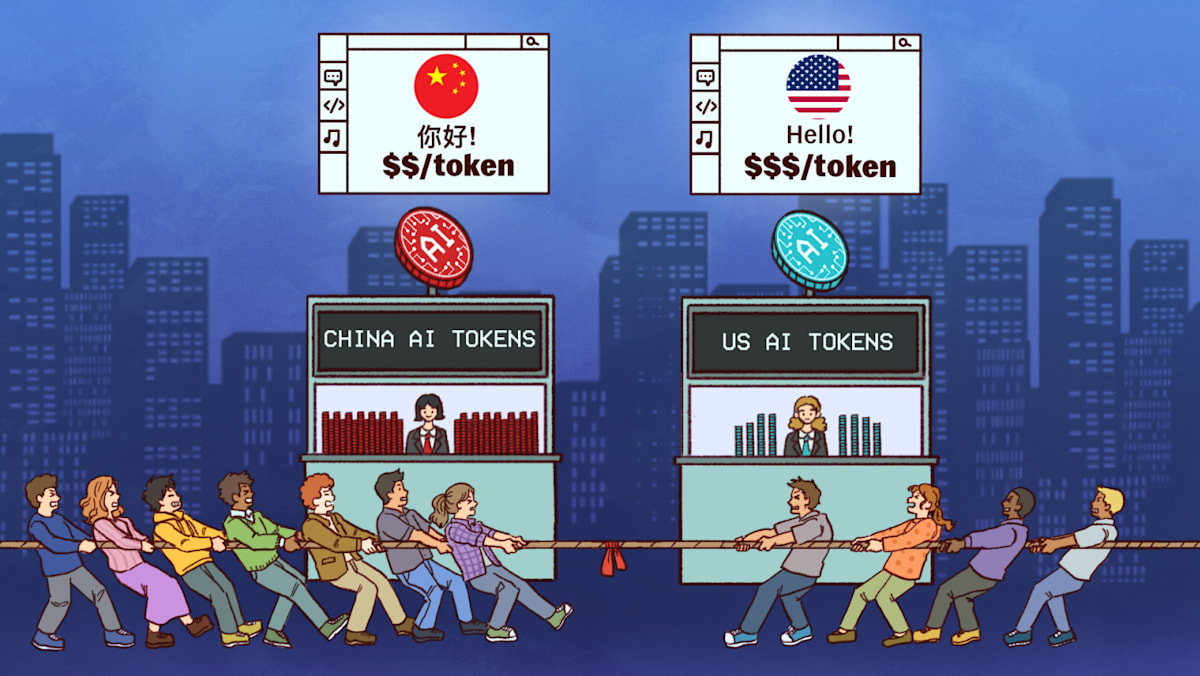
China’s cheaper AI tokens a double-edged sword for Asian businesses
In the second of a two-part series on AI tokens, CNA explores how lower-cost Chinese models are emerging as an attractive option across businesses in Asia, even as experts warn that price is only one part of the equation.
SINGAPORE: Artificial intelligence (AI) is often described as a race to work smarter. But for businesses in Asia, the more urgent question may be simpler: who can afford to use it at scale?
At the heart of that question is the cost of AI tokens - a little-known building block that determines how much companies pay when AI systems read, process and generate information.
This is where Chinese AI models could excel and gain more traction over American AI models among businesses in Asia - especially India and Southeast Asia - experts told CNA, citing their ability to offer cheaper AI tokens.
For instance, models from Chinese companies such as MiniMax and Moonshot charge about US$2 to US$3 per million output tokens.
In comparison, Google’s Gemini 3.5 Flash model charges about US$9, Anthropic’s Claude Sonnet 4.5 costs about US$15 and OpenAI’s GPT 5.5 model is priced at US$30, according to a Financial Times report and Google and OpenAI’s pricing documents.
Charges are based on the number of input and output tokens consumed.
Input tokens come from the prompt or material sent to the AI, while output tokens come from the response it generates. Output tokens usually cost more.
A small sales team of 50 employees could use about 450 million tokens monthly, including both input and output tokens, according to estimates from Amit Verma, founding head of technology at US-based AI services firm Neuron7.ai.
This can amount to a cost of about US$3,150 monthly and US$38,000 annually using GPT 5.5 model, which is around two to three times more than the costs of Chinese AI models.
Chinese AI token costs are cheaper because of a mix of efficient model designs, lower energy and data infrastructure costs, government subsidies, and aggressive pricing strategies, said experts.
As companies move from simple AI chatbots to AI agents that can plan, search, verify information, connect to other software systems and repeat tasks in the background, token usage can surge - and so can costs.
“Token costs multiply across every step, making the unit price of each token far more consequential,” Wong Qi Han, an independent AI researcher and builder, told CNA.
Signs are emerging: companies and organisations such as Airbnb, Thinking Machines Lab - founded by former OpenAI chief technology officer Mira Murati - and AI Singapore have incorporated Alibaba’s Qwen models.
Experts said AI token prices from Chinese AI firms such as Alibaba’s Qwen, DeepSeek, Kimi, Zhipu’s GLM and MiniMax are giving startups and enterprises a cheaper way to run high-volume AI tasks, especially in price-sensitive markets such as India and Southeast Asia.
They added that cheaper AI tokens could make its adoption far more affordable across call centres, software development, e-commerce, education, legal research, manufacturing and back-office operations.
But observers also added that the cheaper route comes with trade-offs, including quality, latency, trust, regulation, data security and geopolitical risk.
WHY CHEAPER TOKENS MATTER TO ASIAN BUSINESSES
AI token-based pricing mainly affects companies and developers that build AI into products, apps and internal workflows.
While ordinary users may access AI through free or fixed-fee subscriptions, businesses running AI at scale typically pay by usage, based on the number of input and output tokens their systems consume.
Tokens also act like a billing meter: the more a system reads and generates, the more it costs.
Experts said this pricing model is now common because corporate businesses and enterprises use AI at a much larger scale than ordinary users - across millions of customer chats, coding requests, research tasks, document summaries and background AI agent actions.
Every chatbot reply, code suggestion, translation, document summary or AI agent action consumes tokens.
According to a joint report by McKinsey, Singapore Economic Development Board and Tech in Asia in February, 46 per cent of companies in Southeast Asia had gone beyond AI experimentation to include them in their workflows and products.
In India that number is 47 per cent, according to an Ernst & Young-Confederation of Indian Industry report.
For Asian companies, the cost of AI is becoming a business problem, especially with the rise of AI agents, experts told CNA.
AI agents go beyond answering prompts. They can plan steps, check information, use apps or company systems, and repeat actions in the background to complete a task.
Verma told CNA that AI use is shifting from “single-turn prompts” - simple one-step AI requests - to agentic workflows that may require 50 to 100 internal operations for a single output.
These background steps, including prompting, verification, reflection, code execution and the use of other external software tools, all consume more tokens, he said.
Based on Anthropic’s estimates, the average AI token cost of a software developer in an enterprise using Claude Code was US$13 per day, with monthly costs of roughly US$150 to US$250 per developer, said a Business Insider report in April.
For large tech businesses employing 500 developers, the AI token costs would be roughly US$75,000 to US$125,000 a month, or US$900,000 to US$1.5 million a year, before any discounts or enterprise deals.
Most AI providers do offer discounts for enterprise customers.
However, these are typically negotiated privately and based on usage volume commitment, contract length, models being used, customer support required and if whether cloud services are included.
According to media reports, OpenAI has offered some enterprise customers 10 per cent to 20 per cent discounts on multi-year or bundled deals.
Verma added that Asia “may become the first region where AI b