
China's 'Artificial Sun' Becomes More Tangible, Promising Eternal Power Source
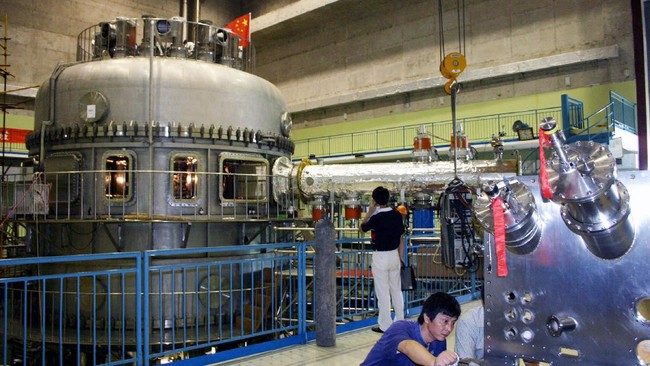
China’s ‘Artificial Sun’ project, a nuclear fusion reactor, is getting closer to reality. The reactor, known as the Experimental Advanced Superconducting Tokamak (EAST), has just made history, bringing humanity closer to an era of limitless clean energy.
Research conducted by the Institute of Plasma Physics at the Chinese Academy of Sciences (ASIPP) carried out an experiment with EAST. They attempted to achieve a plasma density that was previously considered impossible. To conduct the research, they used a new process called plasma-wall self-organisation (PWSO). Through this method, the plasma could be kept stable at unprecedented density levels.
According to the researchers, pushing the plasma density far beyond existing limits means fusion ignition can be achieved with significantly higher energy. “This finding demonstrates a practical and scalable pathway for extending the density limits of tokamaks and next-generation burning plasma fusion devices,” said research leader Ping Zhu from the Huazhong University of Science and Technology. The research team created a new method to ensure it could function under high-performance plasma conditions.
As a result of the experiment, EAST successfully achieved an electron density 1.3 to 1.65 times above the Greenwald density limit range. The Greenwald limit is an empirical boundary for electron density in operations; if the density exceeds this limit, the plasma becomes unstable and can even be disrupted. This has long been a challenge, as achieving operation at this boundary has been difficult for some time.
Meanwhile, this success also serves as proof for the density regime previously predicted by PWSO. The theory explains the physical mechanism in magnetic confinement fusion devices, where the plasma and the reactor wall interact independently, particularly impacting the plasma density limit and impurity levels.