
China's Ambition in Clean Energy
When people speak of green energy, what usually comes to mind are solar panels, wind turbines or hydroelectric power stations. In China, however, the energy transition has been developed more broadly by building an ecosystem that combines technology, education and community economic empowerment.
Electric vehicles have become commonplace in China. Their rapid adoption over the past ten years has been driven by the strengthening of a supporting ecosystem and infrastructure that is also integrated domestically.
According to Xinhua, by the end of May 2026 China had approximately 22.5 million charging points nationally. Of these, 4.95 million are public charging points and 17.55 million are private chargers installed in homes or residential areas.
The Chinese government counts by charging points rather than the number of stations. One public charging station may have several charging points, so the number of physical locations is lower than the number of charging points. The Chinese government also aims to have 28 million charging points by the end of 2027 as part of its plan to accelerate national electric vehicle uptake.
“I remember clearly that a few years ago our housing complex had no charging points, so residents complained by putting up protest notices around the neighbourhood; the very next day the charging points were installed,” said Barbara Li, a part-time interpreter accompanying the ASEAN Media Visit China delegation in Guangdong recently.
This swift and measurable effort has brought electric vehicle adoption to 43.97 million vehicles operating on China’s roads. Meanwhile, production reached 16.63 million units, with new sales of 16.49 million units, an increase of more than 28 per cent compared with the previous year.
Meeting electricity consumption from renewable sources has become the government’s ambition. However, China’s green energy projects do not stop at innovation in generating electricity; they must also add value for society.
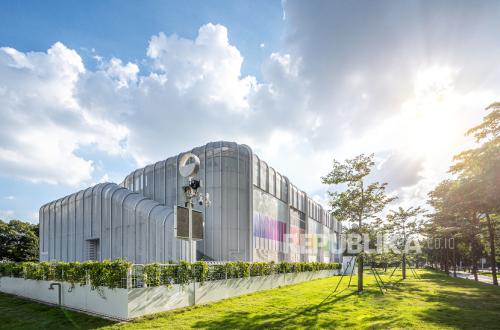
One example is the Moonlight Treasure Box, an electrical substation owned by China Southern Power Grid in Guangzhou that has been transformed into a public education centre on modern electricity systems. From the outside, the building looks like any other modern structure.
Inside, however, the ground floor still functions as a substation, while the second floor has been converted into an interactive education space featuring digital technology, immersive rooms and various installations explaining the electricity distribution process and the development of the smart grid. The top floor is an open space that the public can use to enjoy views of Guangzhou.
The education centre also showcases various innovations developed by the Guangzhou Power Supply Bureau, ranging from grid technology and modern electrical equipment to engineering achievements that form part of China’s national innovation.
Guo Xiang, a member of staff at the Moonlight Treasure Box News and Exhibition Centre, said most of Guangzhou’s electricity needs are already met by clean energy.
“In Guangzhou, energy supply comes from various clean sources, including hydropower, solar and wind. Currently around 50 per cent of energy needs are met from these sources. The Chinese government aims to raise that share to about 66 per cent within the next five years,” said Guo Xiang.