
China's AI classroom revolution begins to bear fruit
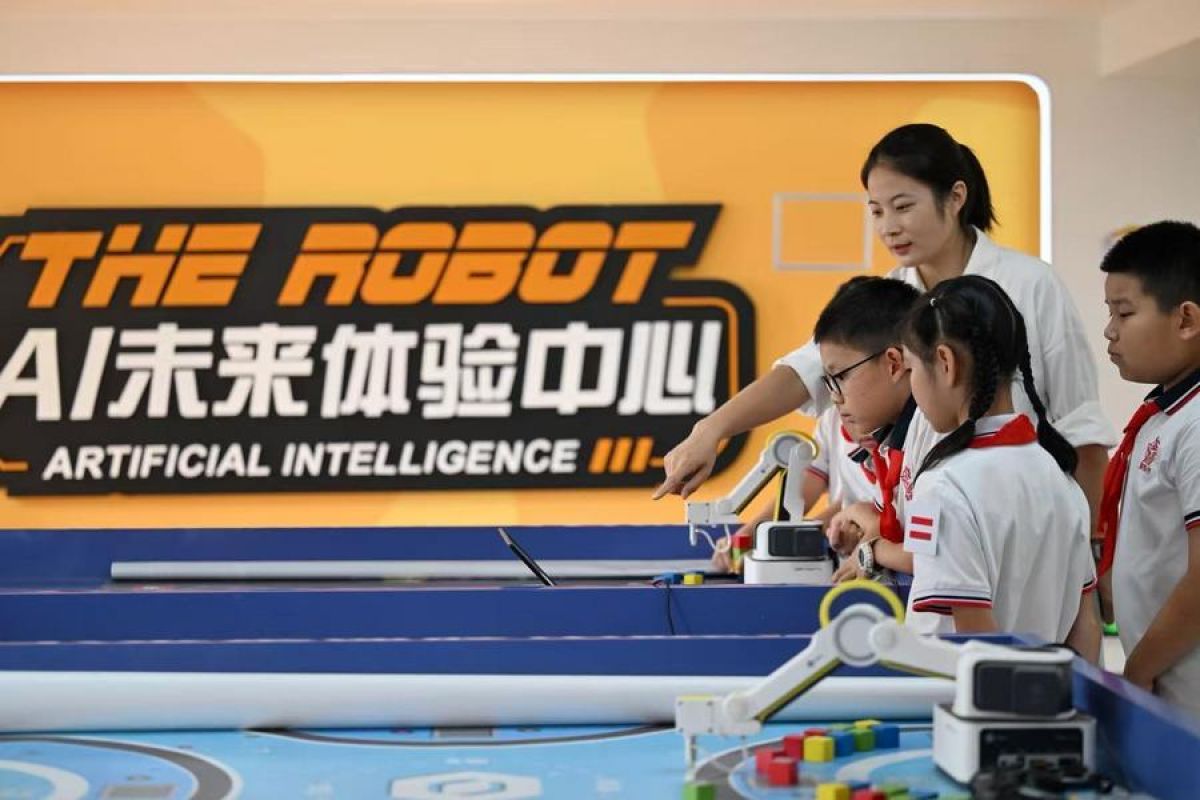
Beijing (ANTARA) - When the mathematics lesson begins at Beijing No. 13 Middle School, an artificial intelligence (AI)-powered “agent” has already been processing student data for weeks, analysing each pupil’s recent class participation, homework and quiz results.
Within minutes, the system generates a series of questions tailored to students of different learning levels and personalised after-class assignments, while teachers review and refine the AI-generated content before putting it to use.
The scene reflects a broader transformation across the world’s largest basic education system, which serves more than 220 million students, as China turns to AI to raise the quality of basic education and better meet the needs of each student, after decades spent expanding access to education and narrowing regional gaps.
Having nearly achieved universal enrolment in compulsory education, China is now shifting its focus from ensuring every child attends school to providing higher-quality, more personalised education for every child.
China’s 15th Five-Year Plan (2026-2030) calls for harnessing AI to transform the education model and integrating the technology into every element, stage and scenario of education. In April, China’s Ministry of Education launched the “AI Plus Education” action plan to accelerate AI education in primary and secondary schools, promote interdisciplinary teaching and expand the application of AI in classrooms.
These policies have already begun taking shape across China.
In Wenzhou, in the eastern province of Zhejiang, AI literacy classes have been introduced. Through the programme, students create digital avatars that introduce the city’s culture in regional dialects using generative AI.
In Beijing, the AI “agent” at Beijing No. 13 Middle School, through learning data analysis, can identify common learning gaps in a class as well as each student’s individual strengths and weaknesses. The system also gives teachers fresh ideas for enriching classroom activities through AI.
For example, Zhang Meiya, a teacher at the school, worked with the AI system to make abstract material more relatable to students’ daily lives, developing case studies on issues such as smart-home privacy disputes and the spread of AI-generated hoaxes, before teaching about citizens’ rights and responsibilities.
At Beijing No. 35 High School, programming teacher Dong Yue sees another benefit.
“Previously, we had to check each student’s code line by line, which took a great deal of time and effort. Now the AI agent can complete the initial assessment very quickly,” Dong said. The time saved is now devoted to drawing up lesson plans, providing individual guidance and professional development, rather than repetitive marking tasks.
These changes build on years of investment in digital education. China achieved internet connectivity across all primary and secondary schools in 2020, laying the foundation for wider adoption of digital learning tools. Today, AI is increasingly seen as the next step in that transformation.
The technology is also helping to bridge what has long been considered a difficult balance between standardised education and individualised learning.
For China’s Vice Minister of Education Wang Jiayi, this points to the future direction of education.
Rather than applying the same model to all students, the education of the future will provide individual learning paths suited to each student’s needs, with greater flexibility, learner autonomy, diverse assessment and personalised teaching becoming ever easier to realise, Wang said.
Nevertheless, educators caution that AI is far from perfect. Current systems may struggle to accurately evaluate certain types of writing, such as travel essays, or to assess students’ reasoning processes in some mathematics problems. Data interoperability between different AI platforms also remains a challenge in some areas.
“That is precisely why the teacher’s role is not diminished, but strengthened,” said Wu Chunhui, deputy principal of Beijing No. 13 Middle School. “AI is an aid. AI cannot replace teachers in providing value-based guidance, intellectually inspiring students, or interacting with students with empathy in complex situations.”
Liu Jizhong, principal of Beijing No. 35 High School, believes teachers will increasingly act as designers of learning experiences, supervisors of AI use and guardians of technological ethics, rather than mere transmitters of knowledge.
For educators, technology is not the end goal. Rather, AI is seen as a tool to help make quality education more accessible, while keeping students’ holistic development at the heart of learning.
As Yao Xiaoying, principal of the Foreign Language Primary School affiliated with Shenzhen University Education Group, put it: “Technology is merely a spark. What we truly want to ignite is the inner motivation of every child — the confidence to say, ‘I want to learn, and I can do it.’”
Translator: Xinhua