
China's Advanced Fighter Jets Showcase Global Presence, Potentially Intimidating the US
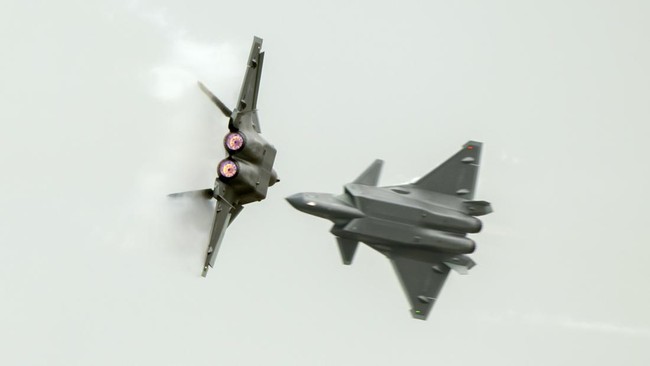
For a long time, the United States has led the competition in fifth-generation fighter jets, with the F-22 Raptor and F-35 Lightning II renowned for their stealth capabilities and technology-driven combat operations. However, China is now catching up in the production of fifth-generation fighters.
Not only is China capable of producing increasingly sophisticated stealth aircraft, but it has also succeeded in producing them in much larger quantities. This is evident in the presence of Beijing’s fifth-generation fighter, the Chengdu J-20, also known as the “Mighty Dragon.”
This twin-engine fighter jet is China’s first fifth-generation aircraft and serves as a symbol of the modernisation of the Chinese People’s Liberation Army Air Force (PLAAF).
China’s Fifth-Gen Fighter Production Surpasses the US
The growth of the J-20 fleet has been incredibly rapid. The Royal United Services Institute (RUSI) estimates that China had only about 50 J-20s in 2020, with a production rate of approximately 20 aircraft per year. Five years later, the number of operational J-20s is expected to reach around 300 units. Production capacity is also projected to surge to about 120 aircraft per year by the end of 2025.
Military aviation observer Andreas Rupprecht even predicts that around 500 J-20s could be delivered by mid-2026. However, these figures remain estimates as China does not disclose detailed production data. If the current production rate continues, RUSI estimates that China could possess around 1,000 units in the J-20 family by 2030. This is not an official target from Beijing, but rather a projection based on recent production developments.
In contrast, US production of the F-22 was halted in 2011 after the US successfully operated 187 aircraft, with the final unit delivered to the US Air Force in 2012. While the F-35 production line continues to this day, with total deliveries reaching 191 units through 2025, this number is split between the US military and several other purchasing nations.
Understanding the Chengdu J-20
The J-20 was developed by the Chengdu Aircraft Corporation, a subsidiary of the Aviation Industry Corporation of China (AVIC). The aircraft first flew in January 2011, was introduced to the public at the 2016 Zhuhai Airshow, and entered military service in 2017.
The J-20 has a longer fuselage compared to the F-22 and F-35. Its large size provides more space for carrying fuel, sensors, and weaponry within the airframe.
China does not disclose all technical data regarding the J-20. Consequently, most specifications remain estimates based on observations and open-source intelligence.
Designed for Long-Range Flight
The J-20 features a long fuselage, delta wings, and small canards near the cockpit. This design assists the aircraft in manoeuvring at high speeds. Its large size also allows the J-20 to carry more fuel, making it suitable for long-range missions.
However, the large airframe also makes the aircraft heavier. The J-20 is estimated to be less agile than the F-22 in close-quarters combat. Nevertheless, the J-20 is not designed solely for direct duels with other fighter jets. Its long range allows it to target high-value assets such as tankers, reconnaissance aircraft, and early warning aircraft.
How Effective is the J-20’s Stealth Capability?
The nose shape, air intakes, panel joins, and internal weapons bays of the J-20 are designed to minimise radar reflection. However, the exact level of its stealth capability is not definitively known.
In early variants, the front of the J-20 is estimated to be quite difficult to detect. However, the rear section still exhibits higher radar reflection and heat signatures due to the use of Russian engines with round exhaust nozzles. The F-22 and F-35 are considered superior because they were designed from the outset to reduce radar reflections from all directions.
China continues to address these deficiencies through the J-20A. This variant features changes to the fuselage shape, air intakes, sensors, software, and new engines.
Reliance on Radar and Missiles
The J-20 is equipped with AESA radar capable of tracking multiple targets and resisting electronic interference. The aircraft also features infrared and electro-optical sensors around the fuselage. These devices assist pilots in searching for opponents without having to constantly activate the main radar, which could reveal the aircraft’s position.
The J-20 carries weapons in three internal bays to maintain low detectability. The main bay can accommodate four PL-15 long-range missiles, while two smaller side bays each carry one PL-10 short-range missile. China has also developed the slimmer PL-16 missile, which could allow the J-20 to carry up to six long-range missiles in its main bay.
RUSI assesses that China’s long-range missiles possess range and speed that could surpass the US AIM-120C/D AMRAAM. This capability gives the J-20 the opportunity to strike first before entering close-range combat.
New Engines for the J-20
Engines have long been a weakness in China’s aviation industry. Early versions of the J-20 used Russian-made AL-31 engines. China subsequently replaced them with the domestically produced WS-10C.
In reality, the engine intended for the J-20 from the start was the WS-15. In January 2026, footage emerged of several J-20As allegedly using the WS-15 engine. These aircraft were seen wearing a yellow primer coat, typically used during the testing phase prior to delivery.
The WS-15 is estimated to produce approximately 181 kilonewtons of thrust per engine. This engine is expected to make the J-20 faster, more fuel-efficient, and more agile. However, the long-term capability and reliability of the WS-15 in sustained operations cannot yet be openly assessed.