
China vs US Tensions Escalate Over Rare Earth Elements, Sending Shockwaves Through 10 Major Corporations
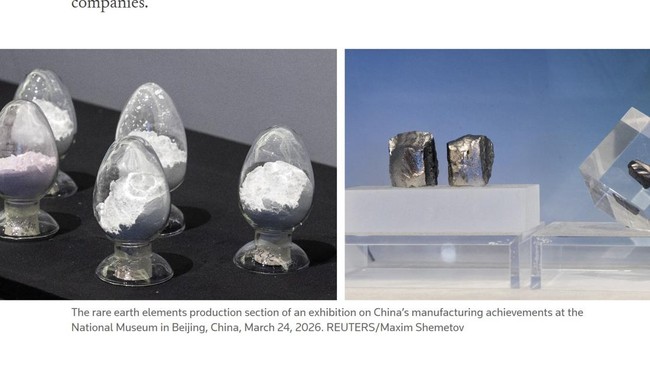
The United States is intensifying pressure on China regarding the supply of rare earth elements (REE). In a recent development, US President Donald Trump signed an executive order on Thursday (30/07/2026) allowing for restrictions on the export of industrial and electronic waste containing critical minerals. This measure aims to secure domestic supplies of rare earth elements, lithium, tungsten, and recycled battery materials while simultaneously reducing US reliance on China.
Following a meeting between US Treasury Secretary Scott Bessent and Chinese Vice Premier He Lifeng, Washington expressed expectations that Beijing would fully honour commitments regarding REE and the purchase of US agricultural products. This follows previous agreements aimed at addressing shortages of yttrium, scandium, neodymium, and indium, alongside restrictions on the export of REE processing technology and equipment. China has also committed to purchasing at least US$17 billion worth of US agricultural products annually until 2028.
The situation presents a dual-sided sentiment for the industry. If China facilitates exports, the scarcity of raw materials in the US may ease, potentially lowering the price premiums for non-Chinese REE, which could benefit US producers in the short term as Chinese products are generally cheaper. Conversely, if Beijing fails to meet its commitments, the urgency to build domestic supply chains will intensify, potentially leading the US government to increase funding, purchase contracts, price guarantees, and financial support for local REE companies.
Among the major US-listed companies with significant exposure, MP Materials is the most directly impacted due to its mining operations at Mountain Pass and its production of NdPr oxide and NdFeB magnet chains in Texas. While supply and price volatility from China directly affect its economics, long-term contracts and government support provide a buffer. USA Rare Earth also faces high policy sensitivity, with plans for US government partnerships that could provide access to up to US$1.6 billion in funding and loans. Meanwhile, Energy Fuels remains more mature in its operations, though it faces pressure if cheap Chinese supplies flood the market.
Smaller-cap companies such as NioCorp, REalloys, Rare Element Resources, and Ucore face higher risks as they still require significant funding and facility development, yet they stand to benefit greatly if Washington expands defence contracts or price guarantees for domestic producers.
As of 2026, rare earth elements have become one of the world’s most strategic commodities, essential for electric vehicles, wind turbines, semiconductors, and advanced defence systems such as radar, missiles, satellites, and fighter jets. While the global demand for clean energy and high technology is surging, supply remains heavily concentrated in China, which dominates both production and processing. China’s production reached 240 kilotonnes, far outstripping the US at 43 kilotonnes and Australia at 16.8 kilotonnes. China’s true dominance lies not just in mining, but in the entire ecosystem, including separation, refining, and magnet production, supported by extensive specialised laboratories and academic institutions.