
China Tightens IPO Rules for Robotics Companies, Why?
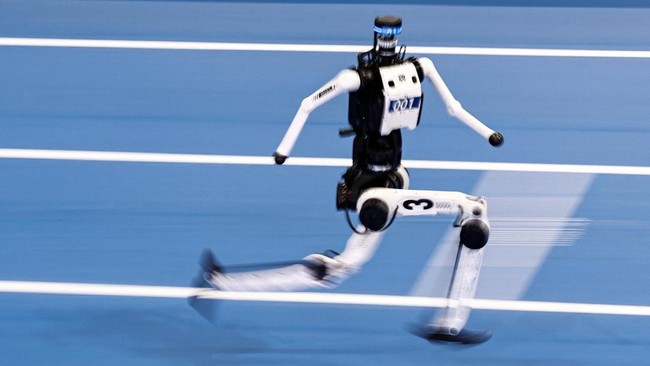
China’s capital market authorities have begun tightening the requirements for initial public offerings (IPOs) for humanoid robot startups. This policy signals a cooling period for one of the market’s hottest sectors, amid global concerns regarding an artificial intelligence (AI) stock bubble.
According to three sources familiar with the thoughts of the China Securities Regulatory Commission (CSRC), as reported by CNBC International on Tuesday (29/09/2026), the regulator has established three specific criteria for ‘embodied AI’ startups—AI integrated with physical hardware, such as humanoid robots—that wish to list on the exchange.
The CSRC requires prospective issuers to meet the following criteria:
Possess sustainable revenue and commercial orders.
Demonstrate the ability to narrow losses, with one source noting that companies must provide three-year performance projections.
Master core technologies, such as the robot’s ‘brain’ or robotic hands.
One source indicated that companies only need to meet two of these three criteria. However, it remains unclear which companies are capable of fulfilling them. Expectations have dropped, with only a handful of startups, or perhaps none at all, being able to list on the exchange.
A Long Queue in Hong Kong
At least two dozen humanoid-related AI companies have applied for listings in Hong Kong alone. Since May 2025, the Hong Kong exchange has allowed technology companies to submit IPO applications privately. However, mainland Chinese companies wishing to list in Hong Kong still require approval from the CSRC.
Neither the Hong Kong exchange authorities nor the CSRC have responded to requests for comment.
Scrutiny of this sector has intensified in recent weeks, particularly regarding the soaring valuations of humanoid startups, which are supported by a mix of government and private funding.
Unitree, regarded as an industry icon, received a regulatory fast-track to list in Shanghai on 19 August, coinciding with the opening of the World Robot Conference in Beijing. The company raised approximately 6.1 billion yuan or US$905 million (around Rp 16.3 trillion) from the IPO. Unitree’s shares surged more than 460% on its debut day, closing at 845 yuan per share.
However, its share price has since fallen by almost half. On Monday (28/09/2026), Unitree shares were trading at 459.65 yuan.
One day after the listing, Unitree founder Wang Xingxing reminded investors that the commercialisation of humanoid robots beyond entertainment, such as dancing robots, still requires several years. This statement sparked debate regarding the actual capabilities of humanoid robots and whether startups in this industry are truly generating profits.
In Hong Kong, shares of Ubtech, which has been listed since December 2023, have also plummeted by more than 40% this year. The company still recorded an operating loss of 279 million yuan in the first half of 2026.
China now possesses more than 100 humanoid companies under the umbrella of the national push for embodied AI. This term has received support from Beijing in the last two annual government work reports, although authorities have also warned of a potential bubble in the humanoid robotics industry.
Data from industry provider Xiniu shows that investment in this sector in the second quarter of 2026 reached 47.09 billion yuan or US$6.95 billion (around Rp 125.1 trillion). This figure is more than double that of the first quarter and an increase of more than six times compared to the same period last year.
The decline in share prices contrasts with the heavy influx of capital into humanoid robotics companies over the past 12 months. This technology, often referred to in China as ‘physical AI’, is viewed by early-stage investors as a way to capitalise on the surge of interest in AI models.
An analysis by the Rhodium Group this month found that Chinese AI companies generate only about 10% of the revenue of Anthropic and OpenAI. The valuation-to-revenue ratio, particularly for Chinese AI startups such as Moonshot and DeepSeek, is significantly higher than that of their US competitors.
Amid rising expectations for major US AI IPOs, chip manufacturer Advanced Micro Devices (AMD) announced on Monday (28/09/2026) that it will acquire World Labs for US$8.2 billion (around Rp 147.6 trillion) through a stock transaction. The startup, founded by AI pioneer Fei-Fei Li, develops AI models to create 3D virtual environments widely used in the development of humanoid robots.