
China Spends 50 Years Planting Trees in the Desert, Here Are the Results
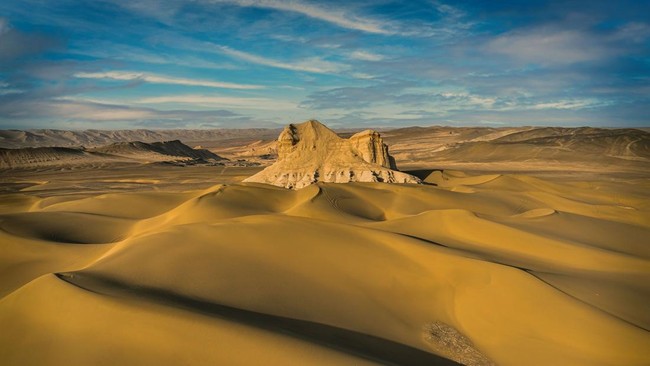
The Taklamakan Desert has long been known as one of Asia’s harshest landscapes. Located in China’s Xinjiang region, this desert is characterised by vast sand dunes, low rainfall, and conditions that leave little room for plant life. Yet the edges of this vast desert have been changing slowly, almost silently. Rows of shelter forests, shrubs, and gradually restored vegetation are spreading across areas once dominated by barren sand, signalling that an ambitious effort to slow desert expansion has evolved into something with broader environmental significance. Recent satellite observations indicate that parts of this restored landscape absorb more carbon dioxide from the atmosphere than they release, offering a rare example of large-scale reforestation on a desert fringe yielding measurable climate benefits under very specific conditions.
China launched the Three-North Shelterbelt Programme in 1978 to tackle spreading desertification across the country’s northern regions. Often called the ‘Great Green Wall’, the project spans several provinces and aims to reduce wind erosion, stabilise shifting sands, and protect farmland and settlements from the encroaching desert. Rather than attempting to fill the desert itself with forests, planners focused on its edges, where carefully selected vegetation could survive with irrigation and provide a protective barrier against wind-blown sand. Over the years, this strategy evolved into an extensive network of tree planting, shrubs, and shelter belts around parts of the desert.
A study published in PNAS, titled ‘Human-induced biospheric carbon uptake: The impact of the Taklamakan afforestation project’, reveals that the latest evidence comes from observations made using Solar-Induced Fluorescence, or SIF. During photosynthesis, plants release a faint signal in the near-infrared part of the spectrum. This signal is invisible to the human eye, but satellites can detect it from space. By tracking this fluorescence over time, scientists can estimate how actively vegetation is absorbing carbon dioxide. Rather than relying solely on ground measurements, this approach provides a broad picture across remote landscapes where regular field monitoring would be difficult. Photosynthetic activity was detected around the restored areas on the Taklamakan border, indicating that the vegetation functions as a carbon sink, storing more carbon than it releases under current conditions.
The scientists involved in the research stressed that the effect should not be compared to dense tropical forests. The vegetation cover around the desert remains relatively sparse, resembling dry shrubland more than a continuous forest. Nevertheless, detecting consistent carbon uptake in such an extremely arid environment is considered a significant finding. The project’s success depends far more on the landscape surrounding the desert than on the trees themselves. The Taklamakan Desert is ringed by several major mountain ranges, including the Kunlun, Pamir, and Tian Shan mountains. Snow and glaciers at these high altitudes feed rivers that flow into the Tarim Basin. Meltwater supports the irrigation systems that allow the planted vegetation to survive despite the extremely dry desert climate. Without this meltwater supply, sustaining large-scale planting would be far more difficult. In arid environments, water typically determines whether vegetation thrives or disappears, regardless of planting efforts. This also explains why the findings are not easily replicated elsewhere. Similar projects in desert areas without reliable mountain water flows would require alternative water sources, either through desalination or groundwater extraction, both of which carry environmental and economic limitations.
Large-scale greening projects often attract attention as climate solutions, but results have been mixed worldwide. Previous tree-planting campaigns in northern China have drawn criticism because many trees struggled to survive in dry areas. Species with high water demands sometimes depleted underground water reserves, adding pressure to already scarce resources. If vegetation fails to establish, the exposed soil can become vulnerable to erosion again. The Taklamakan project appears to have avoided some of these problems by combining irrigation, suitable planting locations, and gradual expansion, rather than attempting to plant forests across the entire desert itself. Long-term success, however, remains closely tied to future water supplies. The rivers sustaining these shelter belts are partly fed by glaciers, which are shrinking as temperatures continue to rise. Increased meltwater may temporarily support the vegetation, but over time the available supply could decline as ice reserves diminish. Planting vegetation brings impacts beyond just the amount of carbon absorbed; it also alters the interactions between the earth’s surface and sunlight. Unbroken desert sand is highly reflective, but trees and shrubs are far less so.
Source: jawawa.id (https://jawawa.id/newsitem/china-spends-50-years-planting-trees-in-the-desert-here-are-the-results-1786261858)
Originally published by CNBC Indonesia (https://www.cnbcindonesia.com/lifestyle/20260809121735-33-757716/china-habiskan-50-tahun-tanami-pohon-di-gurun-ini-hasilnya), translated from Indonesian