
China: South China Sea incidents caused by unauthorised Philippine entry
Beijing (ANTARA) - The Chinese Foreign Ministry has asserted that the incidents between Chinese coast guard and military forces and Philippine government aircraft and vessels last weekend occurred because the ASEAN member state entered the territory without permission.
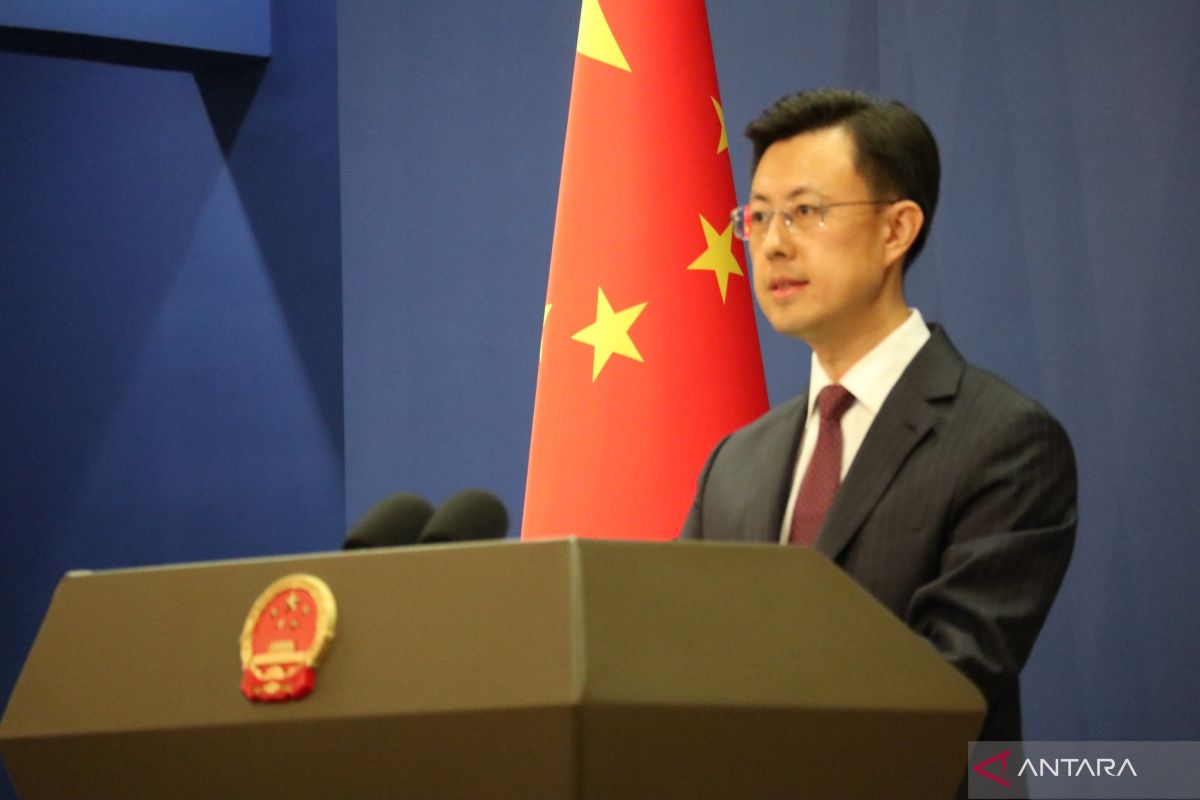
“Over the past few days, Philippine aircraft and vessels have entered airspace and waters under Chinese jurisdiction without permission, thereby disrupting China’s normal law enforcement operations,” said Foreign Ministry Spokesperson Guo Jiakun in a written statement on the Chinese Foreign Ministry website accessed on Wednesday.
On Sunday (4/10), the Philippines accused the Chinese military and coast guard of interfering with Philippine government aircraft and vessels in two areas of the West Philippine Sea.
A J-16 fighter jet interfered with a Philippine Cessna 208 turboprop aircraft conducting “routine military patrols” near Scarborough Shoal on Saturday (3/10).
The Philippine armed forces stated that the J-16 aircraft manoeuvred in front of and around the plane, positioning itself directly in the aircraft’s wake.
Although the Philippine aircraft completed its mission safely, the Philippine military described the incident as “part of a recurring pattern of unsafe and coercive behaviour towards Philippine government ships and aircraft conducting legitimate operations.”
China, Guo Jiakun stated, holds sovereignty over “Huangyan Dao” and “Nansha Qundao”, including “Zhongye Dao” and “Tiexian Jiao”, and its surrounding waters, possessing sovereign rights and jurisdiction over the related waters.
“The scope of Philippine territory is determined by a number of international agreements. China’s Huangyan Dao and Nanchao Qundao fall outside that scope,” added Guo Jiakun.
Guo Jiakun stated that the actions taken by the Philippines over the weekend constituted a serious violation of China’s sovereignty and jurisdiction, as well as a deliberate attempt to undermine peace and stability in the South China Sea.
“China’s military and coast guard measures to respond with lawful actions are entirely legitimate and justifiable. We firmly oppose any Philippine actions that undermine China’s sovereignty as well as its rights and interests, and will continue to take necessary steps to firmly defend our territorial sovereignty and maritime rights and interests in the South China Sea,” explained Guo Jiakun.
He also called on the Philippines to immediately cease such violations and provocations.
In addition to the confrontation on Saturday, an incident also occurred on Sunday (4/10) in the Spratly Islands, located further south in the South China Sea.
The Philippine Coast Guard stated that it deployed small boats to approach a fishing vessel accused of using dynamite to catch fish between the Philippine-occupied Thitu Island and the Chinese-controlled Subi Reef.
Two Chinese Coast Guard ships arrived alongside a Chinese naval helicopter that “circled” the Philippine team four times. One Chinese ship was even reported to have “shadowed and obstructed the Philippine boats,” and at one point approached within approximately nine metres of one of the boats, according as the Philippine Coast Guard reported.
However, the Philippine Coast Guard halted the pursuit “for safety reasons” and returned to Thitu.
Previously, the Spokesperson for the Chinese Southern Theatre Command, Zhai Shichen, stated that the Philippine aircraft had “illegally intruded into the airspace over China’s Huangyan Dao.”
Zhai noted that the “Chinese navy and air force tracked and monitored the Philippine aircraft and issued warnings to expel them in accordance with applicable laws and regulations.” He described the Philippine actions as “a serious violation of China’s sovereignty” and warned Manila “to immediately cease rights violations and provocative actions.”
The weekend’s incidents occurred approximately two weeks after a Chinese Coast Guard ship collided with a vessel belonging to the Philippine government’s fisheries bureau in another area of the Spratly Islands.
China maintains that Nanhai Zhudao (the South China Sea Islands) belongs to it, comprising Dongsha Qundao (the Dongsha Islands), Xisha Qundao (the Xisha Islands), Zhongsha Qundao (the Zhongsha Islands) and Nansha Qundao (the Nansha Islands), also known as the Pratas Islands, Paracel Islands, Spratly Islands, and the Macclesfield Bank area.
In 2013, the Philippines filed an arbitration claim against China at the Permanent Court of Arbitration in The Hague, Netherlands.
In 2016, the Court ruled that the 200-nautical-mile (370-kilometre) Exclusive Economic Zone (EEZ) is the right of the Philippines to utilise energy and other resources, though the area overlaps with waters claimed by China as its own.
However, China has never accepted the decision of the Arbitral Tribunal.
To resolve the dispute in the South China Sea, ASEAN and China signed the Declaration of Conduct (DoC) in 2002, which includes a commitment to “promote conditions conducive to a peaceful and sustainable solution to differences and disputes among the relevant states.”
However, a consensus has yet to be reached regarding an agreement within the framework of a binding Code of Conduct (CoC).
Source: jawawa.id (https://jawawa.id/newsitem/china-south-china-sea-incidents-caused-by-unauthorised-philippine-entry-1791345737)
Originally published by Antara (Indonesian) (https://www.antaranews.com/berita/5774682/china-insiden-di-laut-china-selatan-karena-filipina-masuk-tanpa-izin), translated from Indonesian