
China Secretly Alleged to Have Helped Iran Shoot Down US Fighter Jet
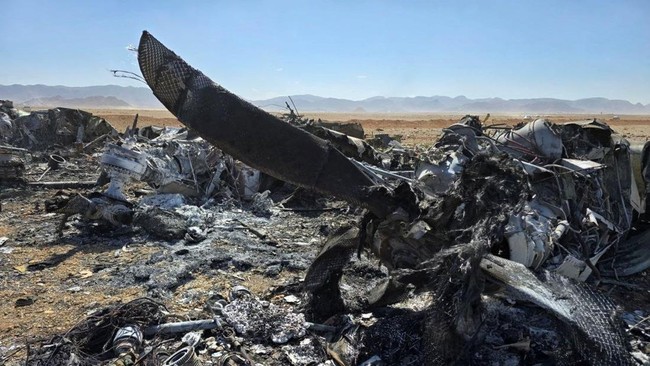
Jakarta, CNBC Indonesia - Iran successfully shot down a United States (US) fighter aircraft in its airspace on Friday. This incident has drawn global attention as it marks the first time a manned US aircraft has been downed in Iranian territory since the conflict erupted in February, while also strengthening suspicions of the involvement of China’s advanced BeiDou navigation system behind the improved accuracy of Tehran’s defences.
Iranian state media released documentation including photos of the tail fin and wreckage of the aircraft, initially claimed to be a stealth F-35 fighter jet. However, aviation experts analysing the debris have stated that it originates from a US Air Force 494th Squadron F-15E Strike Eagle based in Europe.
“The enemy fighter jet in Iranian airspace has been struck and destroyed by the advanced air defence system of the IRGC Air Force (Islamic Revolutionary Guard Corps),” said the spokesperson of Iran’s central military operations command in an official statement on Friday.
This success occurred after former French Foreign Intelligence Director Alain Juillet assessed that Iran’s drastic improvement in targeting capabilities is likely due to access to the BeiDou satellite system. According to Juillet, Iran’s strike precision in recent times far exceeds their capabilities at the start of the conflict, indicating external guidance technology assistance.
“One of the surprises in this war is that Iranian missiles are more accurate than in the war eight months ago, raising many questions about the guidance systems of those missiles,” Juillet told the Tocsin podcast, as quoted by Al Jazeera on Monday (6/04/2026).
What is the BeiDou Navigation Satellite System (BDS)?
China inaugurated the BeiDou navigation system as a rival to the US GPS in a grand ceremony in Beijing in July 2020. Unlike GPS, which relies on 24 satellites, BeiDou is supported by 45 satellites providing broader global coverage and stronger signal resilience against jamming often employed by the US military.
Based on information from the official Chinese government website, the BeiDou system consists of massively integrated space, ground, and user segments. Its ground segment includes various main control stations and inter-satellite link management facilities to ensure highly accurate time synchronisation for users.
“The BDS ground segment consists of various earth stations, including main control stations, time synchronisation/uplink stations, monitoring stations, as well as operational and inter-satellite link management facilities,” states the official BeiDou website.
Military analyst Elijah Magnier explained that satellite navigation systems like BeiDou work by transmitting time signals to ground or vehicle receivers to calculate precise geographical positions. Accuracy levels vary depending on the service type used by operators in the field.
“Accuracy varies depending on the service level. Open civilian signals generally provide positioning accuracy of about five to 10 metres, while restricted services available to authorised users can offer much higher precision,” Magnier told Al Jazeera.
Could Iran Be Using BeiDou?
Although Tehran has never publicly confirmed the use of Chinese technology, strong indications point to the integration of the BeiDou system into Iran’s military infrastructure in recent years. Iran’s Ministry of Information and Communications Technology has only stated that they utilise all available global technological capacities without relying on a single source.
However, China-Iran relations observer Theo Nencini revealed that Iran reportedly signed a memorandum of understanding in 2015 to integrate BeiDou-2 into their military. Access is believed to have widened significantly following the signing of the China-Iran Comprehensive Strategic Partnership in March 2021.
“From there, the Iranian military began incorporating BeiDou into missile and drone guidance, as well as certain secure communication networks,” Nencini disclosed.
This transition is assessed to have peaked in June 2025, when GPS signal disruptions began seriously impacting Iranian air and sea navigation during the 12-day war with Israel. Nencini described that bitter experience as a turning point for Tehran to accelerate full transition to Beijing’s system.
“Iran’s move towards BeiDou reflects long-standing concerns, showing awareness of technological challenges that will shape future battlefields. However, the 12-day war experience was clearly a turning point, prompting Tehran to accelerate full transition last year,” added Nencini.
How Does BeiDou Enhance Targeting Accuracy?
The inertial navigation systems previously used by Iranian missiles have weaknesses as small measurement errors can accumulate over flight distance. With BeiDou satellite signals, Iranian missiles and drones can perform continuous path corrections to reach targets with high precision.
Elijah Magnier added that using multiple satellite systems simultaneously provides redundancy against sabotage attempts by adversaries. If one satellite signal is jammed, the guidance system can still function by receiving signals from other satellite constellations.
“Simultaneous use of multiple satellite systems provides an additional advantage: resilience against jamming or signal interference. In contested environments, navigation signals may be deliberately disrupted. If a weapon relies on a single satellite system, such interference can degrade accuracy,” Magnier explained.
Additionally, the BeiDou military system employs complex frequency-hopping techniques to prevent spoofing or the transmission of false coordinates by enemies. This capability
Source: jawawa.id (https://jawawa.id/newsitem/china-secretly-alleged-to-have-helped-iran-shoot-down-us-fighter-jet-1775638358)
Originally published by CNBC Indonesia (https://www.cnbcindonesia.com/news/20260406131511-4-724181/diam-diam-china-disebut-bantu-iran-tembak-jatuh-jet-tempur-as), translated from Indonesian