
China Rejects US and European Claims on South China Sea
Beijing (ANTARA) - The Chinese government has once again reaffirmed its rejection of statements by the United States, several European countries and other nations marking the tenth anniversary of the Arbitral Tribunal ruling on the South China Sea.
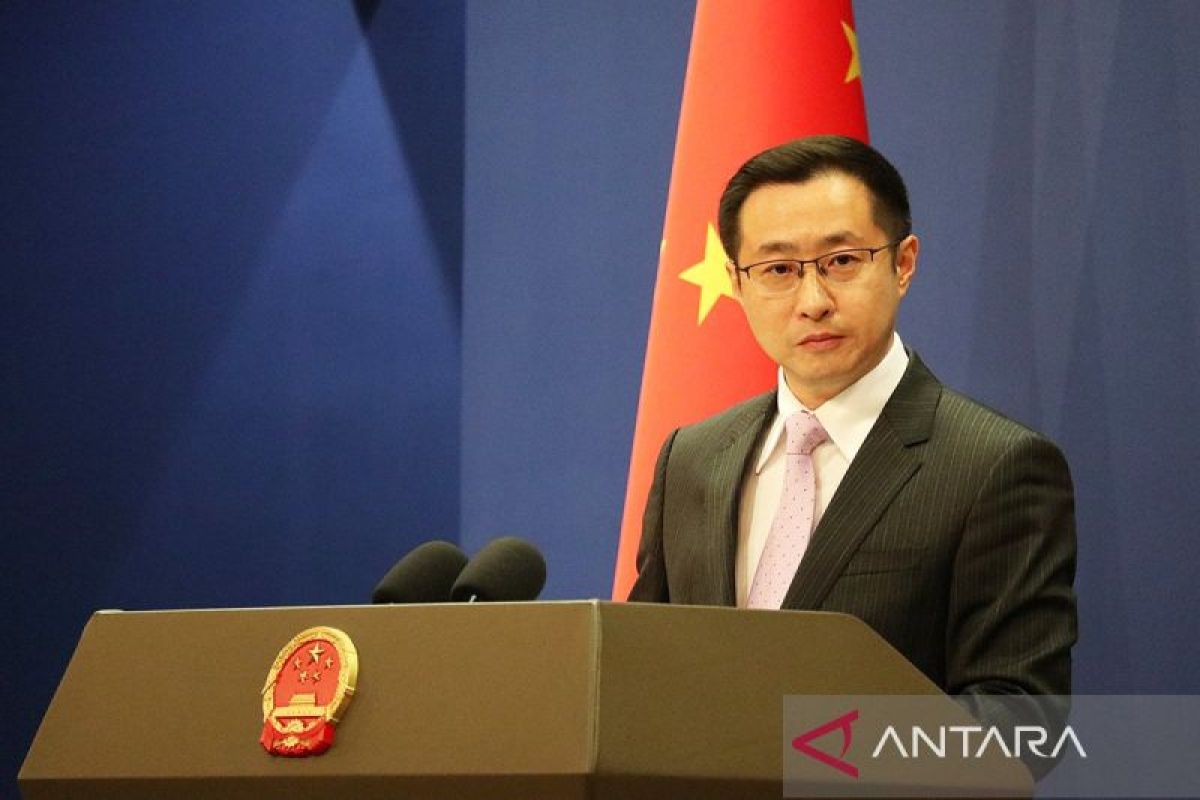
“The joint statements issued by the US, the Philippines and a number of European countries, as well as the statement by the European Union, regarding the tenth anniversary of the South China Sea arbitral ruling are a distortion of facts and an attempt to discredit China. We regret and reject these statements,” said Chinese Foreign Ministry spokesman Lin Jian at a press conference in Beijing on Tuesday.
On Sunday (12 July), 14 countries - Australia, Japan, Canada, Estonia, Germany, Italy, Latvia, Lithuania, New Zealand, the Philippines, Romania, Slovenia, the United Kingdom and the United States - issued a joint statement affirming that maritime disputes must be resolved peacefully in accordance with the United Nations Convention on the Law of the Sea (UNCLOS).
They also affirmed that the Arbitral Tribunal’s ruling is final and legally binding on both China and the Philippines with regard to the rights and maritime claims decided by the tribunal.
The joint statement further noted that the tribunal had ruled there was no legal basis for China’s expansive maritime claims in the South China Sea, including claims based on “historic rights”.
“The head of the European Affairs Department at the Chinese Foreign Ministry has lodged strong protests with the heads of the relevant countries’ diplomatic missions and with the European Union Delegation to China,” Lin Jian added.
Lin Jian said China’s sovereignty over the Nanhai Zhudao (South China Sea Islands) and related rights and interests in the South China Sea had been established through a long historical process and rested on a solid legal foundation.
According to Lin Jian, China’s position on the South China Sea arbitration is very clear, consistent and firm.
“First of all, the so-called ‘Arbitral Tribunal’ was an ad hoc body established for a political agenda and therefore had neither jurisdiction nor impartiality. The arbitration process itself violated the fundamental principles of international law,” he said.
Lin Jian described the process as merely a political manoeuvre by a handful of Western countries aimed at containing China.
“China does not accept or recognise the ruling, and it opposes and will never accept any claims or actions based on that ruling,” he asserted.
According to Lin Jian, certain European countries need to recognise that the blatant application of double standards on issues of international law will only further erode their credibility on the international stage and will not help deepen mutual trust between China and Europe.
“Europe is not a party to the South China Sea dispute and is in no position to pass judgement on China’s territorial sovereignty or its legitimate maritime rights and interests in the region. We urge the European Union to act wisely, stop endorsing this illegal ruling and refrain from disrupting China-EU relations,” Lin Jian added.
Lin Jian reiterated that the “arbitration” was in essence nothing more than a political farce dressed up as a legal process.
“A decade ago, that ‘Arbitral Tribunal’ exceeded its authority and abused its jurisdiction. The ruling it produced is illegal, invalid and null and void. This illegal ruling will never change history or the fact that China exercises sovereignty, sovereign rights and jurisdiction over the Nanhai Zhudao,” he said.
China states that the Nanhai Zhudao (South China Sea Islands) comprise its territory, including the Dongsha Qundao (Dongsha Islands), Xisha Qundao (Xisha Islands), Zhongsha Qundao (Zhongsha Islands) and Nansha Qundao (Nansha Islands), also known as the Pratas Islands, the Paracel Islands, the Spratly Islands and the Macclesfield Bank area.
These islands encompass a variety of islands, reefs, shoals and small coral islets of various sizes. The Nansha Qundao is the largest cluster, both in terms of the number of islands and reefs and its geographical extent.
China asserts that its people’s activities in the South China Sea have spanned more than 2,000 years, making it the first to discover, name, explore and utilise the Nanhai Zhudao and their adjacent waters.
Since the founding of the People’s Republic of China (PRC) on 1 October 1949, China says it has repeatedly defended its sovereignty over the Nanhai Zhudao and its related rights and interests in the South China Sea through the promulgation of laws and regulations, the establishment of administrative structures and the issuance of diplomatic statements.
China considers the territorial claims and forcible occupation of a number of islands and reefs in the Nansha Qundao by several countries to be illegal and null and void.
China also affirmed it will continue to oppose such actions and demand that the countries concerned cease their violations of its territory.
The Philippines filed a case against China at the Permanent Court of Arbitration in The Hague, the Netherlands, in 2013. In 2016, the tribunal ruled that the 200-nautical-mile (370-kilometre) Exclusive Economic Zone (EEZ) was the Philippines’ right to exploit natural resources in the area, even though the zone overlaps with China’s claims.
The ruling also found that China had violated the Philippines’ sovereign rights and caused severe damage to coral reef ecosystems.
The tribunal further stated that China’s island reclamation activities in the area conferred no additional maritime rights on the Chinese government.
However, China has never accepted the Arbitral Tribunal’s ruling.