
China Refines Tailless J-36 Stealth Jet for Long-Range Penetration, Stirring Indo-Pacific
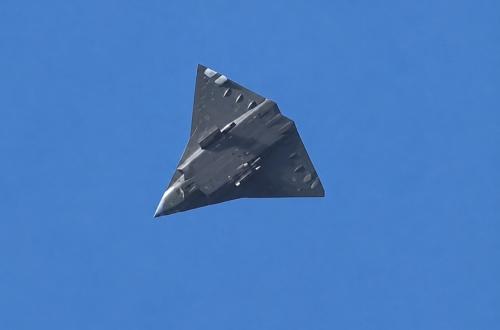
The latest sighting of a prototype J-36 stealth fighter jet has revealed further refinements to its air intake and aerodynamic profile. The changes indicate that China is continuing to mature the tailless, three-engine aircraft to support long-range operations in environments with layered air defences.
Defence media outlet Defence Security Asia, in a report on Monday, 13 July 2026, stated that the modifications to the shape of the air intake and fuselage could potentially enhance the aircraft’s stealth characteristics, airflow management, and its ability to operate in the Indo-Pacific region. However, the circulating photographs have not been accompanied by an official technical explanation from the Chinese government or its aviation industry.
The designation J-36 remains an unofficial moniker used by observers, based on the number ‘36011’ seen on the first prototype. The aircraft is believed to be developed by Chengdu Aircraft Corporation and was first spotted flying over Chengdu on Thursday, 26 December 2024, escorted by a twin-seat J-20S stealth fighter.
The J-36’s shape differs from conventional fighter jets. It uses a wide, double-delta wing planform, lacks vertical tail surfaces, and is equipped with three engines. Two engines receive air through intakes located on the underside or sides of the fuselage, while the third engine utilises a dorsal air intake on the aircraft’s back.
This configuration is thought to provide the J-36 with a large internal volume for fuel, sensors, and weaponry. However, the three-engine setup also presents challenges related to weight, fuel consumption, heat signature, and the complexity of airflow management.
Aviation Week & Space Technology magazine, in its edition published on Monday, 13 January 2025, estimated that the J-36 is at least the size of, or even larger than, the F-111 strike aircraft. The wide fuselage shape is also assessed to provide space for one large main weapons bay and two smaller compartments.
Former YF-23 configuration design lead Darold Cummings cautioned that the large dorsal intake could limit certain flight characteristics. Speaking to Aviation Week & Space Technology on Monday, 13 January 2025, Cummings said the configuration makes the J-36 appear more akin to a ‘bomber-strike aircraft like the F-111’ than a lightweight fighter for close-range dogfighting.
This assessment highlights the lack of consensus regarding the J-36’s primary role. Some observers call it a sixth-generation air superiority fighter, while others view it as a fighter-bomber or a regional strike platform with significant range and payload capacity.