
China Prepares Latest Stealth Fighter Jet, Here Are the Specifications
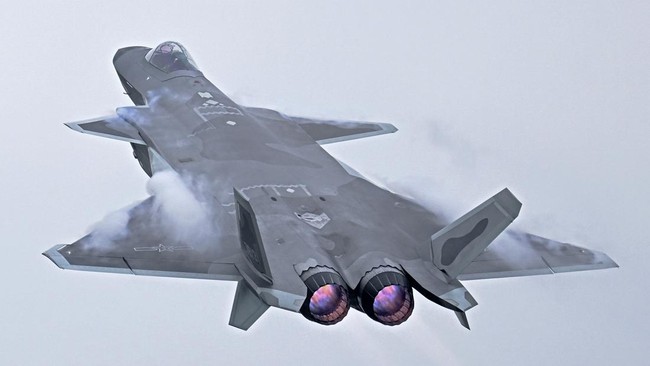
China is continuously expanding its aerial combat capabilities. Following the deployment of the J-20 and J-ability J-35, Beijing is now developing a new generation of stealth jets known as the J-50.
According to the South China Morning Post (SCMP), recent research by Chinese military aircraft designers has revealed several technologies being prepared for this next-generation fighter. The research was conducted by a team from the Shenyang Aircraft Design and Research Institute, an institution linked to the development of the J-50. The team is led by Zhang Dong, the head of flight control systems at the institute.
The J-50 is designed not only to be difficult for radar to detect but is also being prepared for autonomous flight, the ability to navigate without satellite assistance, and the capacity to lead a swarm of drones on the battlefield. One of the technologies under development allows the aircraft’s system to take control if a pilot loses consciousness or is unable to manage multiple tasks simultaneously.
China is also preparing quantum navigation technology so that the jet can maintain its position even when satellite signals, such as GPS, are interfered with or disabled by an enemy. Another capability is the ability to work alongside multiple drones; the primary jet will be able to direct drones to perform attacks, reconnaissance, or provide protection according to changing battlefield conditions.
Although widely referred to as the J-50, this name has not been officially confirmed by the Chinese government. The term is used by observers for the experimental aircraft from Shenyang that was first seen undergoing flight tests in December 2024. However, there is no official information regarding the speed, range, weaponry, or the timeframe for when the aircraft will enter service. The J-50 is still in the development stage and is not yet part of China’s active combat fleet.
Regarding China’s existing stealth fighter fleet, there are two main families: the J-20 and the J-35.
China’s journey in building a stealth fleet began with the J-20. Produced by the Chengdu Aircraft Industry Group, the J-20 first flew in January 2011 and was presented to the public at the 2016 Zhuhai Airshow. It entered service with the Chinese Air Force the following year and was deployed to combat units in 2018, demonstrating China’s capability to operate its own stealth technology.
The J-20 is a large, twin-engine aircraft. To maintain its stealth profile, missiles are stored within the aircraft’s fuselage, as external wing mounts can increase radar visibility. China continues to develop the J-20, with the J-20A featuring improvements in fuselage shape, engines, and flight systems. There is also the J-20S, which features two seats, making it the world’s first two-seat stealth fighter. While the pilot flies the aircraft, the second crew member assists with weapon monitoring, battlefield situational awareness, and controlling companion drones. The J-20S is prepared for air-to-air, air-to-ground, and air-to-sea targets.
Following the J-20, China introduced the J-35 family, developed by the Shenyang Aircraft Corporation. Originally known as the FC-31 experimental aircraft, it first flew in 2012. Development has progressed into two variants: the J-35A for the air force and the J-35 for carrier-based operations.
The J-35A was officially introduced at the November 2024 Zhuhai Airshow. While smaller than the J-20, it is capable of more complex missions. Whereas the J-20 focuses on air superiority, the J-35A is a medium-class multi-role stealth jet capable of engaging enemy aircraft and ground targets. The carrier-based J-35 features folding wings to save space on ships and a reinforced undercarriage for hard landings. The J-35 is intended to be a primary aircraft for the Fujian aircraft carrier, which is set to enter service in November 2025. The Fujian utilises an electromagnetic catapult system, allowing the J-35 to take off with more fuel and weaponry compared to traditional ski-jump carriers.