
China Praises Indonesia’s Agricultural Sector Achievements
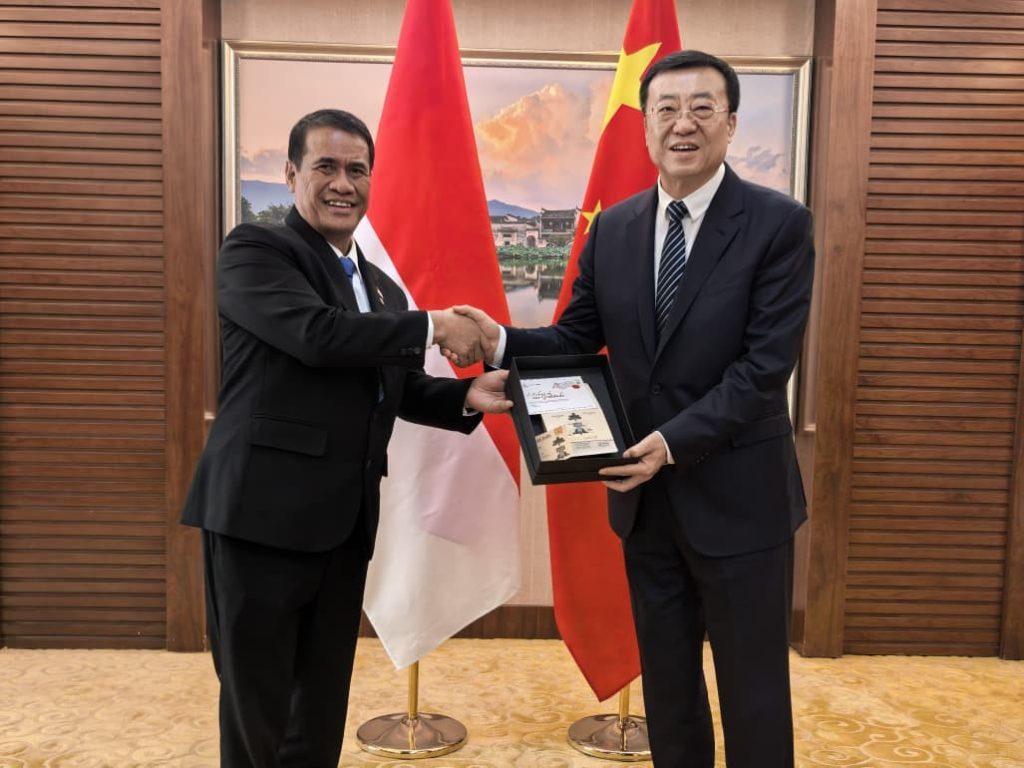
China’s Minister of Agriculture, Zhang Zhu, praised the achievements of Indonesia’s agricultural sector and agreed with Agriculture Minister Andi Amran Sulaiman to strengthen cooperation, particularly in boosting production, transferring technology and developing strategic commodities.
The cooperation is intended to strengthen domestic production capacity, improve productivity and open up wider trade and investment opportunities for both countries.
The agreement emerged from a bilateral meeting between Amran and Zhang in Beijing on Monday, 2 November 2026. The meeting covered garlic development from upstream to downstream, joint research and modern agricultural technology, stronger trade in leading commodities, and investment opportunities in processing industries.
Zhang said agricultural cooperation between China and Indonesia had developed positively since 2019. He also highlighted the substantial trade relationship between the two countries, describing it as an important foundation for expanding their agricultural partnership.
According to Zhang, the value of China–Indonesia imports and exports reached around US$125 billion in 2025. He said the figure represented about 25 per cent of China’s trade with South-east Asian countries. He also highlighted Indonesia’s position as one of the world’s leading palm oil exporters.
“These achievements and this potential offer China and Indonesia greater scope to deepen cooperation, including through technology development, increased production capacity and stronger trade in agricultural commodities,” Zhang said.
Amran stressed that cooperation with China should deliver tangible benefits for Indonesia’s agricultural sector. The partnership should not simply maintain smooth trade flows, but also strengthen national production capabilities, accelerate agricultural modernisation and increase the added value of leading commodities.
“We want to strengthen this cooperation. For commodities we need, such as garlic and soybeans, we hope supplies will improve. At the same time, we also want to increase exports of Indonesia’s leading commodities to China,” Amran said.
One of Amran’s main proposals was to develop garlic production comprehensively, from providing seeds and cultivation technology to supplying agricultural machinery and establishing production clusters in Indonesia. The initiative is intended to strengthen domestic production capacity and reduce dependence on overseas supplies.
At present, around 90 per cent of Indonesia’s garlic needs are met by imports from China. Amran therefore urged the two countries to develop a partnership that would also support increased garlic production in Indonesia.
“We want cooperation across the entire garlic supply chain, from seeds and technology to agricultural machinery and the establishment of clusters in Indonesia,” Amran said.
In addition to garlic, Amran called for the development of clusters for Indonesia’s leading commodities, particularly coconut, coffee and durian. Such cooperation is expected to widen market access, safeguard product quality and increase the value of Indonesian commodities.
On investment, Amran offered Chinese companies opportunities to develop processing industries in designated zones prepared by the government. The sectors on offer include coconut and derivative products, seaweed, and agricultural vaccine production.
Amran said the availability of land, legal arrangements and incentives in these zones should make it easier for investors to establish industries in Indonesia.
“The land is ready, and the legal arrangements are being prepared too. Investors only need to come. We want to build processing industries, such as coconut and seaweed factories, so that our resources can generate greater added value,” he said.
Technology transfer was another important item on the meeting’s agenda. Amran encouraged cooperation in mechanisation, artificial intelligence (AI) and the use of modern technology to improve agricultural efficiency and productivity.
In response, Zhang said China supported the development of garlic production in Indonesia. China was ready to pursue further technical discussions on production technology, planting methods and other aspects of cultivation that could be covered by bilateral cooperation.
“We strongly support the development of garlic production in Indonesia. We are ready to deepen discussions, particularly on production technology, planting and other technical aspects on which the two countries can cooperate,” Zhang said.
On coffee, cocoa and palm oil, Zhang said China would encourage the establishment of working groups to discuss cooperation on these leading Indonesian commodities. The technical discussions are expected to help both countries identify opportunities and determine follow-up measures.
Zhang also proposed strengthening technical discussions and research collaboration, including on the use of unmanned drones, agricultural robots and AI. China was also prepared to organise a business delegation to explore investment opportunities in Indonesia.
At the same meeting, Amran proposed expanding trade cooperation in dairy products, given that Indonesia’s milk needs are around four million tonnes a year. He also proposed research into wheat as one way to help meet domestic demand, which remains dependent on imports.
The two ministers agreed that stronger communication and technical discussions were needed to take these opportunities forward. The Indonesia–China partnership is expected not only to strengthen trade but also to build national production capacity through technology transfer, research, investment and the development of downstream industries.
Through more concrete cooperation, Indonesia aims to reinforce food sovereignty and improve the competitiveness of its agricultural sector. Collaboration with China is expected to create greater opportunities for Indonesian farmers and businesses to raise productivity, expand markets and produce higher-value agricultural goods.
Source: jawawa.id (https://jawawa.id/newsitem/china-praises-indonesias-agricultural-sector-achievements-1793735433)
Originally published by infopublik.id (https://infopublik.id/kategori/nasional-ekonomi-bisnis/995757/rrt-apresiasi-capaian-sektor-pertanian-indonesia), translated from Indonesian