
China Plants So Many Trees That One Country Is Completely Transformed
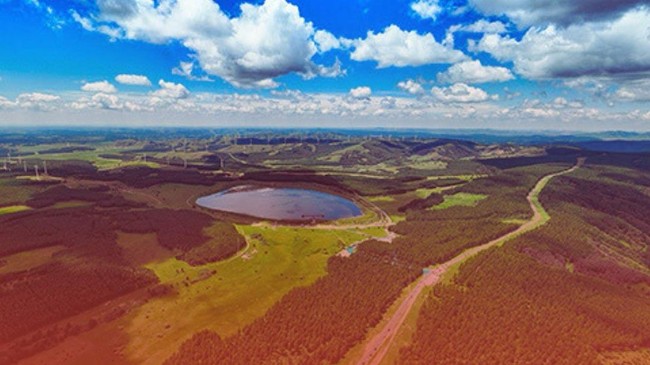
China has been found to be altering the distribution of freshwater. This is all due to the tree-planting habit established decades ago.
Beijing is known to have greening projects for planting trees or restoring grasslands. One such project is the Great Green Wall from 1978, which has increased China’s forest cover to more than 25%.
In addition, there is Grain for Green and Natural Forest Protection to encourage the conversion of agricultural land into green areas and to halt deforestation.
These projects have been found to have changed the distribution of freshwater, according to research published in the journal Earth’s Future. For example, there has been a change in vegetation cover from 2001 to 2020.
According to the report, water availability has decreased for the eastern monsoon region and the arid northwest, which covers 74% of China’s land area. These regions are the main locations for development, agricultural land, and population centres.
Conversely, water availability in the Tibetan Plateau has increased. Evapotranspiration, the process of evaporation and plant transpiration due to increased forest and grassland cover, has been reported to rise.
“China has been carrying out massive re-greening over the past few decades. They are actively restoring ecosystems that are recovering, particularly in the Loess Plateau. This is also reactivating the water cycle,” explained Arie Staal, one of the study’s authors, quoted from Live Science.
In this study, the research team analysed high-resolution data on evapotranspiration, precipitation, land-use changes from various sources, and atmospheric water vapour tracking models. According to the report’s findings, evapotranspiration has increased more than precipitation, meaning some of the water is lost to the atmosphere.
This trend is not uniform worldwide, as winds can transport water vapour. In fact, this phenomenon can move up to 7,000 km from its source.
Another finding is that several regions are experiencing a decline in water availability. This is because the eastern monsoon region and grassland restoration have seen increased evapotranspiration, as well as increased precipitation in the Plateau.
Water distribution in the country is uneven. It is recorded that regions with 46% and 60% of the land have only 20% of the water.
The Chinese government is attempting to address this issue. However, it may fail because the water redistribution due to greening has not been properly accounted for.