
China-North Korea Summit: Agree on Cooperation, Nuclear Issue Not Discussed
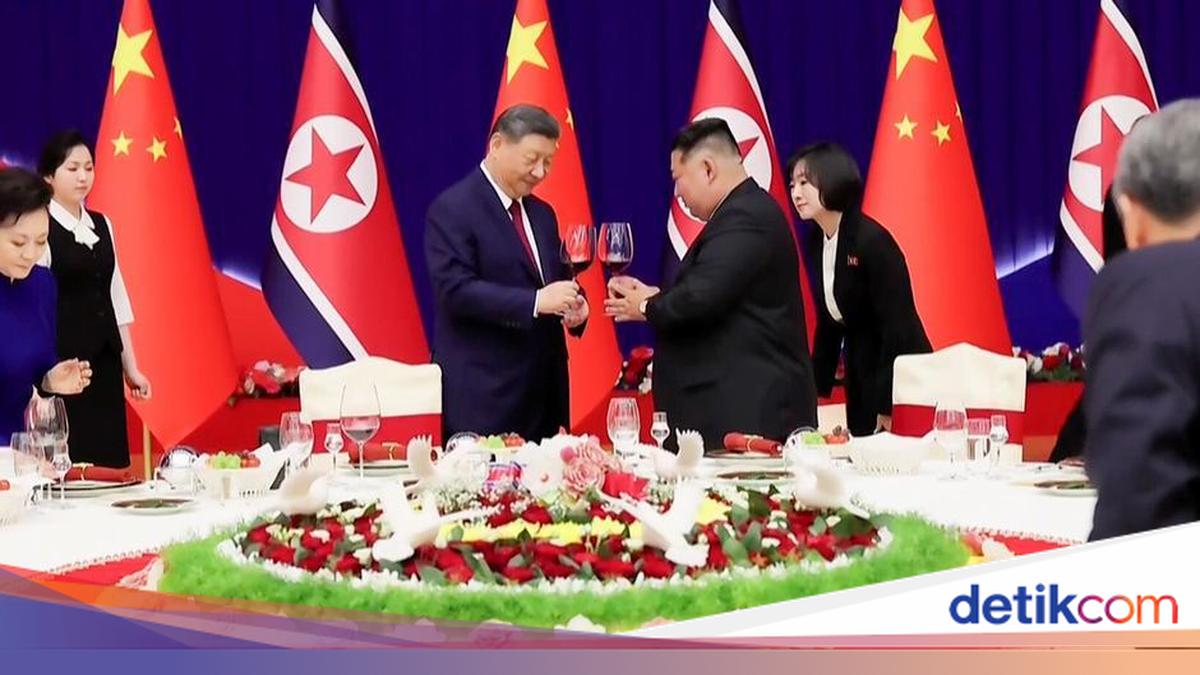
North Korea and China now have a ‘deeper and more comprehensive common understanding,’ China’s official Xinhua news agency reported. The statement came after President Xi Jinping departed Pyongyang on Tuesday afternoon following a summit meeting with Kim Jong Un.
‘The direction for future development is now clearer and more focused,’ Xi said during a farewell luncheon, as reported by Xinhua.
North Korea’s official Rodong Sinmun newspaper reported that Xi and Kim discussed expanding bilateral cooperation and strengthening strategic communication, while deepening exchanges in the political, economic and cultural fields.
Behind the diplomatic statements, however, Xi’s first visit to North Korea since 2019 comes amid concerns in Beijing that it is watching its old ally slowly drift away. Pyongyang is now increasingly close to Russia under Vladimir Putin, including by supplying weapons and personnel in exchange for military technology transfers and other support from Moscow.
‘China appears to be trying to revive and upgrade a relationship that many observers had already regarded as merely symbolic,’ Han Ki-bom, former deputy director of South Korea’s National Intelligence Service, told DW. He added that Xi’s visit is also partly aimed at reducing North Korea’s growing dependence on Russia, amid Beijing’s concerns over the increasingly close military cooperation between Pyongyang and Moscow since Russia’s full-scale invasion of Ukraine.
‘This visit is more than just a repair of bilateral relations,’ Han said. ‘If the Xi-Kim meeting in 2019 was largely focused on restoring and strengthening bilateral ties, this week’s meeting signals that Beijing increasingly views North Korea as a strategic partner in addressing wider international and regional challenges.’
North Korea’s nuclear programme was not mentioned. While supplying Russia’s war needs in Ukraine, North Korea has continued to develop its nuclear weapons programme and test various ballistic missiles in recent years. China has consistently opposed North Korea’s nuclear development, including by supporting a series of UN Security Council resolutions imposing sanctions on Pyongyang over its nuclear tests.
China’s official position supporting the denuclearisation of the Korean Peninsula to prevent regional instability is one of the few issues on which Beijing and Washington stand on the same side. Chinese and US officials recently reaffirmed their support for denuclearisation in a number of diplomatic exchanges.
However, neither Rodong Sinmun nor Chinese state media made any mention of North Korea’s nuclear programme or denuclearisation in their reports on the summit. Prior to Xi’s visit, North Korea’s Foreign Ministry asserted that the country’s denuclearisation ‘will never happen.’ On Sunday, Kim Yo Jong, Kim Jong Un’s highly influential sister, declared that North Korea’s status as a nuclear-armed state is an ‘inviolable red line.’
Han said Beijing is now increasingly avoiding discussing the denuclearisation issue openly with Pyongyang. ‘China does not officially recognise North Korea as a nuclear-armed state,’ he said. ‘However, by no longer emphasising denuclearisation, Beijing is effectively tolerating the reality of North Korea’s nuclear programme.’
Kim Hyung Suk, a former South Korean vice unification minister, assessed that the visit was designed to demonstrate that China and North Korea maintain a strategic partnership. ‘The issue of North Korea’s denuclearisation was deliberately omitted from the talks, while political, military and economic cooperation was highlighted,’ Kim said.
Jeong Joon-hee, a former spokesperson for South Korea’s Unification Ministry, told DW that Pyongyang may be seeking to leverage China’s concerns over the close North Korea-Russia relationship to gain tacit recognition of its nuclear-armed status. At the same time, Beijing could view an increasingly confident North Korea as a stronger strategic partner going forward.
‘The strengthening of the China-North Korea military alliance offers its own advantages,’ Jeong said. ‘It allows North Korea to use its nuclear capabilities to deter the US in the event of a Taiwan crisis. Economically, it secures China’s access to the Sea of Japan via North Korea, while also boosting the development of China’s northeastern region.’
Han noted that the official statements’ repeated emphasis on ‘strategic cooperation’ and coordination between the two countries’ supreme leaders suggests language hinting at a broader geopolitical dimension compared to previous meetings.
‘For North Korea, improved relations with China could provide significant economic and diplomatic benefits,’ Han said. ‘Pyongyang wants to avoid exclusive dependence on Russia,’ he continued. ‘By simultaneously improving relations with both Beijing and Moscow, Kim Jong Un can maximise North Korea’s bargaining power and extract benefits from both sides.’
China remains North Korea’s largest trading partner and a crucial source of economic support, despite ongoing international sanctions. The two sides agreed not only to strengthen political and economic exchanges, but also to expand cooperation across various sectors, including diplomacy and strategic coordination, Jeong said. He added that Pyongyang’s support for Beijing’s position on Taiwan, and China’s support for North Korea’s policy objectives, indicates both governments are increasingly prepared to support each other’s core interests.