
China leverages AI to support smart lifestyles
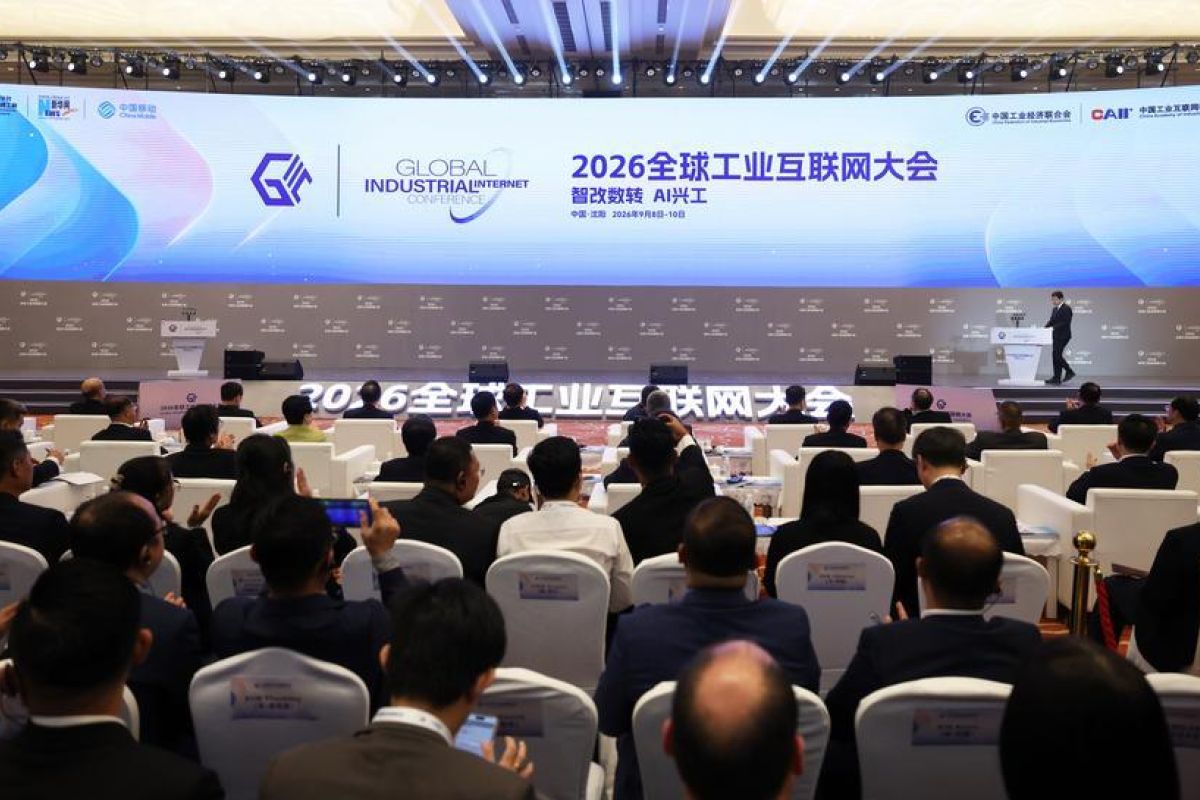
Shenyang (ANTARA) - At the China Mobile exhibition stand, visitors wearing 3D glasses witnessed cityscapes and museum collections appearing to leap from the screen with highly realistic visual depth effects.
“By relying on our high-speed computing networks and artificial intelligence (AI) rendering technology, users can enjoy an immersive 3D viewing experience from home,” said Wang Haimo, a project manager at China Mobile Liaoning, during the Global Industrial Internet Conference (GIIC) 2026, held from Tuesday (8/9) to Thursday (10/9) in Shenyang, the capital of Liaoning Province, northeast China.
Under the theme “intelligent transformation, digital enhancement, and AI-empowered industry,” the conference brought together exhibitors showcasing various innovative achievements that integrate the industrial internet with AI, presenting new scenarios for smart lifestyles.
New models, such as intelligent production, platform-based design, and personalised customisation, have been widely implemented, providing strong momentum for the country’s new industrialisation process, said Xie Yuansheng, Deputy Minister at China’s Ministry of Industry and Information Technology, during the event.
At the exhibition, visitors tested AI glasses that display Mandarin translation text of English conversations on the lenses and translate foreign text with just a glance.
These glasses combine voice translation, visual translation, and simultaneous interpretation in 122 languages, said Zhang Xinyan, a demonstration manager at iFlytek, the developing company.
Beyond daily use, these devices also hold potential in industrial environments, such as for cross-border technical exchanges, equipment inspections, and supply chain coordination, reflecting the expansion of the industrial internet into human-centric wearable devices.
Data from China’s Ministry of Industry and Information Technology shows that the scale of the country’s core industrial internet industry has exceeded 1.6 trillion yuan (1 yuan = Rp2,614), with 26,000 industrial private 5G networks built by 2025.
At the end of June, eight government agencies, including the MIIT, announced new guidelines setting targets for the industrial internet through 2030, which include the construction of 50,000 industrial private 5G networks and achieving a core industrial value-added output exceeding 2.5 trillion yuan.
The industrial internet is also driving “flexible transformation” in the manufacturing sector, shifting production patterns from one-size-fits-all mass models to personalised customisation.
At Dayang Group, a clothing manufacturer based in Dalian, Liaoning, customers upload body measurement data and select fabric types online. Orders then enter the company’s self-developed industrial internet platform, where AI systems match patterns, generate production instructions, and control intelligent cutting machines.
Hu Dongmei, the group’s general manager, stated that before the digital transformation, even the most experienced pattern makers required two hours to create a pattern based on measurements.
“Now, the process takes only two seconds,” said Hu, revealing that custom-ordered suits can be completed in just three days.