
China-led scientist team develops energy-efficient vision chip
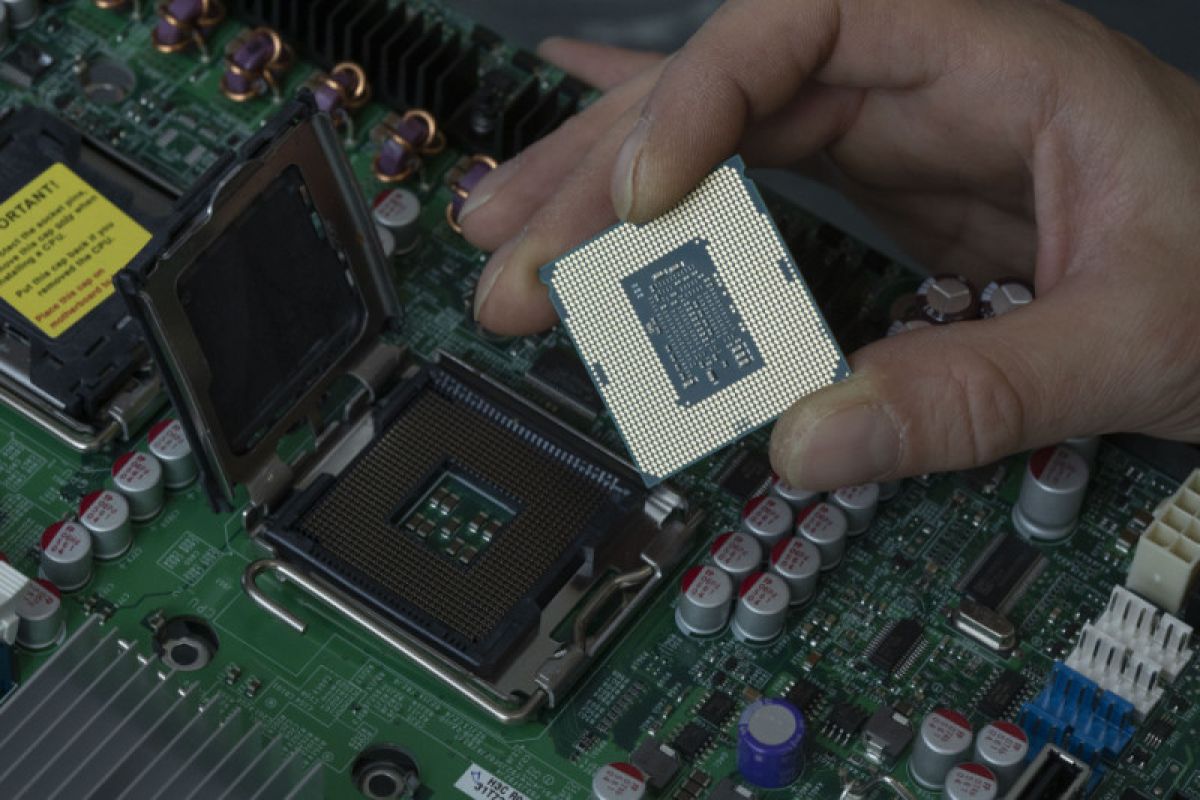
A China-led research team has developed a type of vision chip that converts light directly into tokens, thereby eliminating various processing stages that typically consume power and slow performance.
The study, conducted jointly by Nanjing University and the National University of Singapore, was published on Wednesday (19 August) in the journal Nature Sensors.
Unlike conventional sensors, which capture light and then digitise it, perform buffering, and subsequently transfer data before generating tokens, the new device performs this conversion in the physical domain.
The chip is equipped with an array of specialised pixels, each capable of detecting light simultaneously, storing data locally, and performing computation.
Peripheral circuitry on the chip can selectively activate pixel regions to divide an image into several blocks.
For each selected block, a specific voltage sequence is applied, allowing the stored optical information to perform mathematical operations directly in the analogue domain, with the output current serving as tokens.
“This chip physically eliminates the data transfer process, which is the main source of energy waste,” said Liang Shijun, a professor at Nanjing University.
“Once light enters, tokens are generated,” he explained.
This approach, referred to as “physical tokenisation,” transforms the chip from a passive image recorder into an active visual-semantic generator, Liang said.
In testing, a system using the chip achieved image recognition accuracy of up to 87.3 percent, approaching conventional software benchmarks, while improving energy efficiency more than tenfold during the tokenisation stage, he added.
“This design reverses the traditional ‘sensing-buffering-computing’ sequence and opens a new path for overcoming power and computing bottlenecks in Edge AI in the post-Moore era,” said Miao Feng, a professor at Nanjing University.
He added that the technology could provide a highly efficient vision foundation with near-zero latency for embodied intelligence, drones, and smart security, while accelerating the large-scale deployment of physical AI.
Source: jawawa.id (https://jawawa.id/newsitem/china-led-scientist-team-develops-energy-efficient-vision-chip-1787377931)
Originally published by Antara (Indonesian) (https://www.antaranews.com/berita/5706359/tim-ilmuwan-dipimpin-china-kembangkan-cip-penglihatan-hemat-energi), translated from Indonesian